


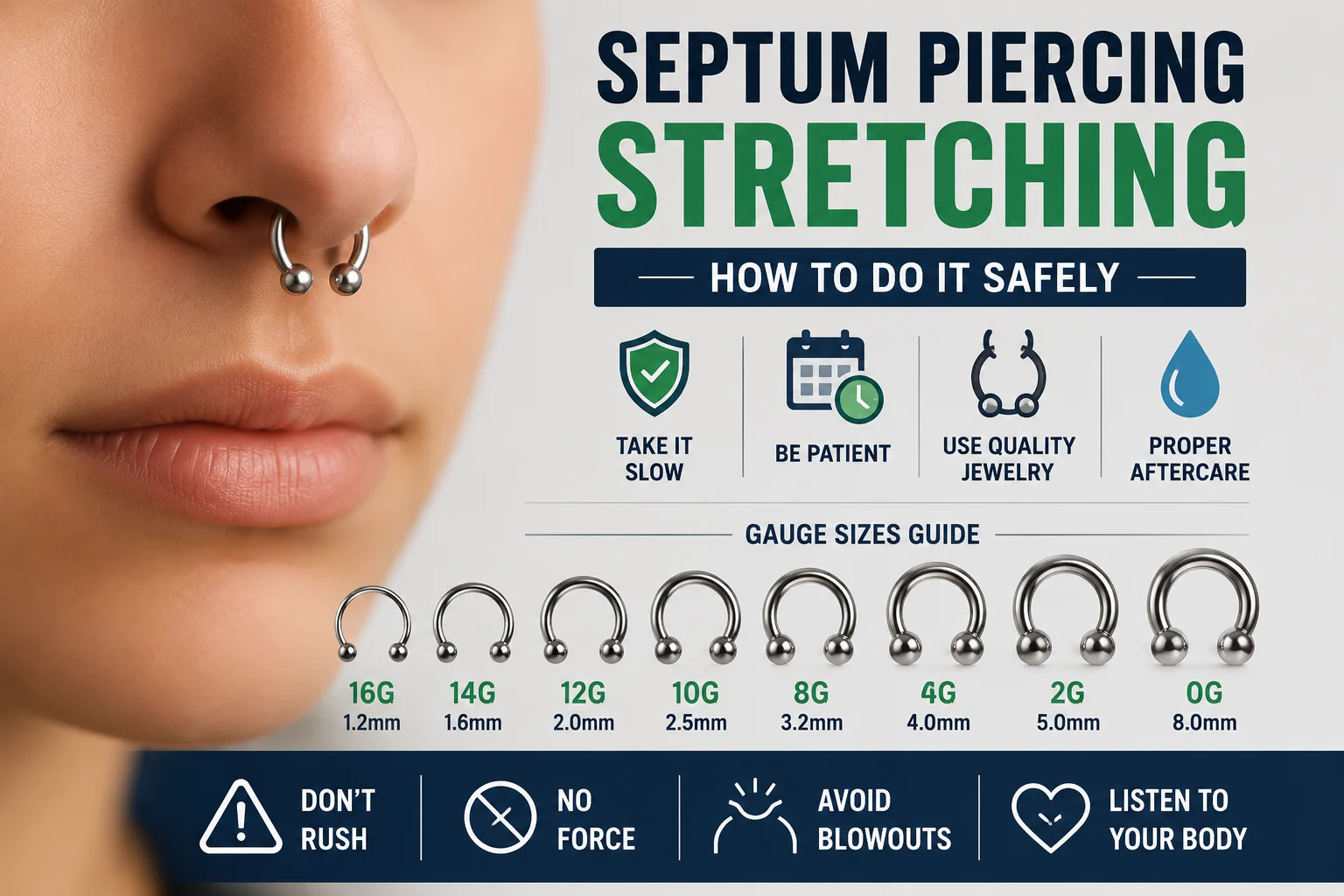
I used to think septum stretching was simply a matter of putting in a larger piece of jewelry. It turns out there is much more to it. A septum piercing needs time to adjust, and trying to move up too quickly can lead to pain, bleeding, irritation, or a septum blowout.
If you are thinking about stretching your septum, the biggest thing I have learned is to slow down and pay attention to how the tissue feels. There is no single schedule that works for everyone. The Association of Professional Piercers also points out that stretching time can vary from person to person and may take weeks, months, or longer.
In this guide, I will explain what septum piercing stretching involves, how gauge sizes work, when I would consider a septum ready to stretch, what jewelry I would use, and which warning signs would make me stop.
What Is Septum Piercing Stretching?
Septum piercing stretching means gradually making an existing piercing larger so it can hold thicker jewelry.
For example, moving from a 16g septum ring to a 14g ring is a stretch because 14g jewelry is thicker than 16g jewelry.
I always keep one thing in mind: stretching is different from simply changing septum jewelry.
If I replace a 16g ring with another 16g ring, I am changing jewelry. If I put a thicker piece through the piercing, I am stretching it.
The goal is to let the tissue adjust slowly rather than forcing a larger piece through the piercing.
Can You Stretch a Septum Piercing?
Yes, a fully healed septum piercing can be stretched.
However, I would not treat every septum piercing as suitable for stretching. Placement and anatomy matter a lot.
A well-placed septum piercing gives you a better starting point. If the original piercing is poorly placed, too high, too low, or passes through tissue that does not handle stretching well, increasing the size can become much harder.
Before I started thinking about larger sizes, I would have an experienced piercer check the placement if I had any doubts.
When Can You Start Stretching Your Septum?
I would wait until the original septum piercing is fully healed, mature, and comfortable before even thinking about stretching it.
A piercing that looks healed from the outside may still be healing inside.
I would look for:
- No ongoing tenderness
- No swelling
- No crusting or unusual discharge
- No persistent redness
- No irritation
- No pain when the jewelry moves naturally
- Healthy-looking tissue around the piercing
I would also avoid using a fixed calendar as my only guide.
Some people may be ready sooner than others, while some septum piercings need much longer. The APP recommends waiting until a piercing is fully healed, mature, and pliable before stretching.
How Do I Know My Septum Is Ready to Stretch?

For me, the biggest sign would be that the current jewelry feels completely comfortable.
If the jewelry still feels tight, sore, or irritated, I would wait.
I would also pay attention to how the current jewelry moves. When the piercing has fully settled, the jewelry may feel looser and move more freely.
That does not mean I should force a stretch just because the jewelry feels loose. It simply tells me that the tissue may have recovered enough to consider the next step.
If I am unsure, I would rather wait another few weeks or ask a professional piercer to check it.
Waiting costs me time. A damaged septum can cost me much more.
Septum Stretching Gauge Chart

Gauge numbers can be confusing at first because a smaller gauge number means thicker jewelry.
Here are some common septum stretching sizes:
| Gauge | Approx. thickness |
| 16g | 1.2 mm |
| 14g | 1.6 mm |
| 12g | 2.0 mm |
| 10g | 2.5 mm |
| 8g | 3.2 mm |
| 6g | 4.0 mm |
| 4g | 5.0 mm |
| 2g | 6.0 mm |
| 0g | 8.0 mm |
These measurements are based on the standard gauge system used for body jewelry.
So if I start at 16g, my next common size would be 14g, then 12g, then 10g.
I would not jump several sizes just because I want to reach a larger gauge quickly.
How Much Can You Stretch a Septum at Once?
I would keep each increase small.
The APP recommends avoiding stretches larger than one full gauge size.
For a septum, I may even prefer smaller jumps if the next standard size feels too large.
Some septum stretching guides recommend half-millimeter increments for difficult stretches. This can make the change between sizes less aggressive.
If the next piece does not fit with very little resistance, I would not try to make it fit by pushing harder.
That is where stretching can turn into tissue damage.
How Long Should I Wait Between Septum Stretches?
There is no universal waiting period.
I would wait until my septum had completely recovered from the previous stretch before moving up again.
Some experienced piercing professionals suggest waiting at least several months between septum stretches, with some people needing longer. Lynn Loheide, for example, recommends at least three months between septum stretches and notes that some people need more time.
I would use that as a general reference rather than a deadline.
If my septum still feels sore after three months, I would wait.
If it feels healthy, comfortable, and fully settled, I could ask a qualified piercer whether it is ready for the next size.
Does Septum Stretching Hurt?
Septum stretching can feel uncomfortable.
I would expect some pressure or tenderness, especially when moving up to a larger size. But severe pain is not something I would try to push through.
A septum stretch may sometimes feel sore after the size change. Lynn Loheide also notes that septum stretches can be uncomfortable and that soreness can sometimes appear after the stretch rather than immediately.
What I would not accept is:
- Sharp or severe pain
- Strong burning
- Bleeding
- Tearing
- Heavy swelling
- Jewelry that will not move into place without force
If I felt those things, I would stop.
Pain is not a sign that I need to push harder.
It is a sign that something may not be ready.
How I Would Stretch a Septum Piercing

I would keep the process slow and simple.
1. Make Sure the Piercing Is Fully Healed
I would not stretch a fresh or irritated septum piercing.
The tissue needs time to mature before I ask it to accommodate larger jewelry.
2. Check the Current Gauge
I would confirm the size of the jewelry already in my septum.
If I am wearing 16g, for example, I would know that 14g is the next common size rather than jumping straight to 10g.
3. Choose the Next Appropriate Size
I would choose a small increase.
If the next standard size feels too large, a half-millimeter option may be worth discussing with an experienced piercer.
4. Choose Suitable Jewelry
I would use smooth, high-quality jewelry made from a suitable material.
For a fresh stretch, I would avoid cheap jewelry, rough surfaces, sharp edges, and materials that are difficult to keep clean.
5. Never Force the Jewelry
This is the rule I would take most seriously.
If the new jewelry does not go in with gentle pressure, I would stop.
The APP warns that stretching too quickly or stretching tissue that is not ready can cause serious problems, including blowouts and tissue damage.
6. Give the Tissue Time to Recover
After a stretch, I would leave the jewelry alone and give the septum time to settle.
I would not keep moving the jewelry around to see how it feels.
7. Wait Before Stretching Again
I would not plan the next stretch based only on the calendar.
I would wait until the tissue is fully recovered.
What Jewelry Is Best for Septum Stretching?

I would pay close attention to jewelry quality because the wrong piece can make a fresh stretch much harder to manage.
For fresh stretches, I would look for:
- Smooth surfaces
- Correct sizing
- Good-quality materials
- No sharp edges
- A comfortable shape
- A finish that will not scrape the tissue
Implant-grade titanium and suitable glass are commonly used options for stretched piercings. Lynn Loheide lists ASTM F67-compliant titanium and lead-free glass among materials suitable for fresh stretches.
I would also avoid putting random objects through a stretched septum. Things like pencils, straws, or cotton swabs can introduce fibers or dirt and can irritate the tissue.
For a detailed discussion of jewelry materials, I would keep that separate in my Best Metal for Septum Piercing Jewelry article.
Can I Stretch My Septum With a Taper?
A taper can help guide jewelry into a piercing, but I would never use it as a tool for forcing a stretch.
This distinction matters.
A taper gradually increases in size, so it can make it tempting to keep pushing even when the tissue is resisting.
The APP describes insertion tapers as tools that can help with jewelry insertion and stretching, but the correct size and type matter.
For septum stretching, I would be especially careful with tapers.
If I had never stretched a septum before, I would rather have an experienced piercer handle the first few size changes than learn by forcing jewelry at home.
Dead Stretching vs Tapering vs Stacking
There are several approaches people talk about in septum stretching.
Dead Stretching
This means moving to a larger piece when the piercing is ready and the new jewelry can enter without being forced.
The idea is simple: the tissue is ready for the next size rather than being pushed open by force.
Taper-Assisted Stretching
A suitable taper can help guide jewelry into the piercing.
I would use one carefully and only when the size is appropriate. A taper should never be used to force a piercing that is not ready.
Septum Stacking
Stacking is different from standard stretching.
Instead of putting one much thicker piece of jewelry through the piercing, stacking uses several smaller rings or similar pieces.
It can create a different look and can change the shape of the piercing channel.
I would treat stacking as its own technique rather than assuming it is exactly the same as regular septum stretching.
What Is Septum Stacking?
Septum stacking means wearing multiple small pieces of jewelry through one septum piercing.
It can be a good option for people who want a stacked look without simply using one very thick piece of jewelry.
However, I would not use stacking as a shortcut to stretch faster.
The tissue still needs time to adjust, and the jewelry needs to fit properly.
If I wanted to build a separate article around stacking, I would keep that topic separate from this septum stretching guide.
What Is a Septum Blowout?
A septum blowout can happen when a piercing is stretched too aggressively.
Instead of the tissue expanding gradually, the inner part of the piercing channel can be pushed outward. This can leave a raised ring or lip of tissue around one side of the piercing.
The APP describes a blowout as tissue from inside the piercing channel being pushed out, often because of overly aggressive stretching.
If I saw what looked like a blowout, I would stop stretching.
I would not try to push the jewelry farther.
A professional piercer may recommend downsizing to a smaller size and allowing the tissue to recover. The APP also recommends treating an overstretched piercing like a new piercing and considering downsizing when the tissue is significantly irritated.
What Are the Signs of a Septum Blowout?
Possible signs include:
- A raised lip of tissue
- Tissue pushed out around the jewelry
- Significant irritation
- Swelling
- Pain
- Redness
- Bleeding
- A noticeable change in the shape of the piercing
A blowout should not be ignored.
If I was not sure whether I had one, I would have an experienced piercer examine it rather than trying to fix it myself.
Can Septum Stretching Cause Bleeding?
It can, but I would not consider bleeding a normal goal of stretching.
If I saw blood after trying to move up a size, I would stop.
Bleeding can mean the tissue has been damaged or torn.
I would not put the next larger piece back through the piercing just to see if I could get it in.
Instead, I would let the tissue settle and seek advice from a professional piercer or healthcare professional if the bleeding was significant or continued.
Can Septum Stretching Cause Scar Tissue?
Yes.
Stretching too aggressively can cause tissue damage and scar tissue.
The problem is that scar tissue may make later stretches harder.
This is one reason I prefer slow progress. Reaching a large gauge quickly is not worth damaging the tissue and then struggling with every later stretch.
The APP warns that improper stretching can lead to scarring, tissue thinning, and other lasting changes.
Can Septum Stretching Thin the Tissue?
It can if the piercing is stretched improperly or too aggressively.
This is another reason I would not treat stretching as a race.
If I notice the tissue becoming unusually thin, irritated, or damaged, I would stop stretching and have it checked.
Can You Stretch a Septum Pierced Through Cartilage?
This depends on the person’s anatomy and the original placement.
Septum anatomy varies from person to person. Some people have a larger area of softer tissue that can accommodate the piercing, while others have less room.
If the original piercing passes through a difficult area, stretching may be more painful and may carry more risk.
I would not try to solve this by forcing a taper or larger jewelry through.
A professional piercer can inspect the placement and tell me whether the piercing is suitable for stretching.
Can You Stretch a Crooked Septum Piercing?
Possibly, but I would have it checked first.
A crooked septum piercing may have been caused by the original placement, swelling during healing, anatomy, or the way the jewelry sits.
Stretching can make an existing placement issue more noticeable.
If my septum looked crooked before I started stretching, I would have a professional piercer inspect it first.
I would also keep this separate from the general issue of a crooked septum piercing, because stretching is only one possible factor.
Common Septum Stretching Mistakes

I have found that most stretching problems come from trying to move too quickly.
Stretching Before the Piercing Is Fully Healed
A healed-looking piercing is not always fully healed inside.
I would wait until the tissue is mature and comfortable.
Jumping Several Sizes
Going from 16g straight to 10g may seem like a fast way to reach the goal, but it puts much more stress on the tissue.
I would use smaller steps.
Forcing Jewelry
This is probably the mistake I would avoid most strongly.
If the jewelry does not fit, it is not ready.
Stretching Through Pain
A little pressure is different from sharp or severe pain.
If I have to grit my teeth and push, I would stop.
Using Poor-Quality Jewelry
Rough, scratched, sharp, or unsuitable jewelry can irritate the tissue.
I would choose smooth, well-made jewelry instead.
Stretching an Irritated Piercing
If my septum is already sore, swollen, or irritated, I would not add more stress.
I would deal with the existing problem first.
Following a Fixed Calendar
A calendar can remind me to check my piercing, but it cannot tell me whether my tissue is ready.
My septum gets the final say.
Septum Stretching Aftercare

After stretching, I would keep aftercare simple.
I would:
- Wash my hands before touching the piercing.
- Avoid unnecessary movement.
- Avoid twisting the jewelry.
- Keep irritating products away from the area.
- Use sterile saline wound wash if aftercare is needed.
- Avoid picking at crusting.
- Give the tissue plenty of recovery time.
The APP recommends sterile saline wound wash for healing body piercings and says unnecessary movement or rotation can irritate the piercing.
I would also avoid making homemade salt solutions unless a professional has specifically advised me to do so. The APP now recommends sterile saline rather than homemade salt mixtures for routine piercing aftercare.
What If My Septum Hurts After Stretching?
Some soreness can happen after a septum stretch.
I would watch the level of discomfort and how it changes.
If the soreness gradually improves, I would continue to leave the piercing alone.
If the pain becomes stronger, or I develop swelling, heat, bleeding, discharge, or other concerning symptoms, I would stop treating it as ordinary stretching soreness.
For broader causes of septum pain, I would keep that discussion in my separate Why Does My Septum Piercing Hurt? article.
What If My Septum Starts Bleeding After Stretching?
I would stop.
I would not push the jewelry farther or immediately try an even larger size.
Bleeding can indicate that the tissue has been injured.
If the bleeding is heavy, does not stop, or is accompanied by severe pain or other concerning symptoms, I would seek medical care.
For general causes of bleeding from a septum piercing, I would keep that information in my Septum Piercing Bleeding article.
What If My Septum Gets Irritated After Stretching?
I would treat irritation as a warning that the tissue needs a break.
Possible reasons include:
- Stretching too far
- Moving up too quickly
- Poor jewelry fit
- Poor jewelry material
- Too much handling
- Existing irritation before the stretch
The APP notes that soreness, redness, weeping, or inflammation after stretching can mean the piercing was stretched too far or too quickly or that the jewelry itself is causing a problem.
If the irritation is significant, I would have the piercing checked and ask whether downsizing is appropriate.
When Should I Stop Stretching My Septum?
I would stop if I noticed:
- Severe pain
- Bleeding
- Tearing
- Major swelling
- Persistent redness
- A blowout
- Tissue thinning
- Strong pressure from the jewelry
- Increasing irritation
- Signs of infection
I would also stop if the next size simply will not fit without force.
There is no prize for reaching a particular gauge quickly.
Can a Stretched Septum Shrink or Close?
It can shrink, but I would not assume that it will return completely to its original size.
The amount of shrinkage varies between people and depends on factors such as how large the piercing was stretched, how long it stayed at that size, and individual tissue.
Lynn Loheide notes that septums can shrink but may also remain at larger sizes for long periods, which is why she recommends treating septum stretching as a potentially permanent modification.
That is something I would think about before starting.
If I am unsure whether I want a permanently larger septum, I would not rush into stretching.
How Large Can You Stretch a Septum?
There is no single maximum size that is safe for everyone.
Anatomy makes a big difference.
The quality and placement of the original piercing also matter. Someone with a larger amount of suitable tissue may have more options than someone with very limited anatomy.
I would not choose a target gauge just because I saw someone else reach it.
I would work with my own anatomy.
If I wanted to reach a large size, I would have a professional piercer assess my septum before and during the process.
Is Septum Stretching Permanent?
It can be.
Small stretches may shrink significantly when jewelry is removed, but larger stretches can create lasting changes.
The larger I go, the more I would treat the decision as a long-term body modification rather than something I can always reverse.
That is why I would decide on my goal size before I begin and then move slowly.
Final Thoughts
Septum piercing stretching is something I would approach slowly.
The biggest lesson for me is that stretching is not about how quickly I can reach a large gauge. It is about giving the tissue enough time to adjust between each size.
I would start with a fully healed septum, use small size increases, choose good-quality jewelry, and never force a stretch.
If the jewelry does not go in easily, I would wait.
If I see bleeding, severe pain, tearing, or a blowout, I would stop.
A few extra months may feel like a long wait when I have a goal size in mind, but I would much rather reach that size with healthy tissue than rush the process and create a problem that takes much longer to fix.
Frequently Asked Questions
Can you stretch a septum piercing?
Yes. A fully healed septum piercing can be stretched gradually to hold thicker jewelry. I would increase the size slowly and never force jewelry through the piercing.
When can I start stretching my septum?
I would wait until the piercing is fully healed, mature, comfortable, and free from ongoing irritation. There is no universal timeline that works for everyone.
How long should I wait between septum stretches?
There is no fixed waiting period. Many experienced piercers recommend waiting several months, and some people need longer. I would wait until the previous stretch has fully settled before moving up again.
Can I stretch my septum from 16g to 14g?
Yes, 16g to 14g is a common first size increase. I would only make that move if the piercing is fully healed and the new jewelry fits without force.
Does septum stretching hurt?
It can cause pressure, tenderness, or discomfort. Severe pain, bleeding, or tearing would make me stop rather than continue.
How often can I stretch my septum?
I would not follow a strict schedule. I would wait for complete recovery after each stretch. Septum tissue can need several months or longer between size changes.
What gauge should I start stretching at?
I would start from whatever gauge my healed septum currently has. Many septum piercings start at 16g or 14g, but I would measure the jewelry rather than guess.
What is a septum blowout?
A septum blowout occurs when tissue from inside the piercing channel is pushed outward because the piercing has been stretched too aggressively. It can leave a raised area of tissue around the piercing.
Can septum stretching cause bleeding?
Yes, but I would treat bleeding as a warning rather than a normal part of stretching. I would stop stretching if the tissue bleeds.
Can septum stretching cause scar tissue?
Yes. Stretching too quickly or damaging the tissue can contribute to scar tissue and other lasting changes.
Can you stretch a septum through cartilage?
It depends on your anatomy and piercing placement. If the piercing passes through an unsuitable area, stretching may be more difficult and painful. I would have a professional piercer assess it first.
Can you stretch a crooked septum piercing?
It may be possible, but I would have the placement checked before stretching. Increasing the size can make an existing placement issue more noticeable.
What is the best jewelry for septum stretching?
For a fresh stretch, I would choose smooth, high-quality jewelry made from a suitable material. Implant-grade titanium and appropriate glass are among the materials commonly used for fresh stretches.
Can I use a taper to stretch my septum?
A taper can help guide jewelry into a piercing, but I would never use one to force a size that the tissue is not ready to accept. The right taper and technique matter.
Is septum stacking the same as stretching?
No. Traditional stretching uses thicker jewelry to enlarge the piercing. Stacking uses multiple smaller pieces of jewelry through the same piercing and can create a different shape.
Can a stretched septum shrink?
Yes, it can shrink after jewelry is removed, but I would not assume that it will return completely to its original size.
Is septum stretching permanent?
It can be, especially at larger sizes. I would treat stretching as a potentially permanent body modification before starting.
How big can you stretch a septum?
There is no universal safe maximum. Your anatomy, placement, tissue quality, and stretching history all matter. I would not choose a large size without having my septum assessed by an experienced piercer.
What should I do if my septum hurts after stretching?
I would leave it alone and give it time to settle if the discomfort is mild. Severe pain, bleeding, tearing, major swelling, or worsening symptoms would be a reason to stop and seek professional advice.
What should I do if I get a septum blowout?
I would stop stretching and have the piercing checked by an experienced piercer. Downsizing may be recommended to reduce pressure and give the tissue a chance to recover.
