


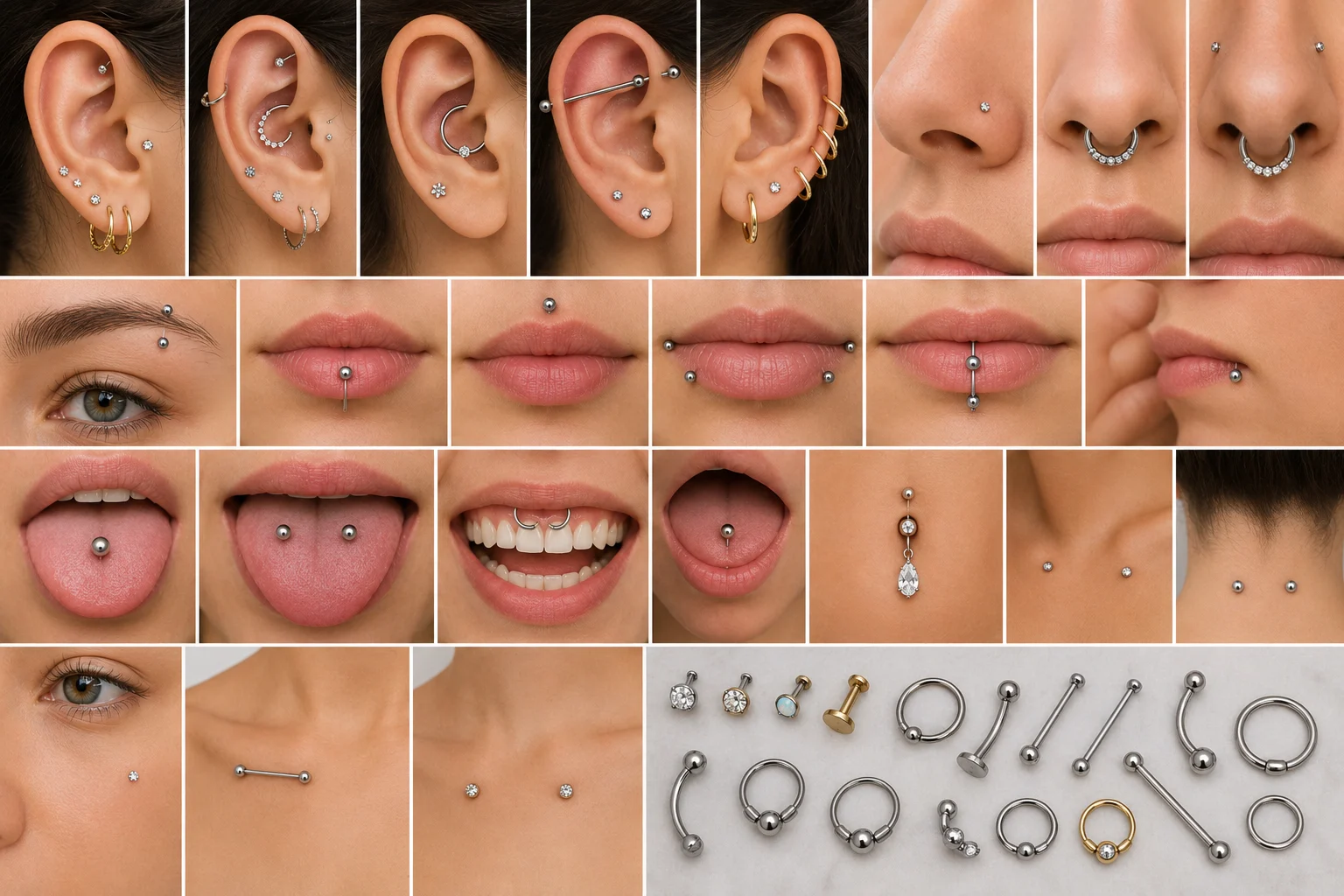
I used to think there were only a handful of piercing types. Once I started looking at different placements, I realized how many options there are and how much the placement can change the final look.
A helix is very different from a conch, even though both are ear cartilage piercings. The same is true for a nostril and septum piercing, or a labret and vertical labret.
In this guide, I break down the main types of piercings by body area. I also explain where each piercing goes, what jewelry is commonly used, what makes it different, and what I would consider before choosing it.
Types of Piercings at a Glance
| Piercing | Area | Placement | Common jewelry |
| Lobe | Ear | Lower soft ear | Stud, hoop |
| Stacked lobe | Ear | Multiple lower-ear placements | Studs, small hoops |
| Helix | Ear | Upper outer rim | Stud, hoop |
| Forward helix | Ear | Front upper ear | Stud |
| Flat | Ear | Flat upper ear | Stud |
| Conch | Ear | Inner ear bowl | Stud, hoop |
| Tragus | Ear | Cartilage flap near ear canal | Flat-back |
| Daith | Ear | Inner cartilage fold | Ring |
| Rook | Ear | Upper inner cartilage fold | Curved barbell |
| Industrial | Ear | Two connected cartilage points | Long barbell |
| Orbital | Ear | Two holes connected by ring | Ring |
| Nostril | Nose | Side of nose | Stud, hoop |
| High nostril | Nose | Upper side of nose | Stud |
| Septum | Nose | Tissue between nostrils | Clicker, horseshoe |
| Bridge | Nose/face | Across nose bridge | Straight barbell |
| Eyebrow | Face | Eyebrow area | Curved barbell |
| Anti-eyebrow | Face | Upper cheek area | Surface jewelry |
| Labret | Lip | Lower lip area | Flat-back |
| Medusa | Lip | Center above upper lip | Stud |
| Monroe | Lip | Side above upper lip | Stud |
| Vertical labret | Lip | Vertically through lower lip | Curved barbell |
| Snake bites | Lip | Two lower-lip placements | Studs, rings |
| Tongue | Mouth | Through tongue | Barbell |
| Navel | Body | Belly button area | Curved barbell |
| Nipple | Body | Through nipple | Barbell |
| Surface | Various | Flat skin area | Surface bar |
| Dermal | Various | Single-point skin anchor | Dermal top |
Ear Piercing Types

The ear gives me the largest number of styling options because there are so many different areas to work with. Some piercings go through soft tissue, while others pass through cartilage.
That difference matters because cartilage piercings generally require more patience during healing.
1. Lobe Piercing
The lobe piercing goes through the soft lower portion of the ear. It is probably the piercing most people recognize.
I like the lobe because it gives me plenty of styling options. A single small stud can look very simple, while several lobe piercings can create a stacked arrangement.
Common jewelry
- Studs
- Small hoops
- Huggies
- Flat-back jewelry
What I would consider
The lobe is soft tissue rather than cartilage, but that does not mean I would ignore aftercare. Sleeping directly on a new piercing or repeatedly catching it on clothing can still cause problems.
2. Stacked Lobe Piercing
A stacked lobe uses two or more piercings placed close together on the earlobe.
The appeal is mainly visual. Instead of spreading piercings across the entire ear, the jewelry is grouped into a small area.
I like this style when I want several earrings without filling the upper cartilage with jewelry.
Common jewelry
Small studs, tiny hoops, and flat-back labrets work well for many stacked arrangements.
What I would consider
The amount of space available on the earlobe limits how many piercings can be placed safely. I would have the piercer mark the positions before deciding on the final arrangement.
3. Upper Lobe Piercing
An upper lobe piercing sits higher than a traditional lobe piercing but still uses the softer lower-ear area.
It can act as a bridge between regular lobe jewelry and upper-ear cartilage jewelry.
Common jewelry
- Small studs
- Flat-back labrets
- Small hoops
What I like about it
It is an easy way to create a layered ear look without immediately moving into more cartilage-heavy placements.
4. Transverse Lobe Piercing
A transverse lobe piercing passes horizontally through the earlobe.
Instead of entering the front and exiting through the back like a standard lobe piercing, the jewelry follows a different path through the lobe.
Common jewelry
A curved or straight barbell may be used depending on anatomy and placement.
What I would consider
The lobe needs enough tissue for the planned placement. This is one where I would let a professional assess the ear before deciding on jewelry.
5. Helix Piercing
A helix piercing sits along the upper outer rim of the ear.
This is one of the most recognizable cartilage piercings. I like the helix because it works well alone but also fits into larger ear-curation setups.
Common jewelry
- Flat-back stud
- Small hoop
- Curved jewelry
What I would consider
The outer rim can easily catch on hair, clothing, headphones, or bedding. I would be careful about pressure while the piercing is healing.
6. Forward Helix Piercing
The forward helix sits on the front part of the upper ear, close to where the ear meets the head.
The placement is smaller than a standard helix, so jewelry tends to be delicate.
Common jewelry
Small flat-back studs are common.
Multiple forward helix piercings
Some people have enough space for two or three forward helix placements. I would not assume that everyone can have the same arrangement because ear anatomy varies.
7. Flat Piercing
A flat piercing is placed on the flatter upper section of the ear.
It gives me a larger surface area for decorative jewelry compared with some smaller cartilage folds.
Common jewelry
- Decorative studs
- Flat-back labrets
- Small gemstone tops
Why I like it
A flat piercing can become a visual centerpiece in an ear-curation setup without requiring a large ring.
8. Conch Piercing
The conch sits through the bowl-shaped inner part of the ear.
There are two broad areas often discussed as inner and outer conch placements, depending on the exact location.
Common jewelry
- Stud
- Flat-back labret
- Hoop after healing
A stud gives the conch a clean look. A ring creates a more obvious circular outline around the ear.
What I would consider
The conch sits in an area that can interact with headphones and earbuds. I would think about my daily headphone use before choosing it.
9. Tragus Piercing
The tragus is the small cartilage flap located in front of the ear canal.
It is usually a relatively small piercing, which is why simple jewelry often looks best.
Common jewelry
- Flat-back stud
- Small decorative stud
- Small hoop after healing
Practical consideration
Earbuds can sit close to this area. If I use earbuds every day, I would think about whether I can comfortably leave them out while the piercing heals.
10. Anti-Tragus Piercing
The anti-tragus is located on the cartilage ridge opposite the tragus.
It is less common than a standard tragus piercing and depends heavily on the shape of the ear.
Common jewelry
A small curved barbell or suitable labret-style jewelry may be used.
What I would consider
The anatomy check matters a lot here because the ridge needs enough suitable tissue for the placement.
11. Daith Piercing
A daith piercing goes through an inner cartilage fold close to the ear canal.
It is usually styled with circular jewelry, which makes it easy to recognize.
Common jewelry
- Captive bead ring
- Seam ring
- Clicker
- Circular jewelry
Practical consideration
The location can make cleaning and jewelry access less convenient. Earbud use can also become an issue.
12. Rook Piercing
The rook sits through a fold of cartilage in the upper inner ear.
It has a tucked-away appearance compared with a helix or conch.
Common jewelry
Curved barbells are commonly associated with rook piercings.
What I would consider
Not every ear has a suitable rook fold. I would have the anatomy checked before planning this piercing.
13. Faux Rook Piercing
A faux rook creates a similar visual effect to a traditional rook but uses a different placement.
This can be useful for someone whose ear does not have the anatomy needed for a conventional rook.
Common jewelry
A small stud or flat-back piece is often used.
14. Snug Piercing
A snug piercing passes through the inner cartilage ridge of the outer ear.
It has a horizontal appearance and sits close to the edge of the ear.
Common jewelry
A curved barbell is often considered for this placement.
What I would consider
The snug area can be difficult to pierce and heal because of its location and cartilage thickness. I would put anatomy and professional placement ahead of jewelry style here.
15. Industrial Piercing

An industrial piercing connects two ear piercing points with one long piece of jewelry.
The classic version usually connects an upper cartilage placement near the front of the ear with another placement toward the upper outer ear.
Common jewelry
A long straight barbell is the classic choice.
Why anatomy matters
This is one of the piercings I would never choose based only on a photograph. The angle between the two piercing points has to work with the shape of the ear.
If the anatomy does not suit a traditional industrial, a professional may suggest another setup that gives a similar visual effect.
16. Orbital Piercing
An orbital piercing uses two separate piercing holes connected by one circular piece of jewelry.
The important difference is that the ring passes through two holes.
Common jewelry
- Captive ring
- Seam ring
- Circular ring
An orbital can be placed in different parts of the ear, depending on anatomy.
Nose Piercing Types

Nose piercings can be subtle or very noticeable. I also find this category interesting because changing the height or angle by a small amount can create a completely different piercing.
17. Nostril Piercing
A nostril piercing is placed through the side of the nose.
It is one of the most common facial piercing choices and works with many jewelry styles.
Common jewelry
- Nostril stud
- Flat-back labret
- Hoop after healing
- Screw-style nostril jewelry
What I would consider
Placement affects how the jewelry sits and whether a hoop will fit comfortably later. I would decide on my long-term jewelry preference before the piercing is marked.
18. High Nostril Piercing
A high nostril sits higher on the side of the nose than a standard nostril piercing.
The higher position gives the face a different look and can also work as part of a paired or multiple-nostril arrangement.
Common jewelry
Small studs or flat-back jewelry are commonly suited to this type.
What I would consider
Because the placement is higher, jewelry changes and future hoop options can be more limited.
19. Double Nostril Piercing
Double nostril piercings mean having two nostril placements.
They can be placed on the same side or one on each side, depending on the look and anatomy.
I like the symmetrical version when I want facial jewelry that is noticeable but still relatively simple.
20. Triple Nostril Piercing
A triple nostril setup uses three nostril placements.
This can create a more detailed jewelry arrangement, but spacing becomes very important.
What I would consider
The piercer needs to make sure there is enough room for the jewelry without creating unnecessary crowding.
21. Septum Piercing

A septum piercing passes through the soft tissue located between the nostrils.
When placed correctly, it does not mean piercing directly through the hard cartilage of the nasal septum.
Common jewelry
- Septum clicker
- Circular barbell
- Horseshoe
- Seam ring
- Segment ring
Why I like the septum
A septum piercing can be styled in many ways. A small ring can look subtle, while a decorative clicker can become the main feature of the face.
The jewelry can also be changed to create very different looks after the piercing has properly healed.
What I would consider
The exact anatomy of the nose matters. I would have the piercer identify the suitable tissue and mark the placement before the needle is used.
22. Bridge Piercing
A bridge piercing passes horizontally through the skin across the upper bridge of the nose.
It sits between the eyes and is therefore much more noticeable than a typical nostril piercing.
Common jewelry
A straight barbell is commonly associated with the placement.
What I would consider
Bridge piercings are surface-style placements, so migration and rejection are issues I would discuss with the piercer before getting one.
23. Nasallang Piercing
A nasallang is an advanced nose piercing setup that passes through both nostrils and the septum area using one piece of jewelry.
From the outside, it can look like two nostril piercings connected by a bar.
Common jewelry
A straight barbell is commonly associated with the classic setup.
What I would consider
This is not a piercing I would choose casually. Anatomy, placement accuracy, jewelry size, and professional experience all matter.
24. Rhino Piercing
A rhino piercing is a vertical piercing through the lower portion of the nose.
The jewelry is usually visible on the underside and front of the nose.
Common jewelry
A curved or straight barbell may be selected depending on anatomy.
Style
It creates a very different appearance from a standard nostril or septum piercing, so I see it more as a statement facial piercing.
25. Septril Piercing
A septril is a specialized piercing associated with a stretched septum.
The jewelry passes through a specific part of the septum and nose rather than following the path of a standard septum piercing.
What I would consider
This is an advanced piercing and generally requires an existing stretched septum and suitable anatomy.
I would not treat a septril as a beginner alternative to a regular septum piercing.
26. Mantis Piercing
Mantis piercings are positioned near the upper front area of the nose.
They are often performed as a symmetrical pair.
Common jewelry
Small studs are commonly suited to the look.
Style
The placement gives the appearance of small pieces of jewelry sitting higher on the nose than standard nostril jewelry.
Facial Piercing Types

Facial piercings can change the balance and appearance of the face more noticeably than many ear piercings.
27. Eyebrow Piercing
An eyebrow piercing is placed through the eyebrow area.
It is commonly positioned vertically or at a slight angle.
Common jewelry
A curved barbell is a common choice.
What I would consider
The skin in this area moves frequently with facial expressions, so placement and jewelry fit matter.
28. Horizontal Eyebrow Piercing
A horizontal eyebrow piercing runs along the eyebrow area rather than passing vertically through it.
It is generally considered a surface-style placement.
Common jewelry
Surface jewelry may be used depending on the exact location.
Style
It gives a more unusual look than the classic eyebrow piercing.
29. Anti-Eyebrow Piercing
An anti-eyebrow piercing is positioned below the eye, usually along the upper cheekbone area.
It is sometimes called a cheekbone piercing.
Common jewelry
Curved jewelry or surface jewelry may be used depending on placement.
What I would consider
This area moves with facial expressions and can experience friction from clothing, hands, or makeup.
30. Cheek Piercing
Cheek piercings pass through the cheek area and are sometimes chosen because they can create a dimple-like appearance.
Common jewelry
Flat-back labrets are commonly associated with cheek piercings.
What I would consider
The cheek contains important structures, so I would treat this as a placement that requires careful professional assessment.
31. Dimple Piercing
Dimple piercings are placed in the cheek area to create the appearance of dimples.
Some people get them specifically because they want a permanent-looking dimple effect.
What I would consider
The final appearance can change after healing, so I would discuss the desired result with the piercer before choosing the exact position.
32. Third-Eye Piercing
A third-eye piercing is placed on the forehead area, generally along the center line above the eyebrows.
It is a highly visible facial piercing and is usually considered a surface-style placement.
What I would consider
Because it is a surface placement in a visible area, I would discuss long-term expectations and the possibility of migration before getting it.
Lip Piercing Types

Lip piercings include many individual placements and paired combinations. Some are outside the mouth, while others have jewelry that passes through the lip.
33. Labret Piercing
A traditional labret is positioned through the lower lip area, usually below the lip.
Common jewelry
A flat-back labret stud is one of the most common choices.
Style
A small stud can look very clean and simple. Larger decorative tops can make the piercing more noticeable.
34. Side Labret
A side labret is positioned to one side of the lower lip rather than in the center.
It can be worn alone or paired with another lip piercing.
Common jewelry
Flat-back labret studs are commonly used.
35. Vertical Labret
A vertical labret passes vertically through the lower lip.
One end of the jewelry is visible above the lip and another below it.
Common jewelry
A curved barbell is commonly used.
Why I like it
It gives me a lip-piercing look without placing a backing inside the mouth.
36. Ashley Piercing
An Ashley piercing is a single-point lip piercing with one visible end on the front of the lower lip and the other end positioned inside the lip.
It is sometimes described as an inverse vertical labret.
Common jewelry
A flat-back labret is commonly used.
37. Medusa Piercing
The Medusa piercing sits in the center of the philtrum, the groove between the nose and upper lip.
It is also called a philtrum piercing.
Common jewelry
A small flat-back stud is usually the most recognizable choice.
Style
I like this placement because it creates a strong central point on the face without requiring multiple facial piercings.
38. Monroe Piercing
A Monroe piercing sits above the upper lip on one side.
The placement is associated with Marilyn Monroe’s beauty mark.
Common jewelry
A small stud is usually used.
39. Madonna Piercing
A Madonna piercing is similar to a Monroe but is positioned on the opposite side of the upper lip.
The difference between the two is mainly the side of the face.
40. Jestrum Piercing
A Jestrum is a vertical upper-lip piercing.
It produces two visible ends of jewelry, with one above the upper lip and another visible on the lip itself.
Common jewelry
A curved barbell is commonly associated with the placement.
41. Snake Bites
Snake bites are a pair of lower-lip piercings positioned symmetrically on opposite sides.
Common jewelry
- Labret studs
- Hoops after healing
The two piercings create a balanced look that is more noticeable than a single labret.
42. Spider Bites
Spider bites are two closely spaced piercings on one side of the lower lip.
The main difference from snake bites is that both piercings sit on the same side.
43. Angel Bites
Angel bites are two upper-lip piercings, one on each side.
They create a symmetrical pair above the upper lip.
44. Shark Bites
Shark bites use four lower-lip piercings, with two placed on each side.
They create a much fuller lower-lip jewelry arrangement.
What I would consider
Multiple lip piercings require careful spacing. I would have the piercer mark all the planned positions before starting rather than adding them without considering the final arrangement.
Oral Piercing Types

Oral piercings involve areas inside or around the mouth. I would give these extra thought because jewelry can come into contact with teeth, gums, and other oral structures.
45. Tongue Piercing
A traditional tongue piercing passes vertically through the tongue.
Common jewelry
A straight barbell is the standard jewelry style.
What I would consider
Jewelry size and fit matter because a bar that is too long can move more than necessary and contact the teeth.
I would also follow the specific aftercare instructions given for an oral piercing.
46. Tongue Web Piercing
A tongue web piercing is placed through the thin tissue beneath the tongue.
The amount and shape of suitable tissue vary from person to person.
Common jewelry
Small curved or circular jewelry may be used depending on anatomy.
47. Smiley Piercing
A smiley piercing passes through the small tissue fold connecting the upper lip and gum.
It usually becomes visible when the person smiles.
Common jewelry
Small rings are commonly associated with this placement.
What I would consider
Because the jewelry is close to the teeth and gums, I would discuss the potential effect on oral tissues before choosing it.
48. Frowny Piercing
A frowny piercing is placed through the tissue connecting the lower lip and gum.
It is essentially the lower counterpart to a smiley piercing.
Style
It tends to be hidden when the mouth is closed and becomes visible when the lower lip moves.
49. Venom Piercings
Venom tongue piercings use two separate tongue piercings placed side by side.
Common jewelry
Two barbells are commonly used.
What I would consider
Tongue anatomy varies considerably, so I would have the placement assessed rather than assuming the two piercings can be positioned the same way on everyone.
Body Piercing Types

Body piercings cover areas outside the ears, nose, face, and mouth.
50. Navel Piercing
A navel piercing is placed through the skin around the belly button.
Common jewelry
Curved barbells are commonly used.
What I would consider
Waistbands, belts, sleeping positions, and clothing can all put pressure on a new navel piercing.
I would also make sure the anatomy actually supports the style of navel piercing I want.
51. Floating Navel Piercing
A floating navel piercing uses jewelry that sits differently inside the navel than a traditional curved barbell.
It can be useful for certain anatomy types.
Common jewelry
A curved barbell with a smaller lower end is commonly associated with the look.
52. Nipple Piercing
Nipple piercings pass through the base of the nipple.
They can be performed individually or as a pair.
Common jewelry
Straight barbells are common.
What I would consider
Clothing friction, sleeping position, sports, and accidental catches can all affect comfort during healing.
53. Surface Piercing
A surface piercing runs underneath relatively flat skin and has two visible points.
Common placements
- Chest
- Collarbone
- Nape
- Hip
- Some facial areas
Common jewelry
Surface barbells are made specifically for this type of placement.
What I would consider
Surface piercings can be more prone to migration or rejection than some traditional piercings. I would discuss the long-term expectations before getting one.
54. Corset Piercing
Corset piercings are a series of surface piercings arranged in pairs so that ribbon or similar material can be threaded through them.
They are often created for decorative or temporary body-art purposes.
What I would consider
Because several surface piercings are involved, the setup can place considerable stress on the skin.
55. Collarbone Piercing
Collarbone piercings are surface-style piercings placed around the collarbone area.
Common jewelry
Surface bars or specialized surface jewelry may be used.
Style
The placement can create a symmetrical appearance when done on both sides.
56. Nape Piercing
A nape piercing is placed on the back of the neck.
It is generally treated as a surface piercing.
What I would consider
Hair, collars, clothing, and movement around the neck can create friction.
Dermal Piercing Types

57. Dermal Piercing
A dermal piercing uses an anchor placed beneath the skin with one visible jewelry top.
Unlike a traditional piercing, there is usually one visible opening rather than an entrance and exit point.
Common placements
Dermals can be placed in suitable areas such as:
- Cheek
- Chest
- Collarbone
- Back
- Hip
Common jewelry
Dermal tops can include:
- Simple discs
- Gemstones
- Decorative shapes
- Small flat designs
What I would consider
Dermals are not permanent fixtures in the same way as naturally grown tissue. The body can eventually reject or push out an anchor, and the outcome depends on placement, anatomy, jewelry, friction, and other factors.
58. Microdermal Piercing
Microdermal is another term often used for a single-point dermal piercing.
The basic setup is similar: an anchor sits beneath the skin while a decorative top remains visible.
I would use the terms dermal and microdermal together when researching this category because people often use both names.
Genital Piercing Types
Genital piercings include many specialized placements, and the right choice depends heavily on anatomy.
I would keep this category separate from general body piercings because the terminology and placement considerations are much more specific.
Some examples include:
- VCH
- Christina
- Triangle
- Prince Albert
- Frenum
- Apadravya
- Ampallang
These should be performed only by a professional with specific experience in the intended placement.
VCH Piercing
VCH stands for vertical clitoral hood piercing.
It passes through the clitoral hood rather than through the clitoris itself.
The exact suitability depends on anatomy.
Christina Piercing
A Christina piercing is a surface-style genital piercing placed at the front of the vulva where the outer labia meet.
It is primarily a decorative piercing.
Prince Albert Piercing
A Prince Albert is a male genital piercing that passes through the urethral opening and exits through the underside of the penis.
This is a highly specialized placement that requires an experienced professional.
Frenum Piercing
A frenum piercing passes through the tissue along the underside of the penis.
Multiple frenum piercings can sometimes be arranged in a series.
Apadravya Piercing
An apadravya passes vertically through the penis.
It is a more advanced genital piercing and requires careful anatomy assessment.
Ampallang Piercing
An ampallang passes horizontally through the penis.
Like an apadravya, it is a specialized placement that should only be performed by an experienced professional.
Types of Piercing Jewelry
I find piercing terminology much easier once I separate the piercing from the jewelry.
The piercing tells me where the hole is.
The jewelry tells me what I wear in that hole.
Studs
Studs are commonly used in lobe, helix, nostril, tragus, conch, lip, and many other piercings.
They can be plain or decorated with stones and different shapes.
Flat-Back Labrets
Flat-back labrets have a flat backing and a removable decorative front.
They are commonly used for cartilage, nostril, lip, and facial piercings.
Hoops
Hoops are circular pieces of jewelry.
Depending on the piercing, they may be available as:
- Seam rings
- Hinged rings
- Segment rings
- Captive bead rings
I would wait until a piercing is properly healed before changing to a hoop unless a professional specifically recommends otherwise.
Clickers
Clickers are hinged rings that open and close using a small mechanism.
They are especially popular for septum piercings because they can make jewelry changes easier once the piercing is healed.
Circular Barbells
Circular barbells are often called horseshoes because of their shape.
They are common in septum piercings and can also be used in other suitable placements.
Straight Barbells
Straight barbells have a straight shaft with an end on either side.
They are commonly associated with:
- Industrial piercings
- Tongue piercings
- Nipple piercings
- Some genital piercings
Curved Barbells
Curved barbells have a gentle curve rather than a straight shaft.
They are commonly associated with:
- Eyebrow piercings
- Rook piercings
- Navel piercings
- Some genital placements
Surface Barbells
Surface barbells have a shape that allows them to sit beneath relatively flat areas of skin.
They are intended specifically for surface placements.
Captive Bead Rings
A captive bead ring is a circular ring held closed by a bead.
The bead sits between the two ends of the ring.
Segment Rings
Segment rings use a removable segment to complete the circle.
They can create a smooth appearance without a separate bead.
How I Would Choose a Piercing

After looking at so many piercing types, I think the best way to choose one is to start with the area rather than the jewelry.
Start With the Body Area
First, I would decide whether I want an ear, nose, facial, lip, oral, or body piercing.
Then I would compare the individual placements in that area.
Check Your Anatomy
This is one of the biggest things I would consider.
A piercing that looks perfect on someone else may not be suitable for my anatomy.
Examples include:
- Industrial
- Rook
- Forward helix
- Snug
- High nostril
- Bridge
- Surface piercings
- Dermal placements
A professional should check the anatomy before final placement.
Think About Your Daily Routine
I would ask myself what touches the area every day.
For ears, that might be:
- Earbuds
- Headphones
- Glasses
- Helmets
- Pillows
Facial piercings, it could include:
- Makeup
- Razors
- Glasses
- Masks
- Hands
For body piercings, clothing can be the main issue.
Think About Visibility
If I want something subtle, I might consider a small lobe, nostril, or discreet septum setup.
If I want something more obvious, I could look at an industrial, eyebrow, bridge, lip, or larger ear-curation arrangement.
Think About Work and School
A facial piercing can be difficult to hide depending on the placement.
I would check the rules that apply to me before getting a visible piercing.
Think About Jewelry
I would also consider what I want to wear after healing.
If I love hoops, I would make sure the piercing placement can accommodate the type of hoop I want.
If I prefer tiny studs, I would choose a placement that works well with small jewelry.
Which Piercing Is Best for a First Piercing?

There is no single answer for everyone.
If I wanted a simple starting point, I would look at a standard lobe piercing because it uses soft tissue and offers many jewelry choices.
A nostril or septum can make sense if facial jewelry fits my personal style.
The main thing I would avoid is choosing a piercing only because it is popular. I would choose one that fits my anatomy and daily routine.
Which Piercings Are Easier to Hide?
Some piercings are easier to keep discreet than others.
A small lobe piercing can often be hidden by hair or a small piece of jewelry.
A navel piercing is usually covered by clothing.
A septum piercing may offer more flexibility with jewelry positioning once it has healed.
Facial placements such as eyebrow, bridge, and many lip piercings are harder to make invisible.
If hiding the piercing matters to me, I would make that part of my decision before getting pierced.
Which Piercings Take Longer to Heal?
Healing varies by location and person.
Soft-tissue piercings can sometimes settle sooner than cartilage or surface placements, but there is no universal healing schedule that applies to everyone.
Cartilage piercings such as helix, conch, rook, and industrial generally require more patience.
Nostril, navel, nipple, surface, and dermal piercings can also require extended healing care.
I would use a published healing estimate only as a general guide and pay attention to how the piercing is actually progressing.
Which Piercings Hurt the Most?
I would not use a fixed pain ranking because pain is highly personal.
The sensation can change based on:
- Piercing location
- Tissue type
- Anatomy
- Technique
- Individual sensitivity
- Stress level
- Piercer experience
I would focus less on finding the least painful piercing and more on choosing a placement I can properly care for during healing.
Basic Piercing Aftercare
Every piercing needs proper aftercare, but the exact routine can differ depending on the placement.
I would:
- Follow the specific instructions given by the piercer
- Wash my hands before touching the area
- Avoid unnecessary touching
- Avoid twisting or playing with the jewelry
- Protect the piercing from repeated bumps
- Keep pressure and friction as low as possible
- Avoid changing jewelry too early
- Keep objects that touch the piercing clean
I would also avoid assuming that every bit of redness, tenderness, swelling, or discharge means infection. New piercings can show normal healing changes, but symptoms that are severe, worsening, or concerning deserve professional medical attention.
Piercing Problems to Watch For
Knowing common problems helps me make better decisions before choosing a piercing.
Irritation
Repeated pressure, friction, touching, or unsuitable jewelry can irritate a piercing.
Swelling
Some swelling can happen after a new piercing, but significant or worsening swelling needs attention.
Infection
Increasing pain, heat, spreading redness, significant swelling, or pus-like drainage can be warning signs that need medical assessment.
Migration
Migration happens when jewelry gradually moves closer to the skin’s surface.
It can happen with certain surface piercings and other placements.
Rejection
Rejection occurs when the body gradually pushes the jewelry out.
Surface piercings can be particularly prone to this issue.
Jewelry Problems
Jewelry that is too tight, too loose, too heavy, or unsuitable for the placement can cause unnecessary irritation.
That is why I would have the initial jewelry selected based on the piercing rather than choosing it only for appearance.
What Makes a Good Piercing?
For me, a good piercing is more than a nice photograph.
I would look for:
- Correct placement
- Suitable anatomy
- Properly fitted jewelry
- A clean professional setup
- Clear aftercare instructions
- A realistic healing plan
- Jewelry that suits the placement
- A style I will still enjoy later
The piercer’s assessment matters just as much as the jewelry design.
Final Thoughts
Looking through all these piercing types has made one thing clear to me: choosing a piercing is much easier when I separate the placement, anatomy, jewelry, healing, and lifestyle instead of looking at appearance alone.
A simple lobe piercing, a detailed ear setup, a septum, a nostril, an industrial, a lip piercing, a dermal, or a surface piercing can all create very different looks.
I would start by choosing the body area I actually want to decorate. From there, I would compare the available placements, think about my daily routine, consider the jewelry I want to wear, and have a professional check whether the placement works for my anatomy.
That approach gives me a much better chance of ending up with a piercing that looks good and also fits my everyday life.
Frequently Asked Questions
How many types of piercings are there?
There is no fixed number because new combinations and naming conventions exist, and some names describe individual placements while others describe groups of piercings.
The major categories include ear, nose, facial, lip, oral, body, surface, dermal, and genital piercings.
What are the most common types of piercings?
Common choices include lobe, helix, nostril, septum, eyebrow, lip, navel, nipple, and tongue piercings.
Popularity varies by location and personal style.
What are the different types of ear piercings?
Common ear piercing types include lobe, stacked lobe, helix, forward helix, flat, conch, tragus, anti-tragus, daith, rook, faux rook, snug, industrial, and orbital.
What are the different types of nose piercings?
Nose piercing types include nostril, high nostril, double nostril, triple nostril, septum, bridge, nasallang, rhino, septril, and mantis piercings.
What are the different types of lip piercings?
Common lip piercing types include labret, side labret, vertical labret, Ashley, Medusa, Monroe, Madonna, Jestrum, snake bites, spider bites, angel bites, and shark bites.
What is a surface piercing?
A surface piercing passes underneath relatively flat skin and has two visible points.
Common examples include some nape, chest, collarbone, hip, and facial placements.
What is a dermal piercing?
A dermal piercing uses an anchor beneath the skin with one visible jewelry top.
It differs from a traditional piercing because it does not have two visible openings connected by one piece of jewelry.
What is the difference between a dermal and surface piercing?
A surface piercing generally has an entrance and exit point with jewelry passing underneath the skin.
A dermal piercing uses a single anchor underneath the skin with one visible jewelry point.
Which piercing is easiest for a beginner?
There is no universal answer, but a standard lobe piercing is often a simple starting option because it uses soft tissue and has many jewelry choices.
I would still choose based on anatomy, lifestyle, and the amount of aftercare I can manage.
Which piercing is easiest to hide?
It depends on the jewelry and placement.
Small ear piercings, some body piercings, and a healed septum with suitable jewelry can be relatively discreet. Facial piercings are generally harder to hide.
What type of jewelry is used for piercings?
Common piercing jewelry includes studs, flat-back labrets, hoops, clickers, circular barbells, straight barbells, curved barbells, captive bead rings, segment rings, and surface barbells.
Can everyone get every type of piercing?
No. Anatomy varies from person to person.
A professional piercer should check the area before deciding whether a particular placement is suitable.
