


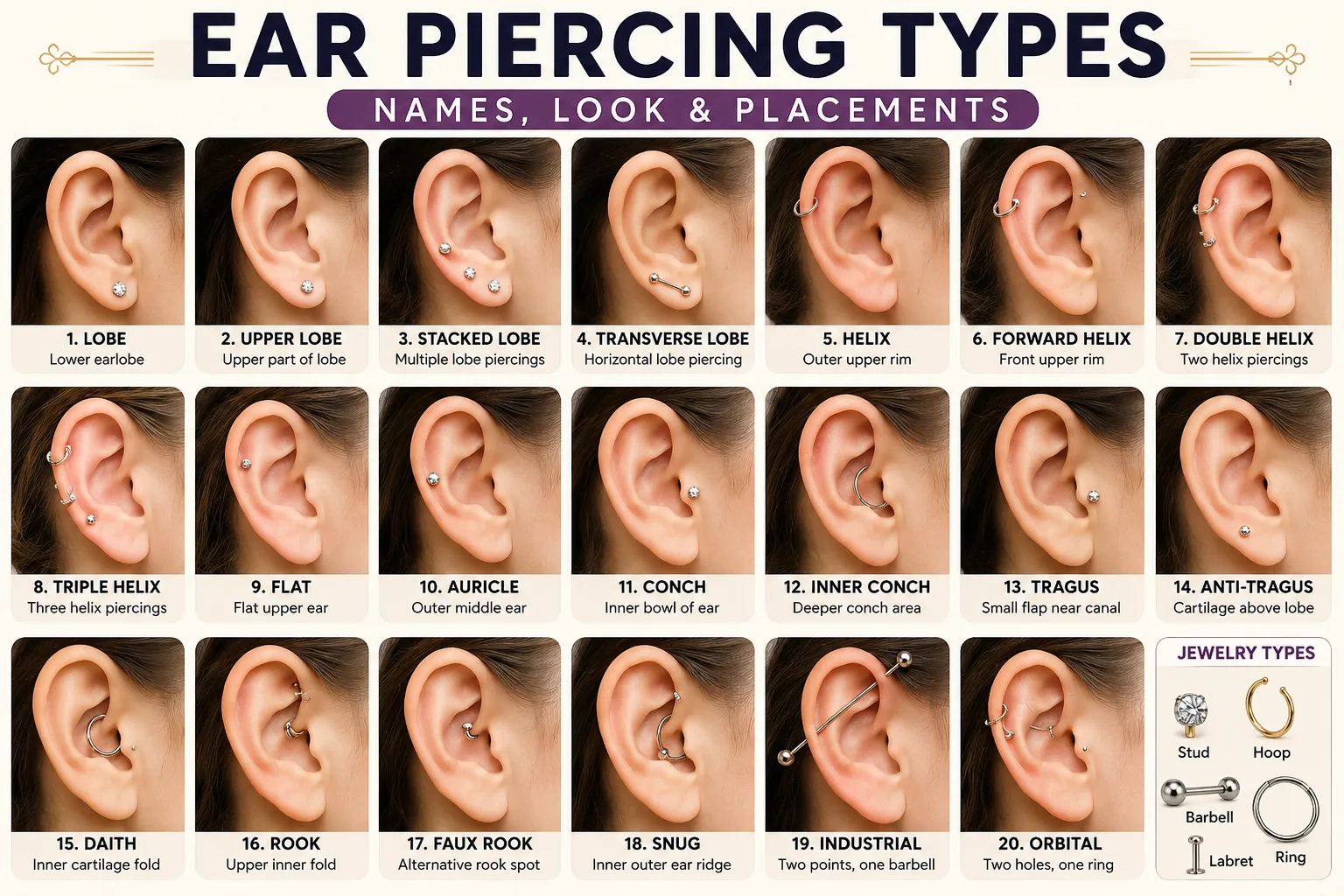
When I first started looking at ear piercings, I thought the choices were pretty simple: a lobe piercing, maybe a helix, and an industrial. Once I looked closer, I found many more ear piercing types, each with its own placement, jewelry options, healing needs, and style.
That is why I put this guide together. I want to break down the different types of ear piercings in a way that makes it easier to compare them before choosing one.
Some piercings go through the soft earlobe, while others pass through cartilage. That difference affects healing time, comfort, jewelry choices, and how careful I need to be during healing.
Ear Piercing Types at a Glance
| Ear piercing | Where it goes | Tissue | Common jewelry |
| Lobe | Lower earlobe | Soft tissue | Stud, hoop |
| Upper lobe | Upper part of lobe | Soft tissue | Stud, small hoop |
| Stacked lobe | Multiple lobe placements | Soft tissue | Studs, hoops |
| Helix | Outer upper rim | Cartilage | Stud, hoop |
| Forward helix | Front upper rim | Cartilage | Small stud |
| Double helix | Two helix placements | Cartilage | Studs |
| Triple helix | Three helix placements | Cartilage | Studs |
| Flat | Flat upper ear | Cartilage | Flat-back stud |
| Auricle | Outer middle ear | Cartilage | Stud, hoop |
| Conch | Inner bowl of ear | Cartilage | Stud, hoop |
| Tragus | Small flap near ear canal | Cartilage | Flat-back stud |
| Anti-tragus | Cartilage above lobe | Cartilage | Curved barbell |
| Daith | Inner cartilage fold | Cartilage | Ring |
| Rook | Upper inner cartilage fold | Cartilage | Curved barbell |
| Faux rook | Rook-style alternative placement | Cartilage | Stud |
| Snug | Inner outer-ear ridge | Cartilage | Curved barbell |
| Industrial | Two upper-ear points | Cartilage | Long barbell |
| Orbital | Two holes connected by one ring | Depends on placement | Ring |
The exact healing period varies by placement and person. Lobe piercings generally heal faster than cartilage piercings, while many cartilage placements can take several months or longer to fully settle.
Understanding Ear Anatomy Before Choosing a Piercing

I find ear anatomy much easier to follow once I divide the ear into a few basic areas.
The Earlobe
The earlobe is the soft lower part of the ear. Standard, upper, stacked, and transverse lobe piercings use this area.
Because the lobe is soft tissue, it generally heals faster than cartilage piercings. A standard lobe is also one of the most flexible placements for different types of earrings.
Outer Ear Cartilage
The upper and outer part of the ear contains cartilage. Helix, forward helix, flat, and auricle piercings are found around this area.
These placements usually need more patience during healing than a standard lobe.
Inner Ear Cartilage
The conch, daith, rook, and some other placements sit deeper within the ear.
These areas can be more anatomy-dependent. A placement that works beautifully on one person’s ear may not work on another person’s ear.
Why Anatomy Matters
I would never choose an ear piercing based only on a photograph.
The shape, thickness, folds, and available space in my ear can affect whether a specific piercing is suitable. Industrial, rook, snug, daith, anti-tragus, and some other placements depend heavily on having the right anatomy.
Types of Ear Piercings
Lobe Piercing

The lobe piercing is the classic ear piercing and the one most people recognize immediately.
It goes through the soft lower part of the earlobe. I like this placement because I can wear almost any style of earring with it once it has healed.
Common jewelry
- Studs
- Small hoops
- Huggies
- Drop earrings
- Dangle earrings
Why I like it
A lobe piercing is simple enough for a first piercing but also works well as part of a larger ear stack.
I can wear one lobe piercing for a minimal look or add a second and third placement for a layered style.
Upper Lobe Piercing

An upper lobe piercing sits higher on the earlobe, usually below the main cartilage area.
I see it as a useful middle ground between traditional lobe piercings and cartilage piercings.
Common jewelry
Small studs and small hoops work especially well.
Why choose an upper lobe?
It gives me another place to add jewelry without immediately moving into the slower-healing cartilage area.
Stacked Lobe Piercing

A stacked lobe piercing uses two or more placements grouped together on the earlobe.
This is one of my favorite options for creating a curated ear without filling the upper cartilage with jewelry.
I can combine tiny studs, small hoops, and different shapes to create a balanced look.
Things I would consider
The available space on the earlobe matters. The piercer should mark the placements before piercing so the final spacing looks intentional.
Transverse Lobe Piercing

A transverse lobe piercing runs horizontally through the earlobe rather than following the usual front-to-back path of a standard lobe piercing.
It creates a very different appearance from a traditional lobe piercing.
Common jewelry
A curved or straight barbell may be used depending on the anatomy and exact placement.
This is one I would have assessed carefully because enough suitable tissue is needed for the placement.
Helix Piercing

A helix piercing sits along the outer upper rim of the ear.
It is one of the most recognizable cartilage piercing types and works well as a single piercing or as part of a larger ear stack.
Common jewelry
- Flat-back stud
- Small hoop
- Ring
I would usually start with jewelry suited to healing rather than choosing something purely for its appearance.
Why I like the helix
It gives the ear a noticeable detail without taking up the center of the ear.
It can also be combined with lobe, conch, tragus, or other piercings.
Forward Helix Piercing

The forward helix sits on the front section of the upper ear, close to where the ear meets the head.
Because the area is relatively small, tiny jewelry usually looks best.
Common jewelry
- Small flat-back stud
- Tiny gemstone stud
- Small decorative top
I like the forward helix for a subtle look. Two or three forward helix piercings can also create a neat vertical arrangement if the anatomy allows it.
Double Helix Piercing

A double helix means having two helix piercings placed along the upper outer ear.
The two placements can be styled with matching jewelry or slightly different pieces.
My styling approach
I would use two small studs if I wanted a clean appearance. A combination of a stud and a small hoop can create more contrast after healing.
Triple Helix Piercing

A triple helix uses three helix placements.
It creates a more noticeable ear stack and gives me more room to play with jewelry sizes.
What I would consider
Spacing is very important. Three piercings placed too close together can make the arrangement look crowded.
Flat Piercing

A flat piercing sits through the flatter section of upper-ear cartilage.
Unlike a helix, it is not placed directly on the outer rim.
Common jewelry
Flat-back studs are a popular choice, especially decorative pieces with gemstones or interesting shapes.
Why I like it
The flatter surface gives me room for a statement stud without needing a large hoop.
Auricle Piercing

An auricle piercing is placed through the outer middle section of the ear, between the lobe and upper cartilage areas.
It can be a good choice for someone who wants another outer-ear placement without going as high as a traditional helix.
Common jewelry
- Small studs
- Flat-back labrets
- Small hoops after healing
The exact placement can vary based on ear anatomy.
Conch Piercing

A conch piercing goes through the bowl-shaped cartilage in the middle of the ear.
It is one of the ear piercing types I find especially versatile because it can work with either a stud or a ring after healing.
Inner conch

An inner conch is positioned deeper within the bowl of the ear.
Outer conch

An outer conch sits closer to the outer part of the ear.
Common jewelry
- Flat-back stud
- Decorative stud
- Hoop after healing
I would think about headphone and earbud use before getting a conch piercing because the jewelry sits close to where these devices may rest.
Tragus Piercing

The tragus is the small cartilage flap directly in front of the ear canal.
A tragus piercing is relatively compact, which makes it useful when I want a subtle cartilage piercing.
Common jewelry
A small flat-back stud is a common choice.
What I would consider
Earbuds can sit close to the tragus. If I use them every day, I would plan for a period where I may need to avoid pressure around the new piercing.
Anti-Tragus Piercing

The anti-tragus is located on the cartilage ridge opposite the tragus and just above the lobe.
It is less common than a standard tragus piercing.
Common jewelry
Depending on anatomy, a small curved barbell or suitable ring may be considered.
Anatomy matters
This is one of the placements I would have checked carefully before deciding on it. Not every ear has the same anti-tragus shape or enough suitable tissue.
Daith Piercing

A daith piercing sits through an inner cartilage fold close to the ear canal.
Its location makes it easy to recognize, and circular jewelry is commonly associated with the style.
Common jewelry
- Clicker
- Seam ring
- Captive ring
- Circular jewelry
I would pay close attention to earbud use and cleaning because the placement is deeper inside the ear.
About migraine claims
I have seen daith piercings promoted online as a way to help migraines, but I would not choose this piercing as a medical treatment. The evidence does not establish it as a proven migraine treatment.
For me, the decision should be based on the piercing itself and how it fits my style.
Rook Piercing

A rook piercing passes through the upper inner cartilage fold of the ear.
It has a tucked-away appearance compared with a helix or conch.
Common jewelry
A curved barbell is commonly used.
What I would consider
The rook fold needs to be suitable for the piercing. This is another placement where anatomy matters more than simply copying a look from someone else’s ear.
Faux Rook Piercing

A faux rook gives a similar visual effect to a traditional rook but uses a different placement.
This can be useful when the natural rook fold does not provide the right anatomy.
Common jewelry
A small flat-back stud is often used.
I like this option because it shows how a piercer can adapt a general style to the actual shape of the ear.
Snug Piercing

A snug piercing passes through the inner cartilage ridge of the outer ear.
It creates a horizontal-looking placement and can be quite distinctive.
Common jewelry
A small curved barbell is commonly associated with the placement.
Why I would think carefully about it
The snug is one of the cartilage placements I would approach with patience. The location can make healing more demanding, and not every ear has a suitable ridge.
Industrial Piercing

An industrial piercing connects two separate points of upper-ear cartilage with one piece of jewelry.
The traditional version uses a long straight barbell.
Common jewelry
- Straight industrial barbell
- Decorative industrial barbell
Anatomy is especially important
I would never assume that an industrial piercing will fit my ear just because I like how it looks on someone else.
The two piercing points have to line up properly for the intended jewelry. A professional piercer should assess the ear before deciding whether the classic industrial is suitable.
Industrial alternatives

If the classic setup is not suitable, a piercer may suggest separate piercings that create a similar visual effect without forcing an unsuitable angle.
Orbital Piercing

An orbital piercing uses two piercing holes connected by one circular piece of jewelry.
The important difference is that the ring passes through both holes.
Common jewelry
- Captive ring
- Seam ring
- Segment ring
An orbital can be created in different parts of the ear, so the exact placement and healing depend on where the two holes are made.
Ear Piercings by Location
Sometimes I find the piercing names confusing until I group them by where they sit.
Earlobe Piercings
These include:
- Standard lobe
- Upper lobe
- Stacked lobe
- Transverse lobe
These use the softer lower-ear area.
Outer Ear Piercings
These include:
- Helix
- Forward helix
- Double helix
- Triple helix
- Flat
- Auricle
These are mostly cartilage placements.
Inner Ear Piercings
These include:
- Conch
- Tragus
- Anti-tragus
- Daith
- Rook
- Snug
Their exact placement depends on the folds and shape of the ear.
Connected Ear Piercings
Industrial and orbital piercings are different because the final jewelry connects two piercing points.
An industrial normally uses one straight barbell, while an orbital uses a ring.
Lobe vs Cartilage Ear Piercings
This is one of the biggest differences I would consider before getting pierced.
Lobe Piercings
Lobe piercings pass through soft tissue.
They generally have:
- Faster healing
- More jewelry choices
- Lower discomfort for many people
- Less cartilage-related irritation
A standard lobe is often considered one of the simplest starting points for someone getting their first ear piercing.
Cartilage Piercings
Cartilage piercings include helix, conch, tragus, daith, rook, snug, industrial, and others.
These generally need more time to heal. Current piercing guides commonly give several months for many cartilage placements, with some taking up to a year or longer.
For me, that means I would think about my sleeping habits, headphones, hair, glasses, and daily activities before choosing one.
Which Ear Piercings Hurt the Most?

I do not think it makes sense to give every piercing a fixed pain score.
Pain is personal, and the experience can vary based on anatomy, placement, technique, and individual sensitivity.
As a general guide, I would expect a standard lobe to be on the easier end. Cartilage placements such as helix, tragus, conch, daith, rook, snug, and industrial can feel more intense or stay tender longer.
Generally lower discomfort
- Lobe
- Upper lobe
- Stacked lobe
Moderate for many people
- Helix
- Forward helix
- Flat
- Tragus
- Conch
Often more challenging
- Rook
- Snug
- Industrial
- Some anti-tragus placements
I would treat these as broad comparisons, not promises.
Ear Piercing Healing Times
Healing time depends on the placement and the person.
A standard lobe may heal in weeks, while many cartilage piercings can take several months. Some cartilage placements can take around six to twelve months to fully heal.
| Piercing group | General healing expectation |
| Standard lobe | Often several weeks |
| Upper lobe | Several weeks to a few months |
| Helix | Several months |
| Forward helix | Several months |
| Flat | Several months |
| Tragus | Several months |
| Conch | Several months |
| Daith | Several months |
| Rook | Several months to around a year |
| Snug | Several months to around a year |
| Industrial | Several months to around a year |
| Orbital | Depends on the placement |
I would not treat a calendar date as proof that a piercing is fully healed. A piercing can look fine outside while the inside is still settling.
Best Jewelry for Different Ear Piercings
The jewelry I choose can change the whole appearance of an ear piercing.
Studs
Studs are useful for:
- Lobe
- Upper lobe
- Helix
- Forward helix
- Flat
- Conch
- Tragus
- Rook variations
For many cartilage placements, I like the clean look of a small stud.
Flat-Back Labrets
Flat-back labrets have a flat backing and a removable front.
They are commonly used for cartilage piercings and can also work for some lobe and facial placements.
I like them when I want jewelry that sits close to the ear.
Hoops
Hoops can completely change the look of a piercing.
They are commonly used for:
- Lobe
- Helix
- Conch
- Auricle
- Some other healed placements
I would not rush to replace healing jewelry with a hoop simply because I like the look. The jewelry needs to suit the stage of healing and the placement.
Curved Barbells
Curved barbells are associated with placements such as:
- Rook
- Anti-tragus
- Snug
- Some specialized ear piercings
The curve allows the jewelry to follow the shape of the tissue.
Industrial Barbells
Industrial piercings traditionally use a long straight barbell.
The length and angle need to be chosen for the individual ear rather than copied from another person’s setup.
Ear Piercing Ideas for a Curated Ear

I like the idea of a curated ear because I can build it slowly instead of trying to get everything at once.
Simple Ear Stack
A simple combination could be:
- Standard lobe
- Second lobe
- Helix
Small studs and tiny hoops can keep this setup clean.
Minimal Cartilage Stack
Another option is:
- Lobe
- Conch
- Helix
This gives me a little more detail without filling every part of the ear.
Multiple-Lobe Setup
I can use two or three lobe piercings with different-sized studs.
This is one of the easiest ways to create a layered look.
Industrial and Lobe Combination
An industrial can become the main feature while the lobe piercings add smaller details.
I would plan this carefully because the industrial itself depends heavily on ear anatomy.
Asymmetrical Ear Stack
I do not have to make both ears identical.
For example, I could have:
Left ear: double lobe + conch + helix
Right ear: triple lobe + rook + helix
I like this approach because it gives each ear its own look while still keeping the overall jewelry connected.
How I Would Choose the Right Ear Piercing
I would start with the placement rather than the jewelry.
Check My Ear Anatomy
I would have the piercer check whether the area has enough suitable tissue and whether the placement will work with the jewelry I want.
This is especially important for industrial, rook, snug, daith, and anti-tragus piercings.
Think About My Sleeping Position
If I sleep heavily on one side, I would think twice before getting a new cartilage piercing on that side.
Sleeping on it can create pressure and friction, which may make healing much harder.
Think About Headphones and Earbuds
If I use earbuds every day, I would consider whether they will touch the piercing.
Tragus, daith, and conch placements can be especially relevant here.
Think About My Hair
Long hair can catch on fresh ear jewelry.
I would be careful when brushing, washing, tying, or styling my hair around a new piercing.
Think About Glasses
Glasses can sit close to some upper-ear placements.
I would check whether the frame touches the planned piercing before committing to the location.
Think About My Work or School
Some environments have rules about visible jewelry.
If I need to keep my piercing discreet, I would choose a placement and jewelry style that fits those requirements.
Best Ear Piercing for a First Piercing
If I wanted a straightforward first ear piercing, I would consider a standard lobe.
It offers many jewelry choices and generally heals faster than cartilage piercings.
If I already know I want cartilage jewelry, a helix or another suitable placement could also be an option, but I would be prepared for a longer healing period.
The best choice is the one that fits my anatomy and routine rather than simply the piercing that looks most popular online.
Ear Piercing Aftercare
I treat aftercare as part of the piercing rather than something separate from it.
Wash My Hands Before Touching It
I would wash my hands before any necessary contact with the piercing.
Follow the Piercer’s Cleaning Instructions
I would stick to the aftercare routine given for the specific piercing.
Avoid Unnecessary Touching
I would avoid playing with the jewelry, pulling it, or checking it repeatedly.
Reduce Pressure and Friction
I would keep pressure from pillows, headphones, hair, helmets, and clothing as low as possible.
Avoid Rotating the Jewelry
I would not repeatedly twist or rotate a healing piercing just to check whether it moves. Unnecessary movement can irritate the area.
Don’t Change Jewelry Too Early
I would wait until the piercing is sufficiently healed before changing jewelry unless a qualified piercer needs to make an adjustment.
Common Ear Piercing Problems
Most new piercings need some tenderness and care, but problems can happen.
Irritation
Repeated pressure, friction, touching, or unsuitable jewelry can irritate a piercing.
Swelling
Some swelling can happen after a new piercing. Severe, increasing, or persistent swelling is different and deserves attention.
Bleeding
A small amount of bleeding can occur after a fresh piercing, but ongoing or heavy bleeding is not something I would ignore.
Discharge
Some crusting can occur during healing. Thick, unusual, or increasing discharge combined with other concerning symptoms should be checked.
Infection
Increasing pain, warmth, spreading redness, significant swelling, or pus-like drainage can be warning signs of infection.
If I were concerned that a piercing was infected, I would seek medical advice rather than trying random home treatments.
Irritation Bumps
A bump can develop around a piercing because of irritation or other causes.
I would first look at possible sources of pressure, friction, jewelry problems, and repeated touching rather than immediately assuming it is an infection.
Jewelry Embedding
If jewelry begins sinking into the tissue or the skin appears to be growing over it, I would get professional help promptly.
Migration and Rejection
Some piercing types can migrate or reject, especially surface-style placements.
This is another reason I would choose the placement based on anatomy rather than appearance alone.
Ear Piercing vs Cartilage Piercing
The term cartilage piercing covers many of the placements people call ear piercing types.
A lobe piercing uses soft tissue, while helix, conch, tragus, rook, daith, and many other upper-ear placements involve cartilage.
That difference affects healing and aftercare. Cartilage generally has less blood supply than soft tissue, so these piercings can take much longer to settle.
Ear Piercing Names I Would Learn First
If I were new to ear piercings, I would start with these names:
- Lobe
- Upper lobe
- Helix
- Forward helix
- Flat
- Conch
- Tragus
- Daith
- Rook
- Snug
- Anti-tragus
- Industrial
- Orbital
Once I knew these, it would be much easier to talk to a piercer about the exact placement I wanted.
Final Thoughts
After looking at all these ear piercing types, I think the biggest mistake would be choosing a piercing only because I like how it looks on someone else.
The same helix, conch, rook, or industrial piercing can look very different from one ear to another. Anatomy affects placement, jewelry, comfort, and whether a particular style is even suitable.
If I were choosing my next ear piercing, I would start by deciding what kind of look I want. Then I would check my anatomy, think about my sleeping position and daily routine, consider the jewelry I want, and talk with a professional piercer about the placement.
For a simple start, I would look at the lobe or upper lobe. For a cartilage-focused look, I would consider options such as the helix, conch, flat, tragus, daith, or rook. And if I wanted a more distinctive setup, I would look at an industrial, orbital, or a carefully planned curated ear.
The goal for me would be simple: choose a piercing that looks good, fits my anatomy, and is realistic for the way I live.
Frequently Asked Questions About Ear Piercing Types
What are the different types of ear piercings?
The main ear piercing types include lobe, upper lobe, stacked lobe, helix, forward helix, flat, auricle, conch, tragus, anti-tragus, daith, rook, faux rook, snug, industrial, and orbital piercings.
There are also less common variations and combinations.
What is the most common ear piercing?
The standard lobe piercing is the classic and most widely recognized ear piercing.
It goes through the soft lower part of the ear and can be worn with many different types of jewelry.
What is the best ear piercing for a first piercing?
A standard lobe is a common starting choice because it uses soft tissue and generally has a shorter healing period than cartilage piercings.
I would still choose based on my anatomy, style, and ability to care for the piercing.
Which ear piercing hurts the least?
The standard lobe is generally considered one of the least uncomfortable ear piercings.
Cartilage placements tend to feel different and may be more uncomfortable for some people, but pain varies from person to person.
Which ear piercing takes the longest to heal?
Many cartilage piercings can take several months to heal fully, and some may take around a year or longer.
Industrial, rook, snug, and some other cartilage placements can require a long healing period.
What is the difference between a helix and a forward helix?
A standard helix sits along the outer upper rim of the ear.
A forward helix sits on the front part of the upper ear, closer to the head.
What is the difference between a rook and a daith?
A rook sits through an upper inner cartilage fold.
A daith sits through an inner fold closer to the ear canal.
Both are cartilage piercings, but their exact locations are different.
What is the difference between a conch and a tragus?
A conch sits in the bowl-shaped center of the ear.
A tragus sits on the small cartilage flap in front of the ear canal.
Can everyone get an industrial piercing?
No.
Industrial piercings depend heavily on ear anatomy because two piercing points need to work together with one piece of jewelry. A professional should check the ear before deciding whether the traditional setup is suitable.
Can I sleep on a new cartilage piercing?
I would avoid putting direct pressure on a new cartilage piercing.
Sleeping on it can create pressure and friction, which may make healing more difficult.
Can I wear headphones with a new ear piercing?
It depends on the piercing and the type of headphones.
I would avoid anything that presses directly against the fresh piercing and follow the aftercare advice given for the placement.
Which ear piercings are good for a curated ear?
Lobe, upper lobe, helix, forward helix, flat, conch, tragus, rook, and daith piercings can all be used in different curated ear combinations.
The best combination depends on anatomy, existing piercings, jewelry preference, and how much healing time I am willing to manage.
What jewelry is best for a new ear piercing?
The right jewelry depends on the placement, anatomy, and stage of healing.
For many ear piercings, properly fitted flat-back studs are a practical starting option. I would let a qualified piercer choose the appropriate size and material rather than choosing jewelry based only on appearance.
