

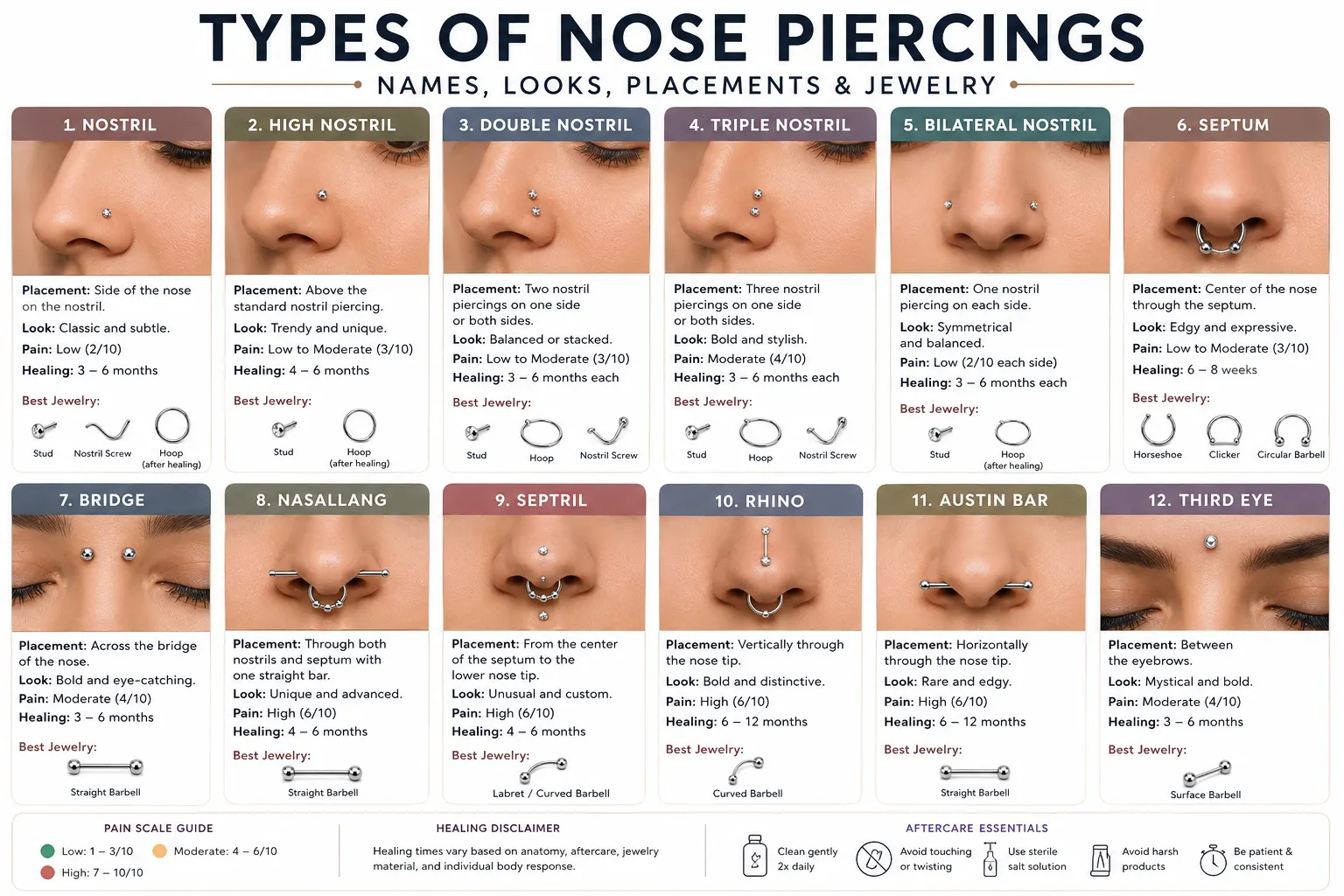
When I first started looking at nose piercings, I thought the choices were pretty simple: a nostril stud or a septum ring. Once I looked deeper, I realized there are many different nose piercing types, and each one has its own placement, healing process, jewelry options, and anatomy requirements.
Some are simple and familiar, such as the standard nostril and septum piercing. Others, such as the nasallang, septril, rhino, and Austin bar, are much less common and require a piercer with experience in that specific placement.
I put this guide together to explain the different nose piercing names and placements in plain language. I also cover pain, healing, jewelry, anatomy, cost, and how I would choose between them.
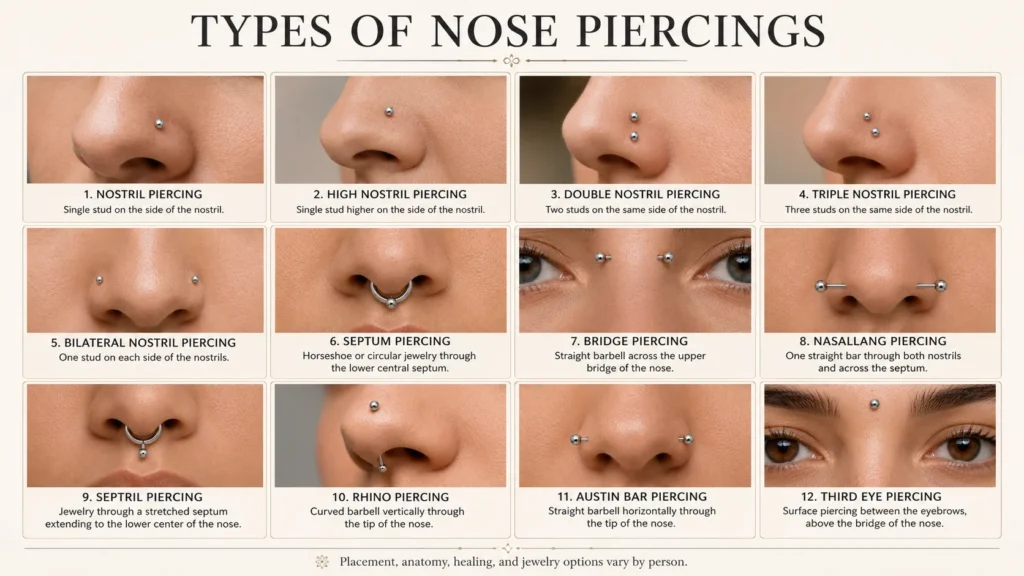
Nose Piercing Types at a Glance
| Nose piercing | Placement | General difficulty | Common jewelry | Good starting option? |
| Nostril | Side of the nose | Lower | Flat-back stud, nostril screw, hoop after healing | Yes |
| High nostril | Higher on the side of the nose | Moderate | Flat-back stud | Sometimes |
| Double nostril | Two nostril placements | Moderate | Studs, hoops after healing | Depends |
| Triple nostril | Three nostril placements | Moderate | Studs | Depends |
| Bilateral nostril | One nostril on each side | Moderate | Studs, hoops after healing | Depends |
| Septum | Center underside of the nose | Lower to moderate | Clicker, horseshoe, circular barbell | Yes |
| Bridge | Skin across the upper nose | Anatomy-dependent | Straight barbell | Usually not |
| Nasallang | Both nostrils and septum | Advanced | Long straight barbell | No |
| Septril | Nose tip connected to a stretched septum | Advanced | Small stud or suitable curved jewelry | No |
| Rhino | Vertical through the nose tip | Advanced | Curved barbell | No |
| Austin bar | Horizontal through the nose tip | Advanced | Straight barbell | No |
| Third eye | Upper nose/between the eyebrows | Advanced | Surface-style jewelry | No |
These categories are useful for comparing styles, but I would not treat difficulty, pain, or healing as fixed numbers. Anatomy, jewelry fit, placement, aftercare, and individual healing can all change the experience.
Nose Anatomy and Piercing Placement
Before choosing one of these nose piercing types, I think it helps to know where each area actually is.
Nostril and Ala
The nostril is the side portion of the nose around the opening. A standard nostril piercing is placed through tissue around the outer nostril area.
The exact position can vary based on the shape of the nose, available tissue, existing piercings, and the jewelry I want to wear later.
Septum
The septum divides the two nasal passages.
A properly placed septum piercing is generally positioned through the softer tissue in the lower part of the septum rather than simply passing through the thick central cartilage. The exact placement depends on individual anatomy.
I keep my detailed septum pain, problems, healing, and complication topics in separate articles because they deserve more space than they need on a general nose piercing guide.
Bridge
The bridge is the upper part of the nose between the eyes.
A bridge piercing passes through the skin over this area. It is different from a nostril or septum piercing because it is a surface-style placement, which means anatomy and the risk of migration or rejection need extra attention.
Nose Tip
The tip of the nose is used for less common piercings such as the rhino and Austin bar.
These placements are much more anatomy-dependent than a basic nostril piercing. I would never choose one simply because I liked a photo online.
Why Nose Anatomy Matters
One thing I always keep in mind is that a piercing can look completely different on two people.
The thickness of the tissue, shape of the nose, existing piercings, and available space all affect where jewelry can sit. Advanced placements need even more careful assessment.
That is why I would have a professional piercer check my anatomy before committing to an unusual nose piercing.
Types of Nose Piercings
Nostril Piercing
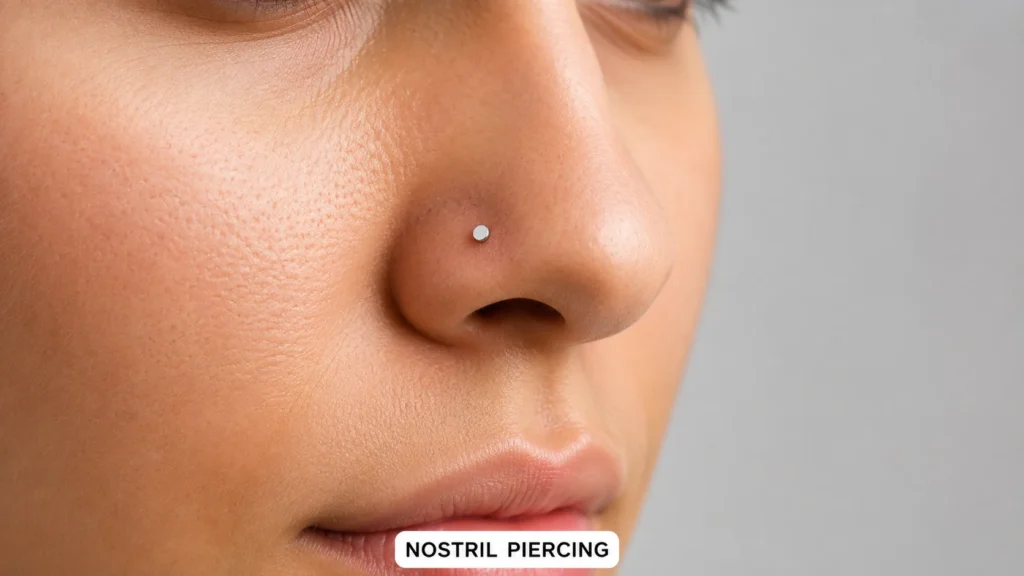
The standard nostril piercing is the classic nose piercing most people picture first.
It sits on the side of the nose and can be placed on either the left or right nostril. It is also one of the most versatile choices because I can eventually wear a small stud, hoop, or other suitable jewelry.
Common jewelry
- Flat-back labret
- Nostril screw
- L-bend stud
- Nose bone
- Small hoop after healing
For a fresh piercing, I would focus on properly fitted jewelry rather than immediately choosing the ring I like most. A flat-back labret is a common choice for a fresh nostril piercing, while hoops are often better saved until the piercing has healed.
Why I like the nostril piercing
The standard nostril gives me a lot of styling freedom.
I can keep it subtle with a tiny gemstone or make it more noticeable with a larger decorative piece once it has healed.
It also works well with other nose piercings.
High Nostril Piercing
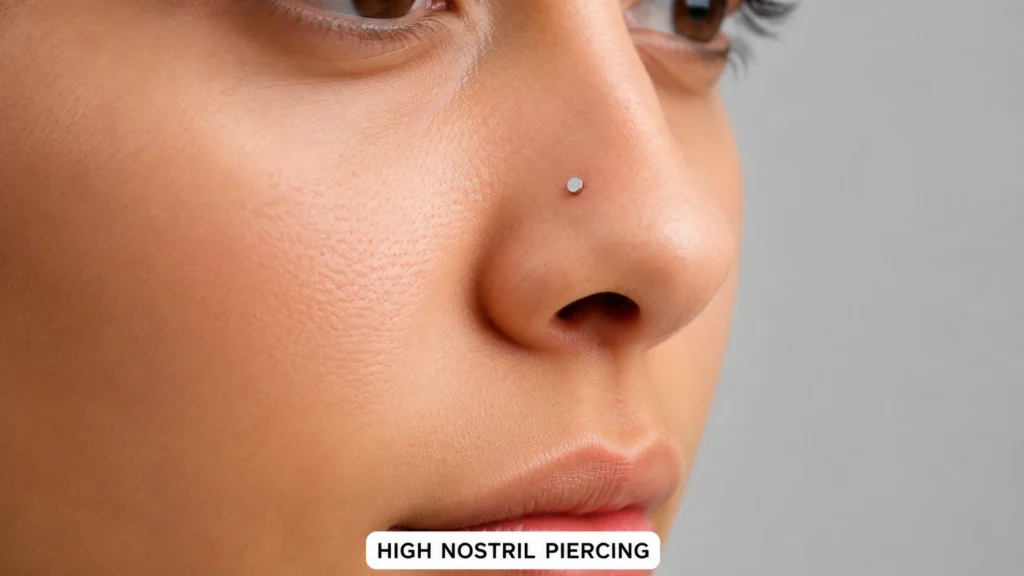
A high nostril piercing sits higher on the nose than a standard nostril piercing.
The higher position creates a different look and can work especially well when combined with a regular nostril piercing. Because the placement can involve thicker tissue and is harder to reach, healing may take longer than a standard nostril piercing.
Common jewelry
A small flat-back stud is usually more practical for this placement than a hoop.
Why choose a high nostril?
I would consider a high nostril if I wanted something less common than a traditional nostril but did not want an extremely unusual piercing.
It can also create a layered look when paired with a lower nostril piercing.
Double Nostril Piercing

A double nostril piercing means having two nostril piercings.
They can be placed on the same side or arranged across both sides of the nose.
Same-side double nostril
Both piercings sit on one side.
This gives me a stacked appearance and lets me combine two studs or a stud and hoop after healing.
Bilateral double nostril
One nostril is pierced on each side.
This gives a more symmetrical appearance.
Jewelry ideas
I could use:
- Two matching studs
- Different-sized studs
- One stud and one hoop after healing
- Matching hoops after healing
I would pay attention to spacing because poor spacing can make a double nostril setup look crowded.
Triple Nostril Piercing

A triple nostril piercing uses three nostril placements.
The three piercings may be grouped on one side or arranged between both sides.
This creates a much more noticeable nose piercing setup than a single nostril.
What I would consider
Spacing becomes very important with three piercings.
I would have the piercer mark every position first so I could see how the final arrangement would look before any needle is used.
Bilateral Nostril Piercing

Bilateral nostril piercings place one nostril piercing on each side of the nose.
I like this option for a balanced look.
It can be very simple with two tiny studs or more noticeable with matching hoops after healing.
Multiple Nostril Piercings
Multiple nostril piercing is the broader term I would use for setups involving two or more nostril placements.
This can include:
- Double nostril
- Triple nostril
- Same-side nostril piercings
- Bilateral nostril piercings
- Mixed high and standard nostril placements
I would plan multiple nostril piercings together if I already know I want several pieces. That makes it easier to leave enough space for future jewelry.
Septum Piercing
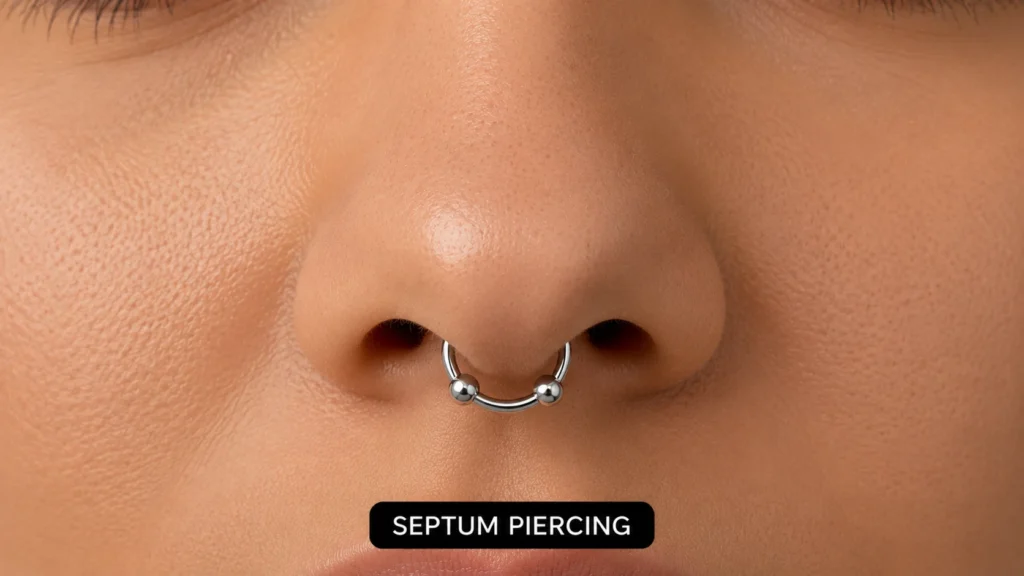
The septum piercing sits in the center of the nose between the nostrils.
It is one of the most recognizable nose piercing styles and gives me many jewelry choices.
Common septum jewelry
- Horseshoe ring
- Circular barbell
- Septum clicker
- Captive bead ring
- Septum retainer
One benefit I like about a septum piercing is that some jewelry can be positioned upward when appropriate, making the piercing less visible.
How it fits into this article
I already treat septum piercing problems as their own topic cluster, so I would keep this section focused on the piercing type itself.
For detailed questions about pain, bleeding, discharge, irritation, allergic reactions, stretching, crooked placement, damage, and other problems, I would use separate supporting articles rather than repeating all of that information here.
Bridge Piercing

A bridge piercing sits horizontally across the upper part of the nose, between the eyes.
Unlike a nostril or septum piercing, it passes through the skin across the bridge area.
Common jewelry
A straight barbell is commonly used for this placement.
Why I would think carefully about it
A bridge piercing is highly dependent on anatomy.
Because it is a surface-style piercing, migration and rejection can happen. I would therefore have the piercer check the available tissue and explain how the jewelry should sit before deciding.
Style
A bridge piercing creates a noticeable horizontal line across the upper nose.
For someone who wants an unusual facial piercing, it can be a strong choice.
Nasallang Piercing

The nasallang is one of the more advanced nose piercing types.
A single straight barbell passes through one nostril, the septum area, and the other nostril. From the outside, it can look like two nostril piercings, but the jewelry is connected internally by one bar.
Common jewelry
A long straight barbell is used.
Why it is advanced
The piercing requires accurate alignment across several points.
I would only consider this after finding a piercer with specific experience in this type of work.
It is not a piercing I would choose as my first nose piercing simply because I liked the appearance.
Septril Piercing

A septril piercing is one of the more unusual nose piercing styles.
It is built around an existing stretched septum. The jewelry uses the established septum opening and creates an additional route toward the lower part of the nose tip.
Common jewelry
Depending on anatomy and the exact setup, a small labret-style stud or other suitable jewelry may be used.
Who is it for?
I would see this as an advanced option for someone who already has a healed, stretched septum.
It is not a normal alternative to a first-time septum piercing.
The existing septum needs to be suitable, and the entire setup requires careful planning.
Rhino Piercing
A rhino piercing, also called a vertical nose tip piercing, runs vertically through the tip of the nose.
The jewelry follows a vertical path rather than sitting on the side of the nose.
Common jewelry
A curved barbell is commonly associated with the placement.
Why I would think carefully about it
The nose tip has different anatomy from the nostril area.
This is a more advanced piercing, and healing can take considerably longer than a simple nostril piercing.
I would only consider it after a professional confirms that my anatomy can support the placement.
Austin Bar Piercing

An Austin bar is a rare horizontal piercing through the tip of the nose.
Unlike a nasallang, it does not pass through the septum. It travels horizontally through the tissue at the nasal tip.
Common jewelry
A straight barbell is used.
Why it stands out
The Austin bar is much less common than a nostril or septum piercing.
I would treat it as a specialist piercing rather than a normal beginner option.
Third Eye Piercing

The third eye piercing is placed on the upper part of the face between or above the eyebrows.
It is sometimes included in broader nose piercing guides because of its position close to the upper nose.
However, I would separate it from standard nostril and septum piercings in my mind because it is a surface-style facial placement rather than a typical nose piercing.
It is also much less common, so I would not give it the same amount of attention as nostril, septum, high nostril, or bridge piercings.
Nose Piercing Types by Difficulty
I would not use a rigid pain score to decide how difficult a piercing is.
There is a difference between how much a piercing hurts, how complicated the procedure is, and how difficult it may be to heal.
Those three things should not be treated as the same.
Beginner-Friendly Nose Piercings
For many people, a standard nostril and properly placed septum are reasonable places to start.
They are common, have many jewelry choices, and are widely performed by experienced piercers.
That does not mean they are risk-free or that everyone has identical anatomy.
Intermediate Nose Piercings
I would put options such as:
- High nostril
- Double nostril
- Triple nostril
- Bilateral nostril
into a more involved category.
The individual piercing may not be extremely unusual, but multiple placements require careful spacing and planning.
Advanced Nose Piercings
These include:
- Bridge
- Nasallang
- Septril
- Rhino
- Austin bar
These placements have more specific anatomy or jewelry requirements.
For these, I would focus heavily on finding a piercer who regularly performs the exact placement rather than choosing a studio based only on general reviews.
Which Nose Piercing Hurts the Least?
I would avoid giving every nose piercing a fixed number from 1 to 10.
Pain is personal, and current guides give very different ratings for some of the same placements. That makes a rigid pain chart less useful than a general comparison.
In general, I would expect a standard nostril or a correctly placed septum to feel manageable for many people.
High nostril and multiple nostril setups can feel more demanding.
Advanced placements such as nasallang, rhino, and septril involve more complicated procedures or anatomy, so I would focus less on a number and more on the experience, placement, and healing commitment.
Nose Piercing Pain Levels Compared
If I were comparing them before choosing one, I would think about them in broad groups:
Lower discomfort: standard nostril and properly placed septum.
Moderate: high nostril and multiple nostril placements.
More demanding: bridge, rhino, nasallang, septril, and Austin bar.
This is only a general guide. A person’s anatomy, sensitivity, stress level, and the piercer’s technique can change the experience.
Nose Piercing Healing Times
Healing time is another area where I would avoid promising an exact date.
Current piercing guides give different estimates for several placements. For example, recent guides put standard nostril healing anywhere from several months to longer, while septum healing can be shorter when correctly placed. High nostril and rhino placements are often given longer healing windows.
General healing guide
| Piercing | General healing expectation |
| Nostril | Several months |
| Septum | Often a few months or less when properly placed |
| High nostril | Often several months |
| Double/triple nostril | Each piercing needs its own healing time |
| Bridge | Several months or longer depending on the piercing |
| Nasallang | Several months |
| Rhino | Often six months or longer |
| Septril | Several months and highly anatomy-dependent |
| Austin bar | Several months and anatomy-dependent |
These are general ranges, not guarantees.
I would not change jewelry simply because the outside looks healed. A piercing can appear fine while the inside is still healing.
How Much Does a Nose Piercing Cost?
The cost of a nose piercing can vary a lot depending on the studio, location, piercer’s experience, jewelry, and type of piercing.
A simple nostril or septum piercing is usually less involved than an advanced placement such as a nasallang or septril.
The jewelry itself can also make a large difference in the final price.
If I were comparing studios, I would look at the total cost rather than choosing the cheapest option. I would also ask whether the quoted price includes the initial jewelry and whether there are additional charges for more complex placements.
I would not use one fixed dollar amount for every reader because prices vary significantly by country and city.
Nose Piercing Jewelry Types

The piercing itself and the jewelry are two different things.
A nose piercing type describes where I get pierced.
A nose jewelry type describes what I put into that piercing.
That distinction matters because people often use these terms interchangeably.
Flat-Back Labret
A flat-back labret has a decorative front and a flat disc on the inside.
I like this style for many nostril piercings because it sits close to the skin and can be fitted to the individual anatomy.
Nostril Screw
A nostril screw has a curved section that helps hold the jewelry inside the nostril.
It is specifically associated with nostril piercings.
L-Bend Stud
An L-bend has a post that turns at a right angle inside the nostril.
It can work for some people, but the fit needs to be right.
Nose Bone
A nose bone has a small enlarged end that helps hold it in place.
I would be more cautious about using jewelry like this in a fresh piercing and would follow the piercer’s recommendation.
Nose Hoop
A nose hoop creates a completely different appearance from a stud.
It can be used for suitable healed nostril piercings, but I would not rush to put a hoop into a fresh piercing simply because I prefer the look.
Horseshoe Ring
A horseshoe ring is a circular barbell with two ends.
It is commonly associated with septum piercings.
One reason I like it is that the jewelry can create a simple, bold, or decorative look depending on the ends.
Septum Clicker
A septum clicker is a hinged ring that closes into place.
I like clickers because they can range from very simple to highly decorative.
Captive Bead Ring
A captive bead ring uses a removable bead to hold the ring closed.
It can work for suitable nose piercing placements depending on anatomy and the piercing’s stage of healing.
Straight Barbell
Straight barbells are used for some advanced placements, including bridge, nasallang, and Austin bar piercings.
The length needs to be selected for the specific anatomy rather than guessed from another person’s jewelry.
Curved Barbell
Curved barbells can be used for certain nose-tip placements, including rhino piercings.
The curve allows the jewelry to follow the path of the piercing.
Best Jewelry Materials for a New Nose Piercing
For a fresh piercing, I would pay as much attention to the jewelry material as I do to its shape.
Common professional options include implant-grade titanium and suitable solid gold.
Implant-Grade Titanium
Titanium is a popular choice because it is lightweight and can be suitable for people who have problems with certain metals.
If I wanted titanium, I would ask exactly what grade the studio uses rather than assuming every piece sold as titanium is the same.
Suitable Solid Gold
Solid gold can also be used for appropriate piercings when the jewelry meets suitable quality standards.
I would avoid choosing jewelry simply because it has a gold-colored finish.
Why Jewelry Material Matters
The jewelry stays inside the piercing while it heals.
If the material, finish, shape, or size is unsuitable, it can contribute to irritation and make healing harder.
That is why I would let an experienced piercer recommend the material and size for the exact placement.
What Happens During a Nose Piercing?
Before getting pierced, I would expect the process to involve more than simply sitting down and having a needle used.
1. Anatomy Check
The piercer should look at the nose and decide whether the placement is suitable.
2. Jewelry Selection
The jewelry should match the piercing, anatomy, and healing stage.
3. Marking
The piercer should mark the intended position so I can see where the piercing will sit.
4. Position Approval
I would check the mark from different angles before proceeding.
5. Sterile Preparation
The skin and equipment should be prepared using appropriate hygiene and sterile procedures.
6. Piercing
The piercer performs the piercing using suitable equipment and technique for the placement.
7. Jewelry Insertion
The initial jewelry is inserted and fitted to the area.
8. Aftercare Instructions
I would leave knowing how to care for the piercing and what signs should make me contact the piercer or seek medical care.
For a complicated placement, I would also expect the piercer to explain why my anatomy does or does not suit it.
How I Would Choose the Right Nose Piercing
I would start with the look I want, but I would not stop there.
I Would Check My Anatomy
This would be my first practical step.
A piercing that looks great on someone else may not be suitable for my nose.
This matters even more for bridge, high nostril, rhino, septril, and other advanced placements.
I Would Think About My Existing Piercings
If I already had a septum piercing, I would consider how a new nostril or high nostril placement would work with it.
Likewise, two nostril piercings may need careful spacing if I plan to add another one later.
I Would Think About My Lifestyle
I would consider:
- Glasses
- Sunglasses
- Masks
- Sports
- Work requirements
- Sleeping habits
- Makeup
- Skincare
- Face washing
- Hair and towels
A piercing that looks great but constantly gets caught or rubbed may be harder for me to live with.
I Would Think About Visibility
If I wanted something subtle, I might choose a small nostril stud.
If I wanted something more noticeable, I might consider a septum clicker, bridge, or a layered nostril setup.
I Would Think About Future Jewelry
This is something I would consider before getting pierced, not after.
If I eventually want a hoop, I would tell the piercer before the placement is made.
The position of the original piercing can affect how future jewelry sits.
How I Would Choose a Nose Piercer
I would not choose a piercer based only on a low price or a few good-looking photos.
I Would Check Their Portfolio
I would look for clear examples of the exact piercing I want.
A person who does excellent nostril piercings may not have the same experience with a nasallang, rhino, septril, or bridge piercing.
I Would Ask About Anatomy
A good consultation should include an assessment of whether the placement suits my nose.
If someone says yes to every piercing without checking my anatomy, I would look elsewhere.
I Would Check Hygiene Practices
The studio should use appropriate sterile equipment and hygiene procedures.
I Would Ask About Jewelry
I would ask what material, size, and style they plan to use for the initial jewelry.
I Would Ask About Aftercare
I would want clear instructions for caring for the piercing and knowing when something may need professional attention.
I Would Not Feel Pressured
If a piercer tells me that a particular placement is not suitable for my anatomy, I would take that seriously.
A good piercing is not just about getting the style I want. It is also about getting a placement that my body can reasonably support.
Nose Piercing Ideas and Combinations
I like nose piercing combinations because they let me build a look gradually.
Single Nostril
A tiny stud on one side is probably the simplest option.
I could keep it subtle or switch to a more noticeable piece after healing.
Double Nostril
Two piercings on the same side can create a stacked look.
Matching studs keep it simple, while different jewelry creates more contrast.
Bilateral Nostril
One piercing on each side creates symmetry.
I would use matching jewelry if I wanted a balanced appearance.
Nostril and Septum
This is one of the combinations I would consider if I wanted more than one nose piercing without going into advanced placements.
A small nostril stud with a septum clicker can create a noticeable but flexible look.
Double Nostril and Septum
This creates a stronger facial jewelry setup.
I would plan the three placements together instead of adding them randomly over time.
High Nostril and Standard Nostril
This combination can create a layered effect along one side of the nose.
Spacing is especially important here.
Septum and Bridge
This creates a bold combination because the jewelry sits in two different areas of the nose.
I would be more careful with this setup because the bridge piercing has its own anatomy and healing considerations.
Nose Piercing Aftercare
Once I get a piercing, I would treat aftercare as part of the process.
Wash My Hands Before Touching It
I would wash my hands before touching the jewelry or piercing area.
This is a simple habit, but it can reduce unnecessary contamination.
Follow the Piercer’s Aftercare Instructions
I would follow the cleaning routine given for the specific placement.
Different nose piercings can have different practical concerns.
Avoid Unnecessary Touching
I would not keep moving the jewelry just to see whether it still moves.
Repeated handling can irritate a healing piercing.
Avoid Friction
I would be careful with:
- Towels
- Clothing
- Masks
- Glasses
- Sunglasses
- Makeup
- Hair
- Hands
Anything that repeatedly catches or presses against the jewelry can make healing harder.
Do Not Change Jewelry Too Soon
I would resist the temptation to switch to my favorite hoop or decorative piece before the piercing is ready.
If the jewelry needs to be changed during healing, I would have a qualified piercer handle it.
Be Patient With Healing
I would not judge the healing process by appearance alone.
A piercing may look fine from the outside while the inside is still settling.
Common Nose Piercing Problems
A new nose piercing can experience irritation, swelling, crusting, or tenderness during healing.
However, some symptoms deserve more attention.
Nose Piercing Bump
A bump can develop around a piercing for several reasons, including irritation and pressure.
If I developed one, I would first look at whether the jewelry is being rubbed, pulled, or touched too often.
Swelling
Some swelling can happen after a new piercing.
Increasing or severe swelling would make me more concerned, especially if other symptoms appear at the same time.
Bleeding
A small amount of bleeding may happen after a new piercing.
Continued or heavy bleeding would not be something I would simply ignore.
Discharge
Some clear fluid or crusting can occur during healing.
Thick, unusual, or increasing drainage, especially alongside worsening pain, warmth, redness, or swelling, would make me seek professional advice.
Infection
Possible warning signs include increasing pain, warmth, spreading redness, significant swelling, or pus-like drainage.
If I suspected an infection, I would seek medical care instead of trying random treatments.
Irritation
Repeated pressure, friction, touching, or unsuitable jewelry can irritate a piercing.
This is why I would look at the source of irritation rather than assuming every bump or red area is an infection.
Migration and Rejection
Migration means the jewelry gradually moves from its original position.
Rejection occurs when the body pushes a piercing toward the surface.
These concerns are especially relevant to surface-style placements such as bridge piercings.
Nose Piercing vs Nose Jewelry
This is worth clearing up because the two terms are often mixed together.
Nose Piercing Types
These describe where I get pierced:
- Nostril
- High nostril
- Septum
- Bridge
- Nasallang
- Rhino
- Septril
- Austin bar
Nose Jewelry Types
These describe what I wear:
- Stud
- Flat-back labret
- Nostril screw
- L-bend
- Nose bone
- Hoop
- Horseshoe
- Clicker
- Captive bead ring
- Straight barbell
- Curved barbell
For example, I can have a nostril piercing and wear a flat-back stud.
I can also have a septum piercing and wear a horseshoe ring or clicker.
Which Nose Piercing Is Best for a First Piercing?
If I wanted my first nose piercing, I would probably start by considering a standard nostril or properly placed septum.
Both are common, versatile, and have many jewelry options.
I would not choose an advanced piercing simply because it looks more unusual.
For me, the better question would be:
Which piercing fits my anatomy, style, routine, and willingness to deal with healing?
That answer can be different for every person.
Which Nose Piercing Is Easiest to Hide?
A septum can be relatively discreet with suitable jewelry and positioning.
A small nostril stud can also be subtle, especially if I choose a tiny piece that blends with my skin.
A bridge piercing is much harder to make invisible because of its location across the upper nose.
If hiding the piercing matters for work or school, I would tell the piercer before choosing the placement.
Which Nose Piercing Is Most Popular?
The standard nostril and septum are among the most recognizable and widely chosen nose piercing styles.
The nostril gives me a classic side-of-the-nose look, while the septum creates a centered look with many ring and clicker options.
Which Nose Piercing Takes the Longest to Heal?
There is no single healing time that applies to every person.
More complex placements such as rhino and some high nostril or advanced piercings can require a longer healing period than a simple nostril or properly placed septum. Current guides give different time ranges, so I would use them as rough estimates rather than promises.
Final Thoughts
After looking at all these nose piercing types, I think the biggest mistake would be treating them as simple variations of the same thing.
A standard nostril, septum, high nostril, bridge, nasallang, rhino, septril, and Austin bar all create very different experiences. Their placement, anatomy requirements, jewelry, healing, and styling options can vary a lot.
If I were choosing my next nose piercing, I would start with the look I want. Then I would consider my anatomy, daily routine, existing piercings, future jewelry, healing commitment, and whether I need the piercing to be easy to hide.
For a first nose piercing, I would look closely at the standard nostril or septum. If I wanted something more unusual, I would explore high nostril, bridge, or one of the advanced nose piercing styles after speaking with an experienced piercer.
For me, the best nose piercing is not simply the one that looks great in a photo. It is the one that fits my nose, my lifestyle, and the style I actually want to wear for years.
Frequently Asked Questions About Nose Piercing Types
What are the different types of nose piercings?
The main nose piercing types include nostril, high nostril, double nostril, triple nostril, bilateral nostril, septum, bridge, nasallang, septril, rhino, and Austin bar piercings.
Some guides also include third eye and other less common facial placements.
What is the most common nose piercing?
The standard nostril piercing is one of the most common nose piercing choices.
It is placed on the side of the nose and works with many different jewelry styles.
What is the easiest nose piercing to get?
A standard nostril or properly placed septum is generally a more straightforward starting point than advanced placements such as nasallang, septril, or rhino.
The right choice still depends on individual anatomy.
Which nose piercing hurts the least?
Pain varies from person to person, so I would not give a fixed ranking.
A standard nostril or correctly placed septum may feel manageable for many people, while more complex placements can involve a more demanding procedure.
What is the difference between a nostril and septum piercing?
A nostril piercing is placed on the side of the nose.
A septum piercing is placed in the central tissue between the nostrils.
They also use different jewelry styles and create very different looks.
What is a high nostril piercing?
A high nostril piercing is placed higher on the nose than a standard nostril piercing.
It creates a more unusual appearance and can be combined with a regular nostril piercing.
What is a double nostril piercing?
A double nostril piercing uses two nostril placements.
They may be placed on the same side or across both sides of the nose.
What is a bridge piercing?
A bridge piercing passes horizontally through the skin across the upper bridge of the nose.
It is a surface-style placement and requires careful anatomy assessment.
What is a rhino piercing?
A rhino piercing is a vertical nose-tip piercing.
The jewelry passes vertically through the tip of the nose, making it much different from a standard nostril or septum piercing.
What is a nasallang piercing?
A nasallang uses one straight piece of jewelry that passes through both nostrils and the septum area.
It is an advanced piercing that requires careful alignment and an experienced piercer.
What is a septril piercing?
A septril is an advanced piercing associated with a stretched septum.
The existing septum opening is part of the setup, so it is not a normal alternative for someone getting their first nose piercing.
What is an Austin bar piercing?
An Austin bar is a horizontal piercing through the tip of the nose that does not pass through the septum.
It is rare compared with nostril and septum piercings.
Can everyone get a bridge piercing?
No.
Anatomy plays a major role in whether a bridge piercing is suitable. I would have a professional assess the available tissue before deciding.
Which nose piercing is easiest to hide?
A septum can be hidden with suitable jewelry and positioning, while a tiny nostril stud can also be quite discreet.
A bridge piercing is much more visible because of its location.
Which nose piercing heals fastest?
Healing varies from person to person.
A properly placed septum can heal relatively quickly compared with some other nose placements, while nostril and advanced piercings often take longer.
What jewelry is best for a new nose piercing?
The best jewelry depends on the placement, anatomy, and stage of healing.
For a nostril, a properly fitted flat-back stud is one option I would discuss with the piercer. For a septum, suitable circular jewelry or a horseshoe may be used.
For the material, I would ask about implant-grade titanium or suitable solid gold rather than choosing jewelry based only on appearance.
How much does a nose piercing cost?
The price varies by studio, location, jewelry, and piercing type.
A simple nostril or septum piercing may cost less than advanced placements such as a nasallang or septril. Jewelry quality can also change the total price.
I would compare the full service and jewelry cost rather than choosing a studio based only on the lowest price.
How do I choose a good nose piercer?
I would look for a piercer who has experience with the exact placement I want, checks my anatomy, uses appropriate sterile procedures, offers suitable jewelry, and gives clear aftercare instructions.
For unusual piercings, I would pay particular attention to their portfolio of that exact piercing.
Can I get multiple nose piercings at once?
Sometimes, but it depends on the placements, your anatomy, and the piercer’s approach.
If I wanted several nostril piercings, I would discuss the complete plan before starting so the spacing allows for future jewelry and healing.
