


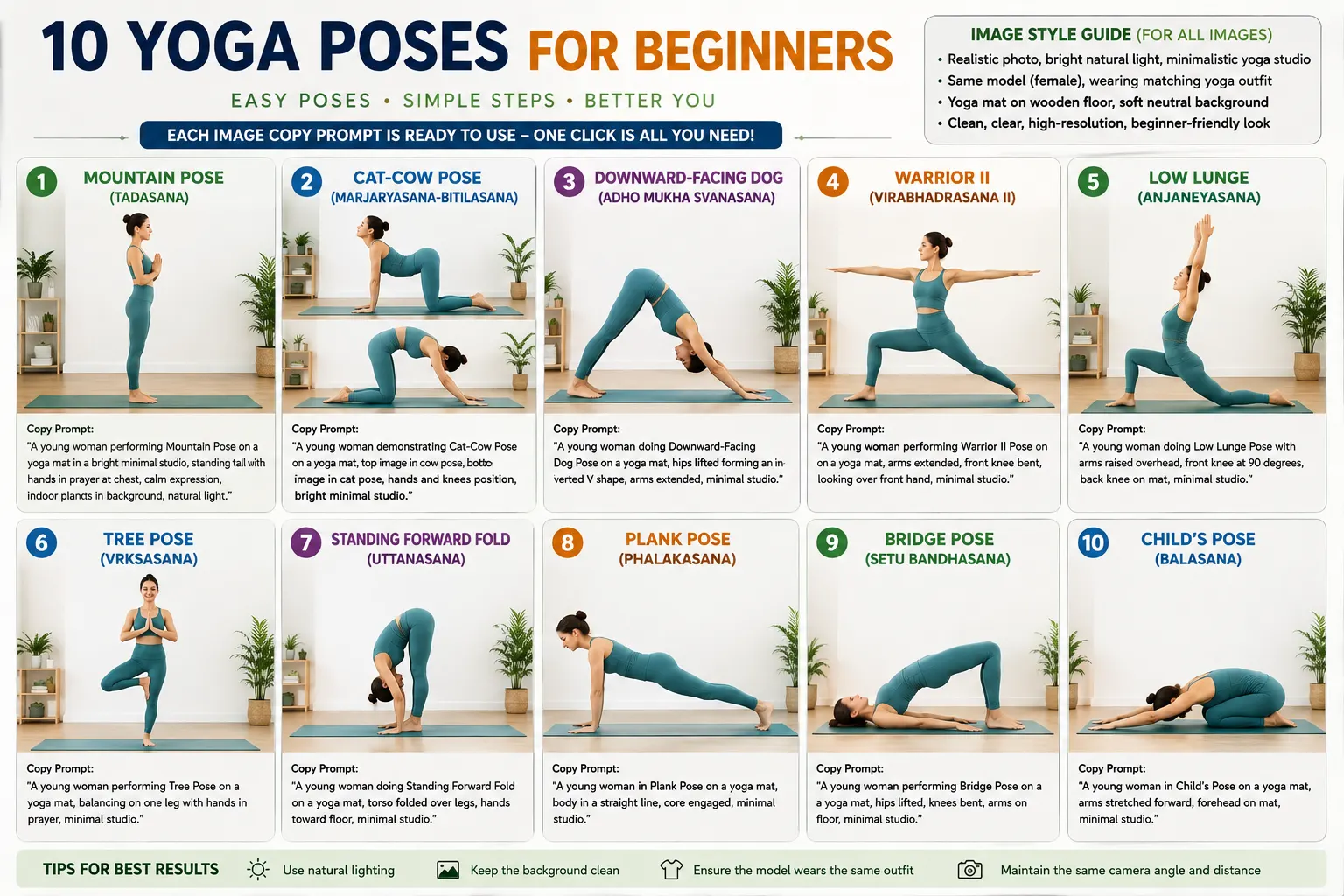
If you are new to yoga, you do not need to be flexible or strong before you begin. I recommend starting with a small set of simple yoga poses, learning the basic movements, and then building a short routine that feels comfortable.
In this guide, I’ll show you 10 yoga poses for beginners, how to do each one, easier options, common mistakes, and how to put the poses together into a simple beginner yoga routine. I’ll also explain basic yoga alignment, breathing, and which style of yoga may suit you best.
What Should Beginners Know Before Starting Yoga?
I think beginners often make yoga harder than it needs to be. You do not have to copy an advanced practitioner or force your body into a certain shape.
When I recommend a beginner yoga practice, I focus on four simple things:
- Move slowly and stay in control.
- Keep breathing throughout each pose.
- Use modifications when a pose feels too difficult.
- Stop if you feel sharp or unusual pain.
Your first goal is to become comfortable with the basic movements. Flexibility, balance, and strength can improve as you continue practicing.
You also do not need a large collection of equipment. A yoga mat can make practice more comfortable, while blocks, straps, blankets, a wall, or a sturdy chair can provide extra support.
10 Yoga Poses for Beginners

Here is a quick look at the poses in this guide:
| Yoga pose | Main focus | Beginner-friendly option |
| Mountain Pose | Posture and balance | Practice near a wall |
| Cat-Cow | Spine movement | Use a smaller range of motion |
| Downward-Facing Dog | Full-body movement | Keep the knees bent |
| Warrior II | Legs and balance | Use a shorter stance |
| Low Lunge | Hip and leg mobility | Place the back knee on a blanket |
| Tree Pose | Balance | Keep toes on the floor |
| Standing Forward Fold | Back of the legs | Bend the knees |
| Plank Pose | Core and upper-body strength | Keep knees on the mat |
| Bridge Pose | Hips and legs | Lift the hips only a little |
| Child’s Pose | Rest and relaxation | Place a blanket under the hips |
You do not need to perform all 10 poses during your first session. Start with a few that feel comfortable and add more as you gain confidence.
1. Mountain Pose

Mountain Pose, also called Tadasana, is a simple standing position that helps you pay attention to your posture and balance.
Stand with your feet about hip-width apart. Let your arms rest naturally beside your body and relax your shoulders.
Spread your weight evenly across both feet. Gently lengthen your spine and keep your chin in a neutral position.
Take several slow breaths while standing still.
I like Mountain Pose as a starting point because there is very little movement. That gives a beginner time to focus on posture and breathing.
Common mistake: Do not push your chest forward or tense your shoulders.
Easy option: Practice beside a wall if you feel unsteady.
2. Cat-Cow Pose

Cat-Cow is a gentle movement between two positions. It can help you get your spine moving before you move into standing or strength-based poses.
Start on your hands and knees. Keep your hands under your shoulders and your knees under your hips.
As you breathe in, gently lift your chest and tailbone while allowing your belly to move down.
As you breathe out, round your back and gently bring your head toward the floor.
Repeat the movement slowly for several breaths.
Common mistake: Do not force your spine into a deep curve.
Beginner tip: Make the movement smaller if your back feels stiff.
3. Downward-Facing Dog

Downward-Facing Dog is one of the most common yoga poses. It combines movement through the shoulders, arms, hips, legs, and back.
Start on your hands and knees. Tuck your toes under and slowly lift your knees while raising your hips toward the ceiling.
Keep your back long. Your knees can stay bent if your legs feel tight.
Your heels do not need to reach the floor. I would focus on keeping your back comfortable instead of trying to make your legs completely straight.
Keep your head relaxed between your arms and breathe normally.
Common mistakes:
- Trying to force the heels down
- Rounding the back
- Locking the knees
- Holding the breath
- Putting too much weight into the hands
Easy option: Keep your knees bent and shorten the pose if needed.
4. Warrior II

Warrior II, or Virabhadrasana II, is a standing yoga pose that works on leg strength, balance, and control.
Stand with your feet wide apart. Turn one foot outward and bend that knee while keeping the other leg straight.
Extend your arms out to the sides at about shoulder height. Keep your chest facing the long side of your mat.
Look over your front hand and breathe steadily.
Stay for several comfortable breaths before straightening the front leg and repeating the pose on the other side.
Common mistake: Do not let your front knee collapse inward.
Easy option: Use a shorter stance and do not bend the front knee as deeply.
5. Low Lunge

Low Lunge is a useful pose for beginners who want to work on hip and leg mobility.
Start on your hands and knees. Step one foot forward between your hands.
Lower your back knee onto the mat. Keep your front foot stable and your front knee comfortable.
You can keep your hands on the floor, place them on yoga blocks, or rest them on your front thigh.
Take a few slow breaths, then return to the starting position and change sides.
Common mistakes:
- Forcing the hips forward
- Letting the front foot become unstable
- Trying to make the lunge deeper than feels comfortable
Easy option: Put a folded blanket under the back knee.
6. Tree Pose

Tree Pose, or Vrksasana, is a simple balance pose that can help beginners practice stability and concentration.
Start in Mountain Pose. Shift your weight onto one foot.
Place the other foot against your ankle or lower leg. Do not press the foot directly against the side of your knee.
Bring your hands together in front of your chest or keep them at your sides.
Choose one point in front of you to look at while you balance.
Common mistake: Trying to balance without support when you are still learning.
Easy option: Keep the toes of your raised foot on the floor and place the heel against your ankle.
You can also stand next to a wall or chair.
7. Standing Forward Fold

Standing Forward Fold is a simple way to stretch the back of the legs while allowing plenty of room for modification.
Start standing with your feet about hip-width apart. Bend your knees slightly and hinge from your hips.
Lower your upper body and let your hands rest on your thighs, shins, yoga blocks, or the floor.
Your knees can remain bent throughout the pose.
I would rather see a beginner bend the knees and keep the movement comfortable than force the legs straight just to reach the floor.
Common mistake: Trying to touch the floor at all costs.
Easy option: Place your hands on yoga blocks or keep your knees bent.
8. Plank Pose

Plank Pose adds a simple strength exercise to a beginner yoga routine.
Start on your hands and knees. Step one foot back and then the other until your body forms a long line.
Keep your hands under or slightly in front of your shoulders. Engage your core gently and avoid letting your hips drop toward the floor.
Hold the position for a few breaths, then lower your knees.
Common mistakes:
- Dropping the hips
- Raising the hips too high
- Holding the breath
- Locking the elbows
- Trying to hold the pose for too long
Easy option: Keep your knees on the mat while maintaining a straight line from your knees through your shoulders.
9. Bridge Pose

Bridge Pose is performed on your back and gives you a simple way to add lower-body and core work to your practice.
Lie on your back with your knees bent and your feet flat on the mat.
Keep your feet about hip-width apart and place your arms beside your body.
Press your feet into the floor and slowly lift your hips. Keep the movement controlled rather than trying to lift as high as possible.
Lower your hips slowly and rest before repeating.
Common mistake: Turning the movement into a deep backbend.
Easy option: Lift your hips only a small amount and focus on controlled movement.
10. Child’s Pose

Child’s Pose is one of my favorite options for giving beginners a place to rest during a yoga session.
Start on your hands and knees. Slowly move your hips back toward your heels and lower your upper body toward the mat.
You can extend your arms forward or let them rest beside your body.
Keep your knees together or separate them if that feels more comfortable.
Take several slow breaths and allow your shoulders to relax.
Common mistake: Forcing your hips all the way back to your heels.
Easy option: Place a folded blanket or cushion under your hips or knees for extra support.
Which Yoga Poses Are Best for Different Goals?

You do not need to practice every pose equally. I find it easier for beginners to choose poses based on what they want to work on.
| Your goal | Beginner poses to try |
| Improve balance | Tree Pose |
| Gentle spine movement | Cat-Cow |
| Work the legs | Warrior II |
| Build core strength | Plank Pose |
| Work on hip mobility | Low Lunge |
| Full-body movement | Downward-Facing Dog |
| Gentle stretching | Standing Forward Fold |
| Relaxation | Child’s Pose |
| Basic posture | Mountain Pose |
| Lower-body strength | Bridge Pose |
This can also help you build a shorter routine. For example, if balance is your main goal, you can spend more time with Tree Pose instead of trying to fit every pose into one session.
Which Type of Yoga Is Best for Beginners?
There is no single yoga style that works for everyone. I would choose a style based on how much movement you want and how comfortable you feel as a beginner.
| Yoga style | What beginners can expect |
| Hatha yoga | Slower practice with time to work on individual poses |
| Gentle yoga | Easier movements and a relaxed pace |
| Restorative yoga | Supported poses with a strong focus on rest |
| Vinyasa yoga | More continuous movement between poses |
| Yin yoga | Longer, quieter holds with less active movement |
If you are completely new, Hatha or gentle yoga may feel easier because you usually have more time to learn each position.
If you want a calm practice with more support, restorative yoga may be a better fit.
I would not worry about choosing the perfect style on your first try. A beginner-friendly class or session can help you learn what type of practice you enjoy.
What Does Alignment Mean in Yoga?
Alignment simply means placing your body in a stable and controlled position.
It does not mean every person’s body needs to look exactly the same. Your proportions, flexibility, strength, and mobility can affect how a pose looks.
For example, in Warrior II, I would focus on keeping the front knee controlled and tracking in line with the direction of the toes.
In Standing Forward Fold, I would rather bend my knees and keep my back comfortable than force my legs straight just to reach the floor.
Good alignment should help you control the pose. It should not become a reason to force your body into a position that feels wrong.
How Should Beginners Breathe During Yoga?
Breathing is part of the practice, but beginners do not need complicated breathing techniques.
I recommend breathing slowly and naturally while learning the basic poses. Avoid holding your breath, especially during strength-based positions such as Plank.
For movement-based poses such as Cat-Cow, you can coordinate your breathing with the movement. If that feels confusing at first, simply keep a steady breath and focus on learning the position.
The main goal is to stay relaxed enough to control the movement.
Which Yoga Poses Should Beginners Learn First?
If you are completely new to yoga, I would not start with all 10 poses.
A simple starting order is:
- Mountain Pose to learn basic standing posture.
- Cat-Cow to gently move the spine.
- Child’s Pose to learn a comfortable resting position.
- Downward-Facing Dog to introduce a full-body pose.
- Warrior II to practice standing strength and balance.
- Tree Pose when you are ready to work on balance.
- Low Lunge for gentle hip and leg mobility.
- Standing Forward Fold for a simple stretch.
- Plank for basic strength.
- Bridge Pose to finish the active part of the session.
You can start with the first four or five and slowly add the others.
How I Would Build a Beginner Yoga Routine

Once you know the basic poses, you can connect them into a short sequence.
Here is a simple routine I would use for a beginner:
Step 1: Start With Mountain Pose
Stand quietly for several slow breaths. Relax your shoulders and pay attention to how your feet connect with the floor.
Step 2: Move Into Cat-Cow
Come onto your hands and knees. Move slowly between Cat and Cow for several repetitions.
Step 3: Try Downward-Facing Dog
Lift your hips and stay for a few comfortable breaths. Keep your knees bent if necessary.
Step 4: Add Low Lunge
Bring one foot forward and lower the opposite knee. Spend several breaths on each side.
Step 5: Practice Warrior II
Stand up and move into Warrior II on both sides. Keep the stance comfortable.
Step 6: Add Tree Pose
Practice balancing on each side. Use a wall if you need support.
Step 7: Add Plank
Hold a full plank or use the knees-down version for a few breaths.
Step 8: Practice Bridge Pose
Lie on your back and complete several slow bridge repetitions.
Step 9: Finish With Forward Fold
Move into a gentle Standing Forward Fold. Keep your knees bent if needed.
Step 10: Rest in Child’s Pose
Finish by resting in Child’s Pose and taking several slow breaths.
I prefer starting with fewer poses when someone is completely new. It gives you more time to learn the positions, pay attention to breathing, and notice how your body responds.
How Long Should a Beginner Yoga Session Be?
You do not need a long yoga session to get started.
A short session can be enough while you are learning the poses. You can gradually add more time as the movements become familiar.
I would focus on these three things rather than chasing a specific number of minutes:
- Can I breathe normally?
- Can I control the movement?
- Do I feel comfortable enough to continue?
If the answer is no, shorten the session or choose an easier version.
How Long Should You Hold Each Yoga Pose?
Hold time depends on the pose and your experience.
For simple poses, several slow breaths can be enough. Balance poses may need shorter holds, while a resting position such as Child’s Pose may feel comfortable for longer.
A simple beginner guide is:
| Type of pose | Beginner approach |
| Standing pose | Several comfortable breaths |
| Balance pose | Short hold on each side |
| Strength pose | Short controlled hold |
| Stretching pose | Stay only while comfortable |
| Resting pose | Spend a little longer if it feels good |
I would not worry about matching someone else’s hold time. Good breathing and control matter more than staying in a pose for a set number of seconds.
How Often Should Beginners Practice Yoga?
You do not have to practice yoga every day.
I prefer a schedule that you can actually maintain. A short, regular practice is more useful for building a habit than forcing yourself through long sessions that you cannot keep up with.
You can also change the type of practice from day to day.
For example:
- Day 1: Basic poses
- Day 2: Short mobility session
- Day 3: Rest
- Day 4: Beginner yoga routine
- Day 5: Gentle stretching
- Day 6: Short yoga session
- Day 7: Rest or easy movement
This is just an example. Your schedule can be shorter or longer depending on your time and goals.
What Equipment Do You Need for Yoga?
You can begin with very little equipment.
Yoga Mat
A mat gives you a stable surface and can make kneeling positions more comfortable.
Yoga Blocks
Blocks can bring the floor closer to you during poses such as Low Lunge and Forward Fold.
Yoga Strap
A strap can help you reach certain positions without forcing your body to stretch farther than it comfortably can.
Blanket
A folded blanket can provide extra padding under your knees or hips.
Wall or Chair
A wall or sturdy chair can provide support during balance poses such as Tree Pose.
You do not need to buy everything at once. Start with what you have and add props if they solve a real problem during practice.
Do You Need to Be Flexible to Do Yoga?
No. You can start yoga without being flexible.
This is one of the first things I would tell someone who feels nervous about trying yoga. Your flexibility does not have to match anyone else’s.
If your hamstrings are tight, bend your knees during Forward Fold. If you cannot reach the floor, use blocks. If your balance is poor, use a wall.
These changes do not mean you are doing yoga incorrectly. They simply make the pose fit your current ability.
7 Common Mistakes Beginners Should Avoid
There are a few mistakes I would watch for during your first yoga sessions:
- Forcing a stretch: Going deeper is not always better.
- Holding your breath: Keep breathing naturally during the pose.
- Trying to copy advanced practitioners: Your body may need a different position.
- Ignoring pain: Stop if you feel sharp or unusual pain.
- Starting with difficult poses: Build basic control before trying advanced movements.
- Skipping modifications: Use blocks, blankets, walls, or easier versions when needed.
- Focusing only on appearance: A pose does not need to look perfect to be useful.
When Should You Modify or Skip a Pose?
Modify a pose whenever the standard version feels too difficult, unstable, or uncomfortable.
For example, you can:
- Bend your knees during Forward Fold.
- Keep your knees on the floor during Plank.
- Use a wall during Tree Pose.
- Place a blanket under your knees during Low Lunge.
- Use blocks when your hands cannot comfortably reach the floor.
- Reduce the depth of a lunge or squat.
- Rest in Child’s Pose when you need a break.
If you have an injury, are pregnant, have a medical condition, or have concerns about whether a particular pose is suitable for you, get individual guidance before starting that movement.
How Can You Improve as a Beginner?
Once the basic poses become familiar, I would focus on improving control rather than immediately moving to advanced poses.
A simple progression looks like this:
Learn the position → improve your breathing → improve your control → stay comfortable for longer → add small challenges → learn harder poses
For example, you might first practice Tree Pose with your toes touching the floor. Later, you can lift the foot higher while keeping your balance.
The same idea works with Plank, Downward-Facing Dog, Warrior II, and other beginner yoga poses.
Beginner Yoga Pose Mistakes: Quick Reference
| Pose | Mistake to avoid | Better approach |
| Mountain Pose | Tensing the shoulders | Relax the shoulders |
| Cat-Cow | Forcing the spine | Use a gentle range |
| Downward Dog | Forcing heels down | Keep knees bent |
| Warrior II | Knee falling inward | Keep knee aligned with toes |
| Low Lunge | Forcing the hips forward | Move only as far as comfortable |
| Tree Pose | Standing without support too soon | Use a wall |
| Forward Fold | Forcing straight legs | Bend the knees |
| Plank | Holding too long | Use a short controlled hold |
| Bridge | Lifting too high | Use a comfortable height |
| Child’s Pose | Forcing hips to heels | Add a blanket or cushion |
Final Thoughts
The best yoga poses for beginners are not necessarily the most difficult ones. They are the poses that help you learn basic movement, breathing, balance, strength, and body control without making the practice unnecessarily hard.
I would start with four or five poses, practice them regularly, and add more as they become familiar. Use props and modifications whenever you need them, and give yourself time to improve.
You do not need to become flexible before starting yoga. You can start where you are, choose poses that match your current ability, and build your practice from there.
Frequently Asked Questions
What are the best yoga poses for beginners?
Some useful starting poses include Mountain Pose, Cat-Cow, Downward-Facing Dog, Warrior II, Low Lunge, Tree Pose, Standing Forward Fold, Plank, Bridge Pose, and Child’s Pose. You can start with just a few and add more as you become comfortable.
What yoga poses should beginners learn first?
I would start with Mountain Pose, Cat-Cow, Downward-Facing Dog, and Child’s Pose. These give you a simple introduction to standing, mobility, full-body movement, and rest.
What is the easiest yoga pose for beginners?
Mountain Pose and Child’s Pose are two simple places to start. Cat-Cow is also easy to learn because it uses a slow movement between two basic positions.
Can a complete beginner do yoga?
Yes. Beginners can start with simple poses and use modifications to make them easier. You do not need previous yoga experience or advanced flexibility.
Can I do yoga at home?
Yes. You can practice many beginner yoga poses at home with a small clear space and a comfortable surface. A mat, wall, chair, blocks, or blanket can provide extra support.
How long should a beginner yoga session be?
Start with a length that lets you practice without losing control or becoming overly tired. Short sessions are fine while you learn the basic movements.
How long should I hold a yoga pose?
Start with several comfortable breaths for many basic poses. Balance and strength poses may need shorter holds, while resting poses can be held longer if they feel comfortable.
Do I need to be flexible to start yoga?
No. You can begin yoga at any flexibility level. Use bent knees, blocks, straps, or other modifications to make poses fit your current mobility.
Should yoga hurt?
Yoga should not require you to push through sharp or unusual pain. If a pose hurts, stop, rest, or change the position.
Do beginners need a yoga mat?
A yoga mat is useful, but you do not need an expensive mat to begin. The main goal is to have a stable and comfortable surface for your practice.
How often should beginners do yoga?
Choose a schedule you can maintain. A short and consistent practice can be a better starting point than trying to complete long sessions before you are ready.
