


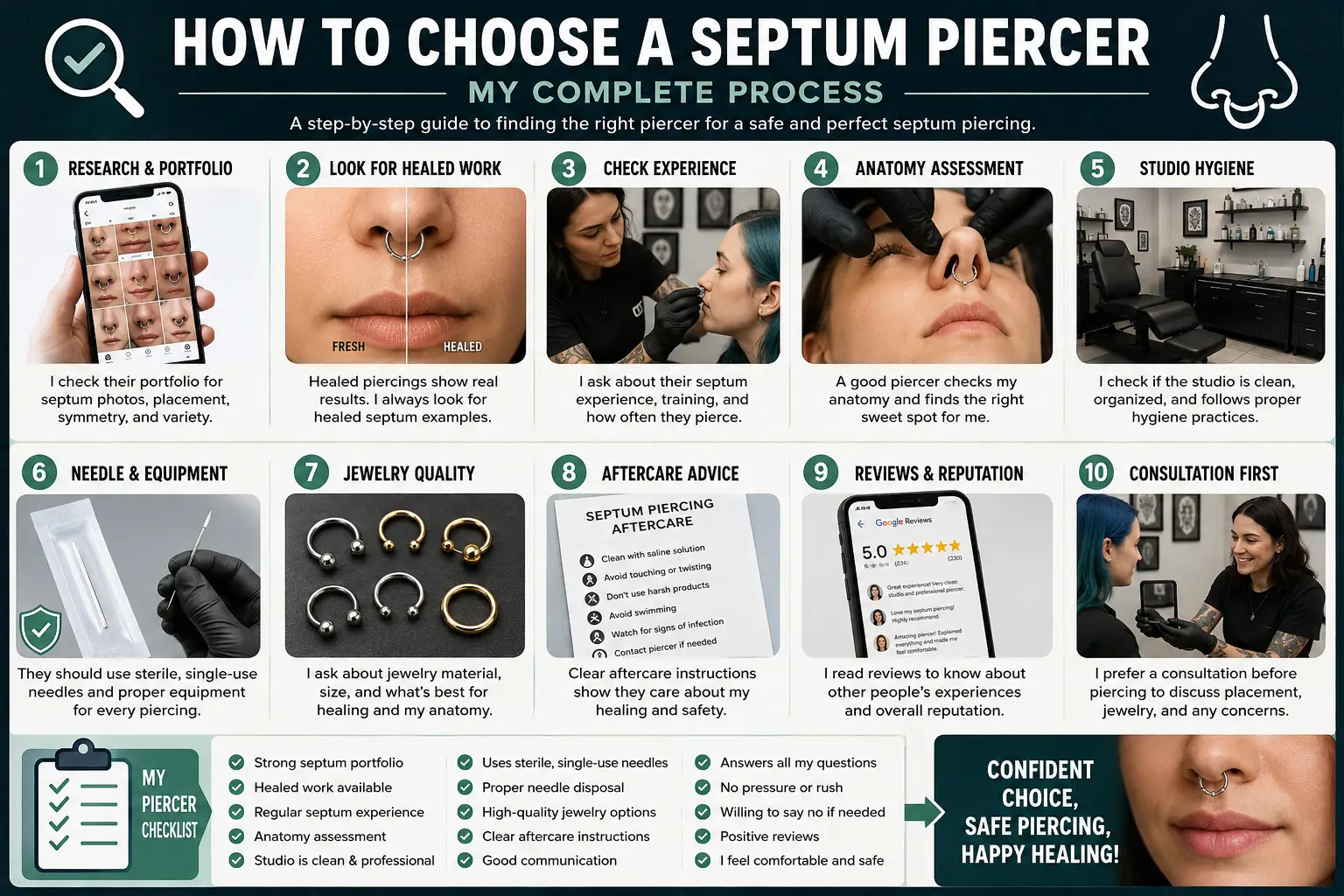
Choosing a septum piercer is something I would take seriously. A septum piercing may look like a simple piercing, but placement depends on the shape and tissue inside your nose.
I would not choose a piercer just because they have good reviews or charge less. I would look at their septum work, ask about their experience, check the studio, and make sure they inspect my anatomy before doing anything.
Here is exactly what I would look for when choosing a septum piercer.
What Makes a Good Septum Piercer?

For me, a good septum piercer should have more than basic piercing skills. I would want someone who has plenty of experience with septum piercings and can show me their work.
I would look for a piercer who:
- Has a strong septum piercing portfolio
- Shows both fresh and healed results
- Checks my nasal anatomy before piercing
- Explains where the piercing will sit
- Uses sterile, single-use needles
- Works in a clean studio
- Uses suitable body jewelry
- Gives clear aftercare instructions
- Answers my questions without rushing me
- Is willing to say no if my anatomy is not suitable
A professional piercer should also be comfortable discussing the procedure, jewelry, risks, healing, and aftercare before taking my money.
1. I Would Look at Their Septum Portfolio

This would be one of my first checks.
I would search the piercer’s website and social media for actual septum piercing photos. I would not assume that someone who does great ear or nostril piercings will automatically be great at septums.
I want to see several septum examples.
I would look at:
- Placement
- Jewelry position
- Symmetry
- Different nose shapes
- Fresh piercings
- Healed piercings
- Recent work
I would also look for consistency. If most of the septum piercings in the portfolio look well placed, that gives me more confidence.
2. I Would Look for Healed Septum Piercings

Fresh photos can be useful, but healed photos tell me more.
A fresh piercing can look different because of temporary swelling and irritation. Once the piercing has healed, I can get a better idea of how the jewelry sits.
So if I were choosing a piercer, I would ask:
Can I see some healed septum piercings you have done?
I would not expect every healed piercing to look identical. Everyone has different nasal anatomy, and jewelry can also change the final appearance.
What I want to see is good placement that suits the person’s nose.
3. I Would Check Their Septum Experience
I would ask how often they perform septum piercings.
There is a big difference between someone who does a septum once in a while and someone who works with them regularly.
Some simple questions I would ask are:
- How long have you been piercing?
- How often do you do septum piercings?
- How did you learn piercing?
- Do you have specific training in anatomy?
- Can I see examples of your healed septum work?
I would not expect the piercer to have one specific certificate that makes them automatically good.
Practical experience, anatomy knowledge, safe technique, and good results all matter.
4. I Would Make Sure They Check My Anatomy

This is one of the biggest things I would look for.
A septum piercing should not be placed in exactly the same spot on every person.
Before piercing, the piercer should inspect the inside of my nose and consider my individual anatomy.
They may look at:
- The shape of my septum
- Available tissue
- The septum sweet spot
- The position of my nostrils
- Any noticeable deviation
- Previous scar tissue
- Previous nose surgery
- Where the jewelry will sit
I would be concerned if someone agreed to pierce me without checking my anatomy first.
5. I Would Ask About the Septum Sweet Spot
I would not tell the piercer exactly where to put the needle.
Instead, I would ask them to show me where they think the piercing should go based on my anatomy.
The area often called the septum sweet spot is an important part of septum placement.
It is also why I would avoid choosing a piercer based only on a low price.
If you want to learn more about the anatomy itself, my article on Septum Piercing Sweet Spot covers that topic in more detail.
6. I Would Tell the Piercer About Previous Nose Problems
I would mention anything that could affect my septum anatomy.
For example, I would tell them if I have:
- A deviated septum
- Previous nose surgery
- An old septum piercing
- Scar tissue
- A previous nose injury
I would rather give the piercer too much useful information than leave something out.
If I had a deviated Septum, I would also read my guide to Septum Piercing With a Deviated Septum before booking.
If I had nose surgery, I would check my guide on Septum Piercing After Nose Surgery as well.
7. I Would Check the Studio Before Booking

The piercer matters, but the studio matters too.
When I visit or research a studio, I would look for signs that the place is clean and organized.
I would pay attention to:
- The piercing room
- Hand-washing facilities
- Gloves
- Sterile equipment
- Needle disposal
- General cleanliness
- Jewelry storage
- How staff handle equipment
I would also want the actual piercing room to be separate from areas where people eat, drink, or handle unrelated items.
8. I Would Ask How They Handle Needles

This is a question I would not feel embarrassed to ask.
A fresh piercing should be performed with a new, sterile, single-use piercing needle.
The needle should be disposed of after use in an appropriate sharps container.
I would want to see that the piercer takes the sterile needle from its packaging as part of the setup.
I would also be concerned if someone suggested using a piercing gun for a septum.
I would simply leave and find another studio.
9. I Would Ask About Jewelry

The piercer is responsible for more than making the piercing.
They also need to help me choose suitable initial jewelry.
I would ask:
- What material is the jewelry?
- Is it suitable for a fresh piercing?
- What size would you recommend?
- Is the surface smooth?
- What styles can I start with?
- Is the jewelry internally threaded or threadless?
I would not choose jewelry only because it looks good in a picture.
The jewelry needs to fit my anatomy and work well for a new piercing.
A good studio should have enough jewelry options to fit different body shapes and piercing needs.
10. I Would Ask About Aftercare
Before I leave the studio, I would want clear instructions about caring for my new septum piercing.
I would ask:
- How should I clean it?
- What should I avoid?
- How long should I expect healing to take?
- Should I move the jewelry?
- When should I contact you if something seems wrong?
- When can I change the jewelry?
I would also want the instructions in writing so I can check them later.
Clear aftercare advice is part of the service I would expect from a professional piercer.
Questions I Would Ask a Septum Piercer

If I were booking my first septum piercing, I would save these questions on my phone:
- How long have you been piercing?
- How often do you perform septum piercings?
- Can I see your healed septum work?
- How do you check septum anatomy?
- What happens if my anatomy is not suitable?
- What jewelry do you use for fresh septum piercings?
- What jewelry materials do you offer?
- How do you sterilize reusable equipment?
- Are the piercing needles single-use?
- What aftercare do you recommend?
- Can I have a consultation before booking?
- What should I expect during the appointment?
I would pay attention to how the piercer answers, not just the answers themselves.
If they are patient and happy to explain things, that would make me feel more comfortable.
How I Would Judge a Piercer’s Portfolio
I would not scroll through a portfolio for five seconds and book immediately.
I would look more closely.
I would check the number of septum examples
One or two photos are not enough for me.
I would prefer to see several examples.
I would look at different noses
A piercer should have experience working with different types of nasal anatomy.
I would check the placement
The jewelry should look naturally placed rather than obviously forced into an awkward position.
I would look for healed results
These give me a better idea of the long-term result.
I would check whether the photos are actually their work
I would want to know that the portfolio belongs to the piercer I am considering.
Reviews Matter, But I Would Not Rely on Them Alone
Reviews can help me learn about the studio.
They can tell me about things such as:
- Customer service
- Cleanliness
- Communication
- Appointment experience
- Waiting times
- Staff attitude
But reviews do not always tell me whether the septum placement was good.
Someone might leave a five-star review because the piercer was friendly.
That does not prove the piercing itself was well placed.
So I would use reviews to judge the overall experience, while using the portfolio to judge the piercer’s actual septum work.
Should I Choose an APP Piercer?
I would consider APP membership a useful sign, but I would not use it as my only test.
I would still check:
- Septum portfolio
- Healed results
- Anatomy assessment
- Studio hygiene
- Jewelry quality
- Communication
- Experience
If an APP member near me has excellent septum work and follows good studio practices, I would certainly consider them.
Why I Would Trust a Piercer Who Says No
This might sound strange, but I would actually feel better if a piercer told me they could not safely perform the piercing.
Not every person has the same anatomy.
A piercer may inspect my septum and decide that the available tissue is not suitable for the placement I want.
I would rather hear:
I don’t think this is safe for your anatomy.
than:
Sure, we can do it.
A piercer who refuses an unsuitable piercing may be showing that they care more about the result than making a quick sale.
Red Flags I Would Watch For

I would leave if I noticed several of these warning signs:
- The piercer does not check my anatomy
- They cannot show me septum work
- They have no healed examples
- The studio looks dirty
- They do not explain the procedure
- They rush me into the chair
- They refuse to answer questions
- They use poor-quality jewelry
- They cannot explain how equipment is sterilized
- The needle is not clearly single-use
- They do not provide aftercare instructions
- They promise everyone the exact same placement
- They pressure me because of a discount
- They agree to pierce unsuitable anatomy without discussion
I would trust my gut here.
If I feel uncomfortable before the piercing, I can always leave.
Should I Choose the Cheapest Septum Piercer?
I would not make price my main factor.
A very cheap piercing may look attractive, but I would first ask what is included.
The price can reflect:
- Piercer experience
- Studio costs
- Jewelry quality
- Location
- Safety procedures
- Consultation
- Aftercare support
At the same time, I would not assume that the most expensive piercer is automatically the best.
I would compare the quality of the whole service, not just the price.
For me, good septum work, safe practices, suitable jewelry, and clear communication would matter more than saving a few dollars.
Should I Have a Consultation First?
I would book a consultation if I had any doubts about my anatomy or placement.
I would especially consider one if I had:
- A deviated septum
- Previous nose surgery
- Previous septum piercing
- Scar tissue
- Concerns about symmetry
- Questions about jewelry
- Anxiety about the procedure
A consultation also gives me a chance to meet the piercer before committing.
If I do not feel comfortable during the consultation, I do not have to continue with the piercing.
My Septum Piercer Checklist
Before I book, this is the checklist I would use:
| What I Check | What I Want |
| Septum portfolio | Several good examples |
| Healed work | Yes |
| Septum experience | Regularly performs septum piercings |
| Anatomy check | Yes |
| Consultation | Available |
| Studio | Clean and organized |
| Needle | New and sterile |
| Needle disposal | Proper sharps container |
| Jewelry | Suitable quality and fit |
| Aftercare | Clear written instructions |
| Communication | Patient and helpful |
| Pressure | None |
If most of these boxes are checked, I would feel much more comfortable booking.
My Final Advice
If I were choosing a septum piercer, I would spend more time researching the piercer’s actual septum work than looking for the cheapest appointment.
I would check their portfolio, look for healed results, ask about their experience, and make sure they inspect my anatomy before piercing.
I would also look closely at the studio and ask about sterile equipment and jewelry.
Most of all, I would pay attention to how the piercer treats me. A good piercer should be willing to answer questions, explain the placement, and tell me no if my anatomy is not suitable.
For me, that is a much better way to choose a septum piercer than simply searching for the highest-rated studio.
FAQs
How do I choose a good septum piercer?
I would look for a piercer with plenty of septum experience, a strong portfolio, healed examples, good studio hygiene, suitable jewelry, and a clear anatomy consultation.
Should I look at a septum piercer’s portfolio?
Yes. I would specifically look for several septum examples rather than judging the piercer by their ear or other body piercings.
Should I look for healed septum piercing photos?
Yes. Fresh photos can look different because of temporary swelling. Healed photos give me a better idea of the piercer’s long-term results.
What questions should I ask a septum piercer?
I would ask about their septum experience, anatomy checks, healed portfolio, jewelry materials, sterile equipment, aftercare, and what they would do if my anatomy is unsuitable.
How important is septum anatomy?
It is very important because the shape and tissue inside the nose vary from person to person. A professional should check your anatomy before deciding on placement.
Is an APP piercer always the best choice?
APP membership can be a useful sign, but I would still check the person’s actual septum work, studio practices, jewelry, and communication.
How much should a septum piercing cost?
Prices vary by location, piercer, jewelry, and studio. I would compare the quality of the complete service rather than choosing based only on the lowest price.
What is the biggest red flag when choosing a septum piercer?
For me, refusing to check anatomy would be a major red flag. I would also avoid a studio with poor hygiene, unclear needle handling, weak septum work, or a piercer who refuses to answer questions.
Should I book a consultation before a septum piercing?
I would, especially if I have a deviated septum, previous nose surgery, scar tissue, or concerns about placement.
What if a piercer says I cannot get a septum piercing?
I would ask why and consider getting a second opinion from another reputable piercer with strong septum work. I would not pressure someone into piercing unsuitable anatomy.
How do I know if a septum piercer is experienced?
I would look for regular septum work, a large portfolio, healed examples, knowledge of anatomy, and a willingness to explain their process before the piercing.
