


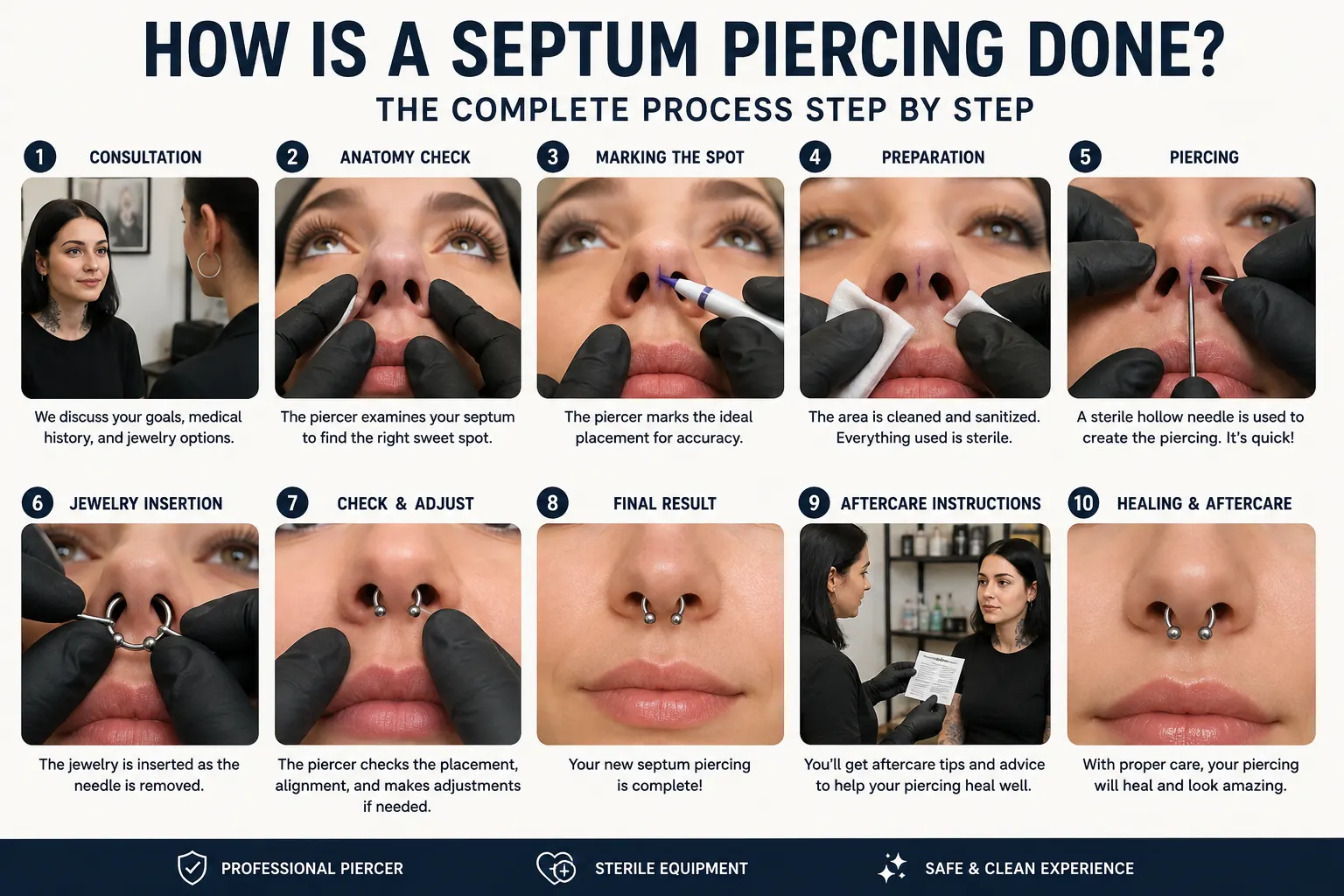
A septum piercing may look simple, but there is more to it than putting a needle through the nose. I think the most useful thing to know before getting one is what actually happens during the appointment.
A professional piercer first checks the shape and tissue inside the nose. They then choose the right spot, prepare the area, make the piercing with sterile equipment, insert the jewelry, and explain how to care for it afterward.
I would always choose a professional piercer for this. I would never try to pierce my own septum because the placement depends on individual anatomy, and a poorly placed piercing can cause more pain and healing trouble.
What Is a Septum Piercing?
A septum piercing is a body piercing placed in the tissue at the front of the nasal septum, the structure that separates the two nostrils.
The piercing is usually placed in an area that piercers often call the sweet spot. This area is different from person to person, so a piercer needs to check the nose before deciding where the jewelry should go.
One thing I would keep in mind is that a septum piercing is not simply about finding the middle of the nose from the outside. The piercer needs to check the tissue from inside the nostrils.
Where Does a Septum Piercing Go?
A properly placed septum piercing goes through suitable tissue near the front of the nose.
Many people think the needle should pass straight through the thick cartilage in the center of the nose. That is not what I would expect from a well-planned piercing.
The piercer looks for the area of tissue that can safely hold the jewelry. This is often called the septum sweet spot.
The exact location can vary because everyone’s nasal anatomy is different.
If you want a full explanation of the placement itself, I would cover that in a separate article about the Septum Piercing Sweet Spot rather than repeating the whole topic here.
How Is a Septum Piercing Done?

The exact technique can vary from one professional piercer to another. Some piercers work freehand, while others may use professional tools to help hold or support the tissue during the procedure. Healthline’s septum piercing guide
Here is how I would expect a professional appointment to go.
1. I Would Start With a Consultation

Before the actual piercing, I would expect the piercer to ask me a few questions.
They may ask about:
- Previous nose surgery
- A deviated septum
- Previous piercings
- Skin or healing problems
- Current irritation or infection
- The type of jewelry I want
- Whether I want to hide the piercing sometimes
This part may be quick, but I would not want a piercer to skip it completely.
It gives the piercer a chance to spot anything that could affect the piercing.
2. The Piercer Checks My Anatomy
This is one of the most important parts of the whole process.
The piercer needs to look at the inside of my nose and check the available tissue.
They are looking at things such as:
- The shape of my septum
- The position of the softer tissue
- The thickness of the tissue
- The shape of my nostrils
- Any noticeable deviation
- Previous scar tissue
- The amount of space available for jewelry
I would want the piercer to check my anatomy before agreeing to the piercing.
A good piercer should not assume that every person’s septum can be pierced in exactly the same place.
3. We Discuss the Piercing Placement

Once the piercer checks my anatomy, we would discuss where the piercing should sit.
I would like to know what the planned placement will look like.
This is also the time to mention if I care about things such as:
- A high-looking septum
- A centered appearance
- Hiding the jewelry
- Wearing a horseshoe
- Wearing a ring later
- Flipping the jewelry up
The jewelry I plan to wear can also affect the placement.
I would rather discuss these things before the piercing than after it.
4. The Piercer Prepares the Area

Before the piercing, the area needs to be cleaned and prepared.
The piercer should use clean gloves and sterile equipment. A professional setup should also include proper handling and disposal of the piercing needle.
The inside of the nostrils is cleaned so the piercing area is as clean as possible.
This is one of the things I would pay attention to when choosing a studio.
If the setup looks dirty or the piercer does not seem to follow basic hygiene practices, I would leave.
5. I Would Get Into Position
The piercer will have me sit or recline in a position that gives them a clear view of my nose.
I would try to stay still and breathe normally.
At this point, the piercer may check the placement again before starting.
That final check matters because even a small change in position can affect how the jewelry sits.
6. The Piercer Makes the Piercing

Once the placement is ready, the piercer uses a sterile piercing needle to create the piercing channel.
The exact technique depends on the piercer and my anatomy.
Some professionals may use forceps, while others may work without them. A receiving tube can also be used in some techniques.
I would not focus too much on which tool is used. What matters more to me is that the piercer knows what they are doing and uses proper sterile equipment.
The actual piercing itself is usually very quick.
I would expect a short pinch or sharp pressure rather than a long-lasting sensation.
7. My Eyes May Water
This is something I would be prepared for.
My eyes may water during a septum piercing.
That does not automatically mean something has gone wrong. The nose is a sensitive area, and tearing can happen as a natural response to stimulation around the nose.
So if my eyes watered during the piercing, I would not panic.
It can happen even when the procedure is quick.
8. The Jewelry Is Inserted

After the piercing channel has been made, the initial jewelry is inserted.
The jewelry follows the newly created channel as the needle is removed.
Common septum jewelry includes:
- Circular barbells
- Horseshoe rings
- Septum clickers
- Captive bead rings
- Other jewelry made for septum piercings
For a fresh piercing, I would let the piercer choose an appropriate size and material based on my anatomy.
I would not choose jewelry simply because I like how it looks in a photo.
The size needs to work with my nose and give the new piercing enough room to heal.
9. The Piercer Checks the Jewelry
After the jewelry is in place, I would expect the piercer to check it.
They may look at:
- The position
- The angle
- The symmetry
- The amount of space around the jewelry
- Whether the jewelry sits comfortably
I would also look at it myself.
If I had questions about how it sits, this would be the time to ask.
What Does a Septum Piercing Feel Like?
The feeling can be different for each person.
I would expect a quick pinch or sharp pressure during the actual piercing, followed by some tenderness.
My eyes might also water.
I would not use someone else’s pain rating as a prediction for my own experience. Anatomy, placement, sensitivity, and the piercing technique can all affect how it feels.
Correct placement also matters. A piercing that does not use suitable tissue can be much more uncomfortable.
Does a Septum Piercing Go Through Cartilage?
A properly planned septum piercing is placed in the tissue selected by the piercer based on the person’s anatomy.
People often describe this area as the soft sweet spot, but anatomy is not identical for everyone.
That is why I would not expect a professional to use the same exact placement on every person.
If someone has a deviated septum, previous nose surgery, or unusual anatomy, the placement may need extra care.
Does the Piercer Use a Clamp?
Not always.
Different professional piercers use different techniques.
A piercer may use:
- A needle alone
- Forceps
- A receiving tube
- Other professional positioning methods
I would not judge the quality of a piercing based only on whether a clamp is used.
I would pay more attention to the piercer’s anatomy check, sterile setup, communication, and placement.
How Long Does a Septum Piercing Take?
The actual piercing is very quick.
The full appointment takes longer because the piercer needs time to:
- Talk with me
- Check my anatomy
- Discuss placement
- Prepare the area
- Perform the piercing
- Insert the jewelry
- Explain aftercare
So I would not expect the whole appointment to take only the few seconds needed for the needle.
The preparation is part of the process.
What Should a Professional Piercing Studio Look Like?
If I were choosing a studio, I would pay attention to the basic setup.
I would look for:
- A clean workspace
- Clean disposable gloves
- Sterile single-use needles
- Proper handling of sterile equipment
- A clean piercing area
- Safe disposal of used needles
- Clear aftercare instructions
- A piercer who checks anatomy before piercing
I would also look at the piercer’s previous work.
For a septum piercing, I would want to see healed examples if possible.
What Should Make Me Leave a Piercing Studio?
There are a few things that would make me uncomfortable.
I would leave if:
- The piercer refuses to check my anatomy
- The workspace looks dirty
- The needle does not appear sterile
- The piercer rushes me
- I am not allowed to ask questions
- The piercer cannot explain the placement
- They pressure me into getting pierced
- They offer to pierce me despite unsuitable anatomy
I would rather lose a deposit or waste a trip than get a piercing from someone I do not trust.
How I Would Prepare for a Septum Piercing
Before my appointment, I would keep things simple.
I would choose the piercer carefully
I would look for someone with plenty of septum work in their portfolio.
I would ask about anatomy
I would ask whether they check the septum before piercing.
I would think about my jewelry
I would have an idea of the style I like, but I would let the piercer help me choose the right starting size.
I would tell them about previous nose problems
If I had a deviated septum, previous nose surgery, or an old piercing, I would mention it.
I would avoid rushing
If the piercer told me my anatomy was not suitable, I would listen.
Not every person has the same septum anatomy, and getting a piercing is not worth forcing an unsuitable placement.
What Happens Right After a Septum Piercing?

Once the jewelry is in, the piercer should explain basic aftercare.
I would expect some tenderness at first.
The new piercing should be treated gently while it heals.
I would avoid unnecessary touching, pulling, twisting, or playing with the jewelry.
I would also follow the cleaning instructions given by my piercer.
The main thing I would avoid is treating a fresh piercing like healed skin.
Can I Flip My Septum Jewelry Up After Getting Pierced?
Some types of septum jewelry can be flipped up inside the nose.
That is one reason many people like septum piercings.
However, I would ask my piercer about this before moving the jewelry.
Repeatedly moving fresh jewelry can irritate a new piercing.
If I needed to keep the piercing hidden from the start, I would tell my piercer before the procedure so we could choose suitable jewelry and a plan.
What If My Septum Is Deviated?
A deviated septum does not automatically mean I cannot get a septum piercing.
However, it can affect the available anatomy and how centered the jewelry looks.
This is another reason I would want an experienced piercer to examine my nose before making a decision.
I would not try to solve the placement problem myself.
If you have a deviated septum, my separate article on Septum Piercing With a Deviated Septum can cover that situation in more detail.
What If I Have Had Nose Surgery?
I would tell my piercer about it.
Septoplasty, rhinoplasty, and other nose procedures can change the tissue inside the nose.
If I had nose surgery, I would make sure the area had healed and ask my doctor or surgeon if there were any concerns before getting pierced.
My separate article on Septum Piercing After Nose Surgery covers this situation in more detail.

What I Would Look for in a Good Septum Piercing
For me, the most important part would be the process rather than how fast the piercing is completed.
I would want a piercer who:
- Checks my anatomy first
- Explains the planned placement
- Uses sterile equipment
- Answers my questions
- Does not rush me
- Chooses suitable jewelry
- Gives clear aftercare instructions
- Is willing to say no if my anatomy is not suitable
A good septum piercing starts before the needle ever touches the skin.
Common Mistakes I Would Avoid
Choosing a piercer only because they are cheap
Price would not be my main factor.
I would care more about experience, hygiene, placement, and healed results.
Asking for a specific spot without an anatomy check
I would not tell a piercer exactly where to put the needle.
I would explain how I want the finished jewelry to look and let them assess the anatomy.
Choosing jewelry only for its appearance
A beautiful ring is not useful if the size or material is wrong for a fresh piercing.
Touching the jewelry too much
I would leave it alone as much as possible.
Trying to pierce myself
This is one mistake I would avoid completely.
A septum piercing requires knowledge of anatomy and sterile technique. A professional piercer can also recognize when the anatomy is unsuitable.
Final Thoughts
When I look at how a septum piercing is done, the needle is actually only one small part of the appointment.
The important work starts with the anatomy check.
A professional piercer needs to assess the tissue, discuss placement, prepare the area, use sterile equipment, insert suitable jewelry, and explain aftercare.
I would also remember that every nose is different. The ideal placement for one person may not be the right placement for another.
If I were getting a septum piercing, I would focus on finding a skilled piercer who takes time with the anatomy instead of someone who promises to do it as quickly as possible.
That would give me much more confidence in the final result.
FAQs
How is a septum piercing done?
A professional piercer first checks your nasal anatomy and chooses suitable placement. The area is then prepared, a sterile piercing needle is used to create the channel, and the initial jewelry is inserted.
Where does the needle go for a septum piercing?
The needle is placed in suitable tissue at the front of the nasal septum. The exact location depends on your anatomy and should be chosen by a professional piercer.
Does a septum piercing go through cartilage?
The exact tissue involved depends on individual anatomy. A professional piercer checks the nose and chooses appropriate placement rather than assuming the needle should pass through the thick central cartilage.
Does getting a septum piercing hurt?
I would expect a quick pinch or sharp pressure during the piercing, followed by some tenderness. Pain varies from person to person.
Why do your eyes water during a septum piercing?
The nose is a sensitive area, so stimulation during the piercing can cause the eyes to water. This can happen even when the piercing is performed correctly.
Does a piercer use a clamp for a septum piercing?
Not always. Some piercers use forceps, while others work freehand or use another professional tool. The technique can vary.
How long does a septum piercing take?
The actual piercing is very quick, but the complete appointment takes longer because the piercer needs to check your anatomy, prepare the area, insert jewelry, and explain aftercare.
Can everyone get a septum piercing?
Not everyone has the same anatomy. A professional piercer should check whether your nose has suitable tissue and placement before agreeing to the piercing.
Can I get a septum piercing with a deviated septum?
Possibly. A deviated septum can affect placement, so I would have an experienced piercer check my anatomy before getting pierced.
Can I flip a new septum piercing up?
Some septum jewelry can be flipped up, but I would ask the piercer about this before moving fresh jewelry. Repeated movement can irritate a new piercing.
What should I do after getting a septum piercing?
I would follow the aftercare instructions from my piercer, keep the area clean, avoid unnecessary touching, and leave the jewelry alone as much as possible while it heals.
Should I pierce my septum at home?
I would not. Septum piercing involves anatomy, sterile equipment, and precise placement. I would have it done by a trained professional instead.
