


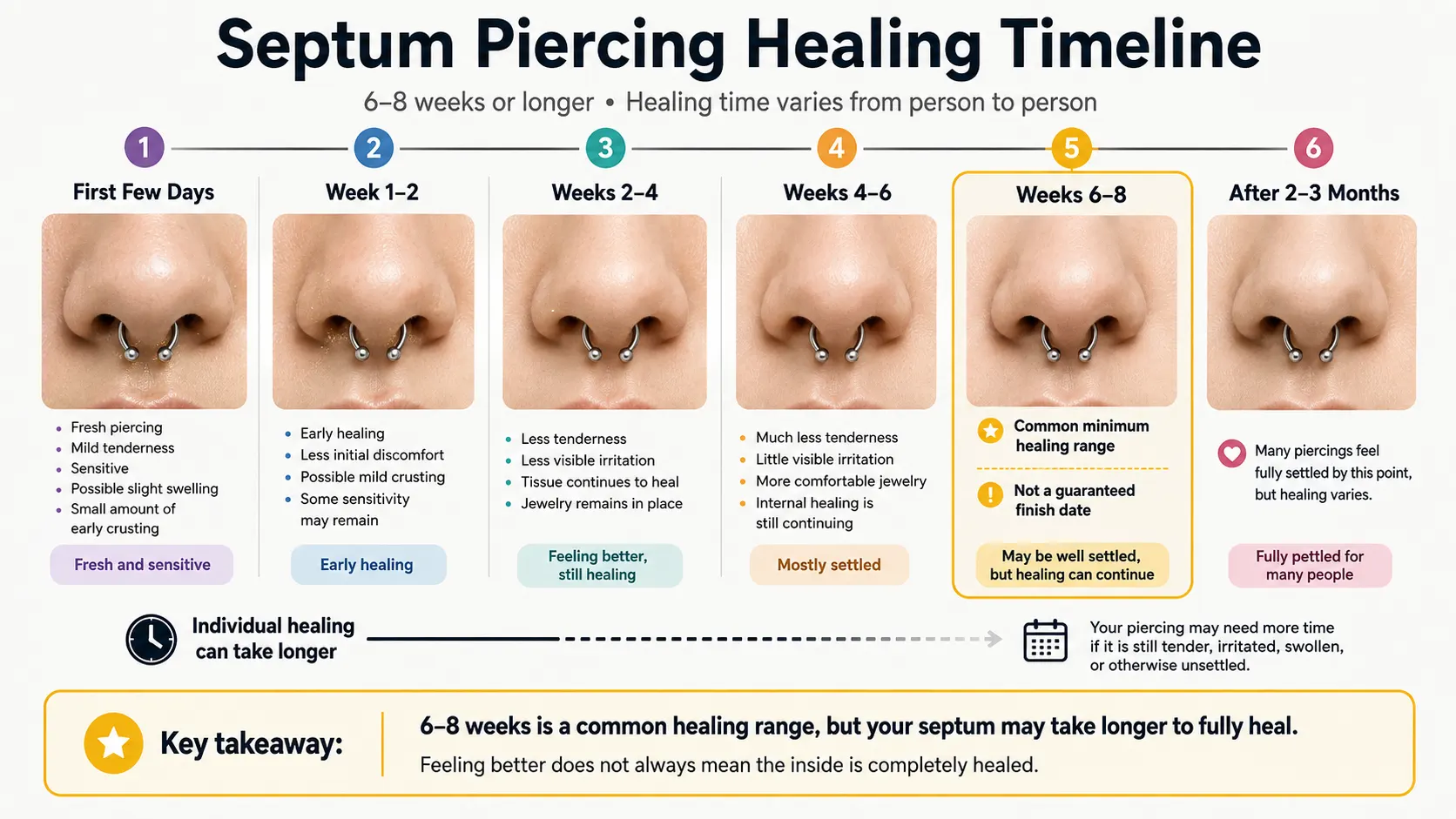
The first thing I would want to know before getting a septum piercing is how long I have to wait before it is fully healed.
A septum piercing can start feeling much better within several weeks, but that does not mean the inside is fully healed. The Association of Professional Piercers lists 6–8 weeks or longer as the average healing time for a septum piercing. Healing can take longer depending on the person and how well the piercing is cared for.
So, if you are asking how long does a septum piercing take to heal, I would not use one exact date for everyone.
For me, the better way to look at it is in stages. A piercing may feel fine on the outside while the tissue inside is still healing.
How Long Does a Septum Piercing Take to Heal?
A septum piercing can take at least 6–8 weeks to heal, but some take longer.
The 6–8 week range is often used as a basic healing estimate. However, it does not mean every septum piercing is completely healed as soon as eight weeks pass.
The body heals at different speeds. Your anatomy, piercing placement, jewelry, aftercare, and how much irritation the piercing receives can all affect the healing process.
I would treat 6–8 weeks as a point where the piercing may be much more settled, rather than a guaranteed finish line.
So, how long does it take for a septum piercing to heal completely?
There is no exact number that applies to everyone.
Some people may find that their septum feels comfortable and settled after the minimum healing period. Others may still have tenderness or irritation and need more time.
That is why I would not change jewelry or stop caring for the piercing just because a certain number of weeks has passed.
Is 6–8 Weeks Enough for a Septum Piercing?
It can be enough for the basic healing period, but I would not assume that every septum piercing is fully healed at six or eight weeks.
This is where a lot of confusion comes from.
A piercing can look healed before it is fully healed inside. The tissue heals from the outside inward, so the surface can look normal while the inside is still fragile.
I would pay more attention to how the piercing feels and how it has been behaving than to the calendar alone.
If it is still sore, irritated, swollen, or producing ongoing discharge, I would give it more time instead of rushing to change the jewelry.
Septum Piercing Healing Timeline

Here is how I would think about the healing process.
The first few days
The first few days are usually when the piercing feels the newest.
I would expect some tenderness and sensitivity. There may also be a small amount of swelling, bleeding, or crust around the jewelry.
My nose might feel strange when I move it or accidentally touch the jewelry.
I would avoid judging the final healing time based on these first few days. The piercing is a fresh wound, so some early irritation is expected.
Week 1 to 2

During the first couple of weeks, the septum may start feeling better.
I might still notice:
- Mild tenderness
- Crusting around the jewelry
- Itching
- Sensitivity
- Occasional irritation
- Mild swelling
The piercing may look much better at this point, but I would still treat it as a healing piercing.
I would not twist or spin the jewelry just to see whether it feels better.
Weeks 2 to 4
This is the stage where I might start forgetting that I have a new piercing.
That can be a good sign, but it can also make it easy to become careless.
I might stop noticing the tenderness, but the piercing channel is still developing and can be irritated by unnecessary movement.
I would continue normal care and avoid playing with the jewelry.
Weeks 4 to 6
By this point, many people may find that their septum feels much more comfortable.
I would still avoid assuming that the piercing is fully healed.
It can feel normal for several days and then become tender again after being bumped, moved, or irritated.
That does not automatically mean something is wrong. It can simply mean the tissue is still settling.
Weeks 6 to 8
This is an important point in the healing timeline because 6–8 weeks is the commonly listed minimum range for a septum piercing.
If mine felt completely comfortable at this point, I would still be careful with it.
I would look for signs such as:
- No ongoing tenderness
- No swelling
- No repeated irritation
- No unusual discharge
- No pain when the area is gently touched
Even then, I would not rush a jewelry change without making sure the piercing is actually ready.
After 2–3 months
Some septum piercings may feel fully settled by this stage.
Others may still need more time.
This is why I would not compare my healing timeline with a friend’s. Two people can get septum piercings on the same day and have very different healing experiences.
How Do I Know If My Septum Piercing Is Healed?

I would look at several signs rather than using the number of weeks alone.
A septum piercing is more likely to be well healed when:
- It is no longer tender
- There is no ongoing swelling
- The skin looks calm
- There is no persistent irritation
- There is no unusual discharge
- The jewelry sits comfortably
- Normal movement does not cause soreness
But I would still be careful.
A piercing can feel completely fine on the surface while the internal tissue is not fully mature yet. This is one reason I would avoid rushing into jewelry changes.
Can a Septum Piercing Look Healed Before It Is Fully Healed?
Yes.
This is one of the most useful things to know about a new piercing.
When I look at the outside, everything may appear normal. There may be no swelling, redness, or obvious irritation.
That does not prove that the piercing channel inside has finished healing.
Piercing tissue heals from the outside inward. Because of this, a piercing can seem healed while the deeper tissue remains fragile.
So I would not use appearance alone to decide that my septum is completely healed.
What Can Make a Septum Piercing Take Longer to Heal?

A few things can slow the process or cause repeated irritation.
Touching the jewelry
I would avoid touching my septum unless I need to clean it.
Hands can introduce dirt and bacteria, and repeated movement can irritate the healing tissue.
Moving or twisting the jewelry
There is no reason to rotate the jewelry during cleaning.
In fact, unnecessary movement can irritate the piercing and prolong healing.
Bumping the nose
This can be surprisingly easy.
I might bump my nose while changing clothes, washing my face, sleeping, or wiping my nose.
Repeated bumps can keep a healing piercing irritated.
Changing jewelry too soon
I would not change the jewelry just because the piercing has reached six weeks.
If the initial jewelry needs a change because of its size, style, or material, I would have a qualified piercer handle it.
Otherwise, I would leave it alone until it has had enough time to heal.
Poor aftercare
Over-cleaning can be just as irritating as not cleaning properly.
I would avoid harsh products such as alcohol and hydrogen peroxide. A sterile saline wound wash is commonly recommended for healing piercings.
Poor placement
The position of the piercing can affect how well it heals.
This does not mean that every slow-healing septum is badly placed. However, if I had ongoing problems, I would have the piercing assessed by an experienced professional.
Does Flipping a Septum Piercing Slow Healing?
Moving the jewelry up and down repeatedly can cause unnecessary irritation.
If I wanted to hide my septum piercing, I would discuss this with my piercer before getting it done.
Once the piercing is healing, repeatedly flipping the jewelry can put stress on the fresh tissue.
I would avoid treating the jewelry like something I need to move every day.
The less unnecessary movement, the better.
Can I Change My Septum Jewelry After 6 Weeks?

I would not automatically change it at six weeks.
Six weeks can fall within the minimum healing range, but that does not mean every septum piercing is ready for a jewelry change.
If the piercing is still tender or irritated, I would wait.
If a jewelry change is needed during healing, I would have a qualified piercer do it. The Association of Professional Piercers recommends leaving the initial jewelry in place during healing unless there is a problem with its size, style, or material.
I would also avoid removing the jewelry just to test whether the hole has healed.
A healing piercing can shrink quickly when jewelry is removed.
Why Is My Septum Piercing Still Sore?
Some tenderness can happen during healing, especially after the piercing has been bumped or irritated.
If mine were still slightly sore after several weeks, I would look at what might be causing the irritation.
For example:
- Am I touching it often?
- Am I moving the jewelry?
- Did I recently bump my nose?
- Am I using harsh cleaning products?
- Did I change the jewelry too soon?
- Is the jewelry causing pressure?
A piercing that is taking longer than expected does not automatically mean something is wrong.
However, pain that keeps getting worse would make me more cautious.
What Does Normal Septum Piercing Healing Look Like?

During healing, I might notice some mild crusting or a small amount of whitish or yellowish fluid around the jewelry.
That is not automatically pus or an infection.
Some itching, tenderness, and mild changes in the tissue can also occur during normal healing.
What I would watch for is a pattern of worsening symptoms rather than one small change.
If the area becomes increasingly painful, swollen, hot, or red, I would get it checked.
When Should I Worry About a Septum Piercing That Is Not Healing?
I would take the situation more seriously if the symptoms were getting worse instead of better.
Warning signs can include:
- Increasing or severe pain
- Significant swelling
- Increasing warmth
- Spreading redness
- Thick or unusual discharge
- Persistent bleeding
- Fever or feeling unwell
I would not try to diagnose an infection myself.
A qualified piercer can check the jewelry and placement, while a healthcare professional can assess symptoms that may need medical treatment.
Does Septum Piercing Placement Affect Healing Time?
It can.
Good placement matters because the piercing needs to pass through suitable tissue for the anatomy.
This is one reason I would choose an experienced piercer rather than focusing only on price.
However, I would not assume that slow healing automatically means poor placement.
People heal at different rates, and even a well-placed piercing can become irritated.
If I had ongoing problems, I would have someone experienced examine the piercing instead of guessing.
My Experience With Septum Piercing Healing Time
If I were judging my own septum piercing, I would not use one date as the finish line.
I would expect the first few weeks to involve some tenderness and crusting. By four to six weeks, I would hope it felt much calmer. Around six to eight weeks, I would see how it was behaving rather than assuming it was completely healed.
If everything felt good, I would still avoid unnecessary movement and continue treating it with care.
For me, the biggest mistake would be thinking, “It has been eight weeks, so I can do whatever I want now.”
Healing does not always work that neatly.
Final Thoughts
So, how long does a septum piercing take to heal?
A septum piercing has an average healing time of 6–8 weeks or longer, but the exact time varies from person to person.
I would treat six to eight weeks as a useful minimum range, not a guaranteed deadline. Some piercings settle quickly, while others need more time because of irritation, individual healing, placement, or other factors.
The best thing I can do is leave the jewelry alone, use gentle care, avoid unnecessary movement, and pay attention to how the piercing feels.
Most of all, I would not rush the healing process just because the outside looks fine.
FAQs
How long does a septum piercing take to heal?
A septum piercing is commonly listed as taking about 6–8 weeks or longer to heal. Some people need more time, so eight weeks should not be treated as a guaranteed finish date.
How long does it take for a septum piercing to heal completely?
There is no exact timeline for everyone. Some septum piercings may feel fully settled after the minimum healing period, while others can take longer.
Is 6 weeks enough for a septum piercing?
Not always. Six weeks falls within the minimum healing range, but I would look at the condition of the piercing rather than relying only on the calendar.
Is 8 weeks enough for a septum piercing?
It can be for some people, but not everyone. If the piercing is still sore, irritated, swollen, or producing unusual discharge, I would give it more time and have it checked if needed.
Can a septum piercing heal in 4 weeks?
I would not assume that a septum piercing is fully healed after only four weeks. It may feel much better by then, but the inside can still be fragile.
How do I know if my septum piercing is healed?
I would look for a lack of ongoing tenderness, swelling, irritation, and unusual discharge. However, feeling fine on the outside does not always mean the internal tissue is fully healed.
Can I change my septum jewelry after 6 weeks?
I would not change it automatically at six weeks. If the jewelry needs changing during healing, I would have a qualified piercer do it.
Why is my septum piercing still sore after 2 months?
It may still be healing or may have become irritated. I would check for repeated touching, jewelry movement, bumps, harsh cleaning products, or other sources of irritation.
Does touching a septum piercing slow healing?
Repeated touching and moving the jewelry can irritate the tissue and may prolong healing. I would leave it alone except when necessary for care.
Does flipping a septum piercing affect healing?
Repeatedly moving the jewelry can irritate a fresh piercing. If I needed to hide the jewelry, I would discuss the best option with my piercer before or during the appointment.
Can poor placement make a septum piercing take longer to heal?
Placement can affect how a piercing heals, but slow healing alone does not prove that placement is wrong. An experienced piercer can assess the piercing if there are ongoing problems.
Is crusting normal during septum piercing healing?
Some crusting can occur during normal healing. I would avoid picking it off and would follow gentle cleaning practices instead.
What should I do if my septum piercing is getting worse?
If pain, swelling, warmth, redness, or discharge is increasing, I would have it assessed. If I also had fever or felt unwell, I would seek medical care.
