


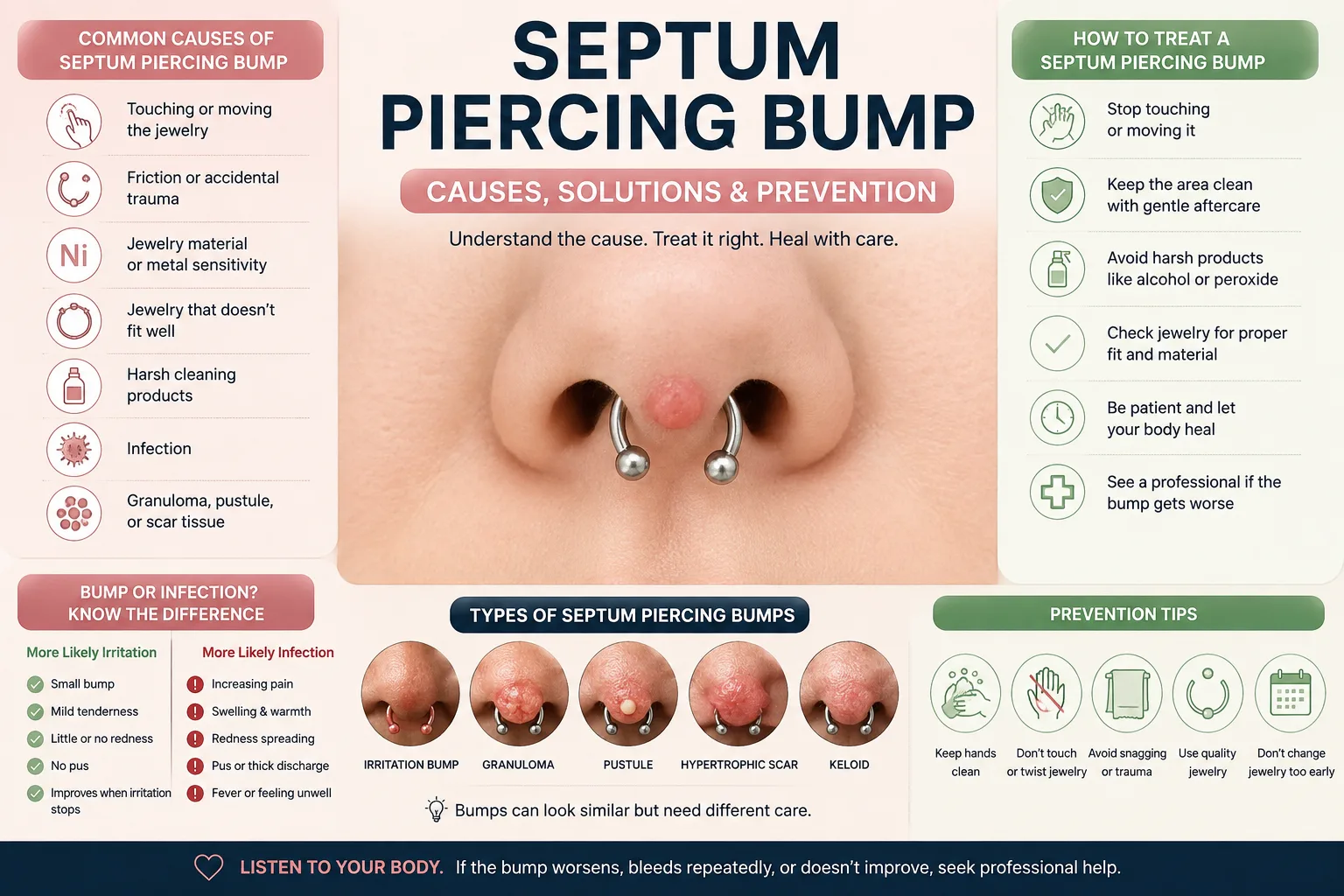
A septum piercing bump can be worrying, especially when it appears inside or around a new piercing. I know how easy it is to see a small lump and immediately think something has gone wrong.
But a bump does not always mean infection. It can come from irritation, friction, jewelry problems, an allergic reaction, a granuloma, a pustule, or scar tissue. An infection is another possibility, especially if the area becomes more painful, hot, swollen, or starts producing pus.
In this guide, I’ll explain the common causes of a septum piercing bump, what I would do about it, how to tell an irritation bump from other problems, and when I would get professional help.
Why Do I Have a Bump on My Septum Piercing?
When I notice a bump around a septum piercing, I first think about what may have irritated the area.
A piercing is a healing wound, so the tissue can react when it is rubbed, pulled, touched, or exposed to something that irritates it. Small raised areas can also develop during healing.
The common causes I would consider are:
- Irritation
- Repeated friction
- Moving or twisting the jewelry
- Accidental injury
- Jewelry that does not fit well
- Sensitivity to the jewelry material
- Granuloma or granulation tissue
- Pustule
- Infection
- Hypertrophic scar
- Keloid
The appearance of the bump alone does not always tell me what caused it. I look at other signs, such as pain, redness, warmth, discharge, bleeding, and whether the bump is getting smaller or larger.
What Does a Septum Piercing Bump Look Like?

A septum piercing bump can look different depending on its cause.
It may appear as:
- A small raised lump
- A red or pink bump
- A skin-colored bump
- A swollen area around the jewelry
- A soft bump
- A firm bump
- A pimple-like bump
- A bump that bleeds easily
- A bump that produces clear fluid
- A bump with pus
- A painful or tender lump
I would not try to diagnose the problem from appearance alone.
For example, an irritation bump and a small infection can both look red and swollen. A granuloma can also look like a small raised growth and may bleed or ooze easily.
What Causes a Septum Piercing Bump?

Irritation From Touching or Moving the Jewelry
One of the first things I check is how often I am touching the piercing.
I try not to twist, pull, push, or play with septum jewelry while the piercing is healing. Repeated movement can keep irritating the tissue and may stop a small bump from settling.
I also avoid touching the bump just to check whether it is still there.
Clean hands are important if I need to touch the area, but I try to keep unnecessary contact to a minimum.
Friction and Accidental Trauma
A septum piercing can become irritated after a small injury.
The jewelry can catch on a towel, clothing, a finger, or another object. I can also bump my nose while sleeping or accidentally pull the jewelry while cleaning it.
Even a small injury can make healing tissue swollen and tender.
If a bump appears after an obvious knock or pull, I give the area time to settle rather than repeatedly checking or moving the jewelry.
Jewelry Material or Metal Sensitivity
The jewelry itself can sometimes be part of the problem.
A reaction to certain metals can cause itching, redness, swelling, and a rash-like reaction. Nickel is one common cause of allergic reactions related to jewelry.
If I notice that the skin is very itchy or irritated around the jewelry, especially without the usual signs of infection, I would consider whether the material is causing the reaction.
I would ask a professional piercer about the jewelry material instead of changing it repeatedly myself.
Jewelry That Does Not Fit Well
Jewelry that is too tight can put pressure on healing tissue.
Jewelry that moves too much can also cause repeated friction.
If I keep getting a bump in the same place where the jewelry rubs or presses against the tissue, I would have the fit checked by an experienced piercer.
I would also avoid buying very cheap jewelry simply because it looks good. The material, size, shape, and finish all matter for a healing piercing.
Harsh Cleaning Products
I have learned that more cleaning is not always better.
Strong products can irritate healing tissue, especially when they are used repeatedly.
I avoid experimenting with alcohol, hydrogen peroxide, strong antiseptics, or other harsh products on a healing septum piercing.
I prefer simple, gentle care and avoid scrubbing the area.
Infection
An infection can also cause a bump.
I become more concerned when the bump is accompanied by increasing pain, swelling, warmth, strong redness, pus, or feeling unwell.
But I do not assume every bump is an infection.
If infection is my main concern, I treat that as a separate problem and get medical advice rather than trying random treatments at home.
For more detail, see Septum Piercing Infection: Signs and What to Do.
Granuloma or Granulation Tissue
A granuloma is another possible reason for a small bump.
It can develop as the body reacts to injury or a foreign material. Some granulomas can look pink, red, or darker and may ooze or bleed easily.
If I have a small bump that does not look like a typical infection but keeps coming back or bleeding easily, I would have it checked rather than trying to remove it myself.
Pustule
A pustule is a small, raised bump that can look similar to a pimple. It may contain pus or blood.
A pustule around a piercing can happen with irritation or infection, so I would pay attention to other symptoms too.
I would never squeeze or pop it. Trying to drain a piercing bump myself can cause more irritation and damage to the healing tissue.
Hypertrophic Scar
A hypertrophic scar is raised scar tissue that stays within the area of the original injury.
It can appear after the skin has been injured and may be raised, firm, itchy, or tender.
If I think a septum piercing bump is scar tissue, I would have a healthcare professional identify it before trying treatment.
Keloid
A keloid is different from an ordinary irritation bump.
It is a raised scar that grows beyond the original wound area and can continue to grow. Keloids can also feel firm, itchy, or uncomfortable.
If a bump keeps getting larger, feels firm, and seems to extend beyond the original piercing area, I would have a dermatologist check it.
Septum Piercing Bump vs Infection

This is where I try not to jump to conclusions.
A small bump can come from irritation, while an infection is more concerning when several signs appear together.
| More likely irritation | More concerning for infection |
| Small bump | Increasing swelling |
| Mild tenderness | Strong or increasing pain |
| Little or no warmth | Area feels hot |
| No spreading redness | Spreading redness |
| No pus | Thick pus |
| Improves when irritation stops | Keeps getting worse |
| No fever or feeling sick | Fever, chills, or feeling unwell |
A new piercing can have some tenderness, itching, slight redness, and pale fluid that forms a crust. Infection becomes more concerning when pain, swelling, heat, redness, pus, or feeling unwell increase.
If I am not sure which one I am dealing with, I would rather have it checked than guess.
For a full comparison, see Septum Piercing Infection vs Irritation.
Septum Piercing Bump vs Pustule

A pustule can look like a small white or yellow pimple near the piercing.
The important thing for me is that I do not squeeze it.
A bump that contains pus may be linked to an infection, but the bump alone does not tell me exactly what is happening. I also look for:
- Increasing pain
- Heat
- Swelling
- Spreading redness
- Thick discharge
- Fever
- Feeling unwell
If these signs appear, I would get medical advice.
If the bump is small and there are no signs of worsening infection, I avoid picking at it and keep my aftercare gentle.
Septum Piercing Bump vs Hypertrophic Scar
These two problems can look similar, but they are not the same.
Irritation Bump
An irritation bump is usually linked to an ongoing source of irritation.
Possible triggers include:
- Jewelry movement
- Friction
- Touching
- Accidental injury
- Poor jewelry fit
- Harsh cleaning products
If I remove the source of irritation and the bump starts settling, irritation becomes more likely.
Hypertrophic Scar
A hypertrophic scar is raised scar tissue that stays within the original injured area.
It can become firm or thick and may itch or feel tender. It may also take time to become less noticeable.
Keloid
A keloid grows beyond the original wound.
It can become firm and raised and may continue getting larger.
If I cannot tell whether a bump is an irritation bump, hypertrophic scar, or keloid, I would have a healthcare professional check it instead of trying to treat it myself.
How to Get Rid of a Septum Piercing Bump

The right approach depends on what caused the bump.
If I think it is an irritation bump, I focus on removing the source of irritation and giving the tissue time to settle.
My basic approach is:
- Look for the source of irritation.
- Stop touching or moving the piercing.
- Keep aftercare gentle.
- Avoid harsh products.
- Leave the jewelry alone.
- Watch for changes.
- Get professional help if the bump keeps growing or develops worrying symptoms.
Stop Touching the Bump
I avoid touching the bump unless I need to clean the area.
Picking at it can cause more injury and keep the tissue irritated.
I also avoid pressing it to see whether it hurts.
Avoid Moving the Jewelry
I leave the jewelry alone as much as possible.
Twisting, spinning, or pulling the jewelry can repeatedly disturb healing tissue.
If the jewelry feels too tight or keeps rubbing the area, I would have a professional piercer check it.
Keep Piercing Aftercare Gentle
I keep my cleaning routine simple.
I clean the piercing gently and avoid scrubbing the bump.
I also avoid cleaning it repeatedly throughout the day because constant handling can create more irritation.
For a full routine, see Septum Piercing Aftercare.
Avoid Harsh Products
I would not use alcohol, hydrogen peroxide, essential oils, strong antiseptics, or other harsh products on the bump.
I also would not use random acne treatments or homemade mixtures.
A product that is safe for normal skin is not automatically suitable for healing piercing tissue.
Check the Jewelry
If the bump keeps returning, I think about the jewelry.
I would check:
- Material
- Size
- Fit
- Shape
- Movement
- Whether it rubs the tissue
If I suspect a metal reaction or poor fit, I would ask an experienced piercer to inspect it.
Don’t Pop or Squeeze the Bump
I would never treat a septum piercing bump like a normal pimple.
Squeezing can damage the tissue and may make irritation worse.
I also avoid poking it with a needle or trying to drain it myself.
Don’t Keep Changing the Jewelry
If a bump appears, my first reaction might be to remove or replace the jewelry.
I would resist doing this repeatedly.
Taking jewelry out and putting new jewelry in can cause more trauma to the area. If I believe the jewelry itself is causing the problem, I would have a professional piercer check it.
If I suspect infection, I would get medical advice before deciding to remove the jewelry.
What Should I Not Put on a Septum Piercing Bump?

This is one area where I would keep things simple.
I would avoid putting these products on a healing septum piercing unless a healthcare professional has told me to use them:
- Rubbing alcohol
- Hydrogen peroxide
- Essential oils
- Undiluted tea tree oil
- Strong antiseptics
- Acne creams
- Harsh exfoliants
- Homemade chemical mixtures
I also would not keep trying different products every few days.
A healing bump needs time and gentle care. Constantly changing the routine can make it harder to tell what is helping and what is causing more irritation.
Why Did I Get a Septum Piercing Bump After Changing Jewelry?

A bump can appear after changing septum jewelry because the tissue may have been disturbed during the change.
Some possible reasons include:
- The piercing was changed too early.
- The jewelry was difficult to insert.
- The new jewelry is too tight.
- The new jewelry moves too much.
- The jewelry material irritates the skin.
- The jewelry has a rough or poor-quality surface.
- The area was injured during the change.
If I get a bump after changing jewelry, I avoid changing it again and again.
I would have the jewelry checked by a professional piercer, especially if it feels tight or keeps rubbing the piercing.
For more information about jewelry materials, see Best Metal for Septum Piercing Jewelry.
Why Did My Septum Piercing Bump Appear After an Injury?
A septum piercing bump can appear after the jewelry is pulled, caught, hit, or moved suddenly.
For example, I might snag the jewelry with a towel or accidentally hit my nose.
This type of trauma can irritate healing tissue and cause swelling or a raised area.
If the injury was minor, I would leave the piercing alone and return to gentle aftercare.
If there is heavy bleeding, severe pain, major swelling, or other worrying symptoms, I would seek medical help.
How Long Does a Septum Piercing Bump Take to Go Away?
There is no single healing time for every septum piercing bump.
The cause makes a big difference.
An irritation bump may start improving after I stop the irritation. A bump caused by an infection needs the right medical care. A granuloma may need assessment if it persists, while a keloid usually needs professional treatment rather than waiting for it to disappear.
So I would not rely on a fixed number of days or weeks.
Instead, I watch the trend.
If the bump becomes smaller, less red, and less tender, that is a good sign.
If it keeps growing, becomes painful, starts producing pus, or develops other worrying symptoms, I would get it checked.
Can a Septum Piercing Bump Go Away on Its Own?
Yes, some bumps can settle on their own.
If irritation is the main cause, removing the source of irritation may give the tissue a chance to heal.
But I would not assume every bump will disappear without treatment.
An infection, persistent granuloma, hypertrophic scar, or keloid can need professional attention.
That is why I focus on the cause instead of simply trying to make the bump disappear as quickly as possible.
Why Does My Septum Piercing Bump Keep Coming Back?
If a bump keeps coming back, I would look for an ongoing cause.
It could be:
- Repeated jewelry movement
- Friction
- Touching
- Jewelry that does not fit correctly
- Metal sensitivity
- Repeated trauma
- Over-cleaning
- Changing jewelry too often
A bump that disappears and returns can be a sign that the original source of irritation has not been fixed.
If I cannot find the cause or the bump keeps returning, I would have the piercing checked by a professional piercer or healthcare professional.
Should I Remove My Septum Jewelry Because of a Bump?
I would not automatically remove my septum jewelry just because a bump appeared.
If the jewelry is too tight, rubbing the tissue, or causing a reaction, I would have a professional piercer check it.
If I think the piercing is infected, I would get medical advice before removing the jewelry.
I also would not repeatedly remove and reinsert jewelry because that can disturb the healing tissue.
When Should I See a Doctor or Dermatologist?

I would get medical help if the bump:
- Keeps getting bigger
- Becomes very painful
- Becomes hot or very swollen
- Produces thick pus
- Has spreading redness
- Causes repeated bleeding
- Comes with fever
- Comes with chills
- Makes me feel unwell
- Does not improve
- Becomes hard and keeps growing
- Looks like it may be a keloid
I would also get help if I simply cannot tell what the bump is.
A healthcare professional can look at the area and decide whether it is an infection, scar tissue, granuloma, allergic reaction, or another problem.
If the bump is growing beyond the original piercing area, I would be especially careful because that can fit the pattern of a keloid rather than a simple irritation bump.
How to Prevent a Septum Piercing Bump

I cannot guarantee that I will never get a piercing bump, but I can reduce some common sources of irritation.
Choose an Experienced Piercer
I would choose an experienced professional who uses clean equipment and follows proper piercing practices.
I would never pierce my own septum.
Keep My Hands Clean
Before touching the piercing, I wash my hands.
I also avoid touching it when there is no reason to.
Avoid Excessive Cleaning
I keep the area clean, but I do not scrub it repeatedly.
Too much handling can become another source of irritation.
Don’t Twist the Jewelry
I leave the jewelry alone instead of spinning or moving it.
If I need to check the jewelry, I would rather have a professional look at it.
Protect the Piercing From Snagging
I try to avoid situations where towels, clothes, fingers, or other objects can catch the jewelry.
A small pull can be enough to irritate healing tissue.
Use Suitable Jewelry
I pay attention to the material and fit of my septum jewelry.
If I have metal sensitivity, I would discuss suitable jewelry materials with a professional piercer.
Don’t Change Jewelry Too Early
I do not change jewelry simply because the outside of the piercing looks better.
The inside can still be healing even when the piercing looks fine from the outside.
Final Thoughts

When I see a bump on a septum piercing, I do not immediately assume it is an infection.
I first look at what has been happening around the piercing. Have I been touching it too much? Has the jewelry been moving or rubbing? Did I accidentally pull it? Did the bump appear after changing the jewelry? Are there signs such as pus, increasing pain, warmth, or spreading redness?
A small irritation bump can be very different from an infection, granuloma, pustule, hypertrophic scar, or keloid.
I also avoid squeezing, cutting, or burning the bump. If it is getting bigger, becoming painful, producing pus, or simply refusing to improve, I would have it checked rather than trying one home remedy after another.
For me, the safest approach is simple: reduce irritation, leave the healing tissue alone, use gentle aftercare, and get professional help if the bump does not improve or shows signs of a more serious problem.
Frequently Asked Questions
Why is there a bump inside my septum piercing?
A bump can come from irritation, friction, jewelry problems, an allergic reaction, a granuloma, a pustule, infection, or scar tissue. I would look at other signs such as pain, warmth, redness, discharge, and how long the bump has been there.
Is a septum piercing bump normal?
A small bump can happen during the healing process, but I would not assume every bump is normal. If it keeps growing, becomes painful, produces pus, or comes with spreading redness or fever, I would get it checked.
How do I get rid of a septum piercing bump?
I would first look for the cause. If it seems related to irritation, I would stop touching or moving the jewelry, avoid harsh products, and keep aftercare gentle. If the bump persists or has signs of infection or abnormal scarring, I would seek professional help.
Is my septum piercing bump an infection?
It may be, but a bump alone does not prove infection. Increasing pain, swelling, warmth, spreading redness, pus, fever, chills, or feeling unwell make infection more concerning.
Can a septum piercing bump be a keloid?
It can be, but keloids are different from ordinary irritation bumps. A keloid can grow beyond the original wound area and continue getting larger. I would have a dermatologist check a bump that keeps growing or seems to extend beyond the piercing site.
Is a septum piercing bump inside the nose normal?
A small raised area can happen during healing, especially after irritation or minor trauma. But I would not ignore a bump that keeps growing, becomes painful, produces pus, or comes with other signs of infection.
How long does a septum piercing bump last?
There is no fixed time. An irritation bump may improve after the cause is removed, while infection, granuloma, hypertrophic scar, or keloid can take a different course.
Can I pop my septum piercing bump?
I would not. Squeezing or poking the bump can cause more irritation and tissue damage. If it looks like a pustule or contains pus, I would get professional advice instead of trying to drain it myself.
Should I remove my septum jewelry if I have a bump?
I would not remove it automatically. If I think the jewelry is causing irritation, I would have the fit and material checked. If I suspect infection, I would ask a healthcare professional before removing it.
Can jewelry cause a septum piercing bump?
Yes. Poor fit, repeated movement, friction, or sensitivity to the jewelry material can contribute to a bump. Nickel can also cause an allergic reaction in some people.
Why did I get a bump after changing my septum jewelry?
The change may have irritated the healing tissue. The new jewelry could also be too tight, move too much, have a rough surface, or contain a material that irritates your skin. I would stop changing the jewelry and have it checked by a professional piercer.
Why did my septum piercing bump come back?
A recurring bump can mean that the original source of irritation is still present. I would check for jewelry movement, friction, touching, poor fit, metal sensitivity, over-cleaning, or repeated trauma.
Can a septum piercing bump bleed?
Yes, some bumps can bleed easily, especially if the tissue is irritated or the bump is a type of granuloma. I would avoid touching or squeezing it. Repeated or heavy bleeding deserves professional attention.
When should I see a doctor about a septum piercing bump?
I would get medical help if the bump keeps growing, becomes very painful, produces pus, becomes hot or swollen, has spreading redness, causes repeated bleeding, or comes with fever, chills, or feeling unwell.
