


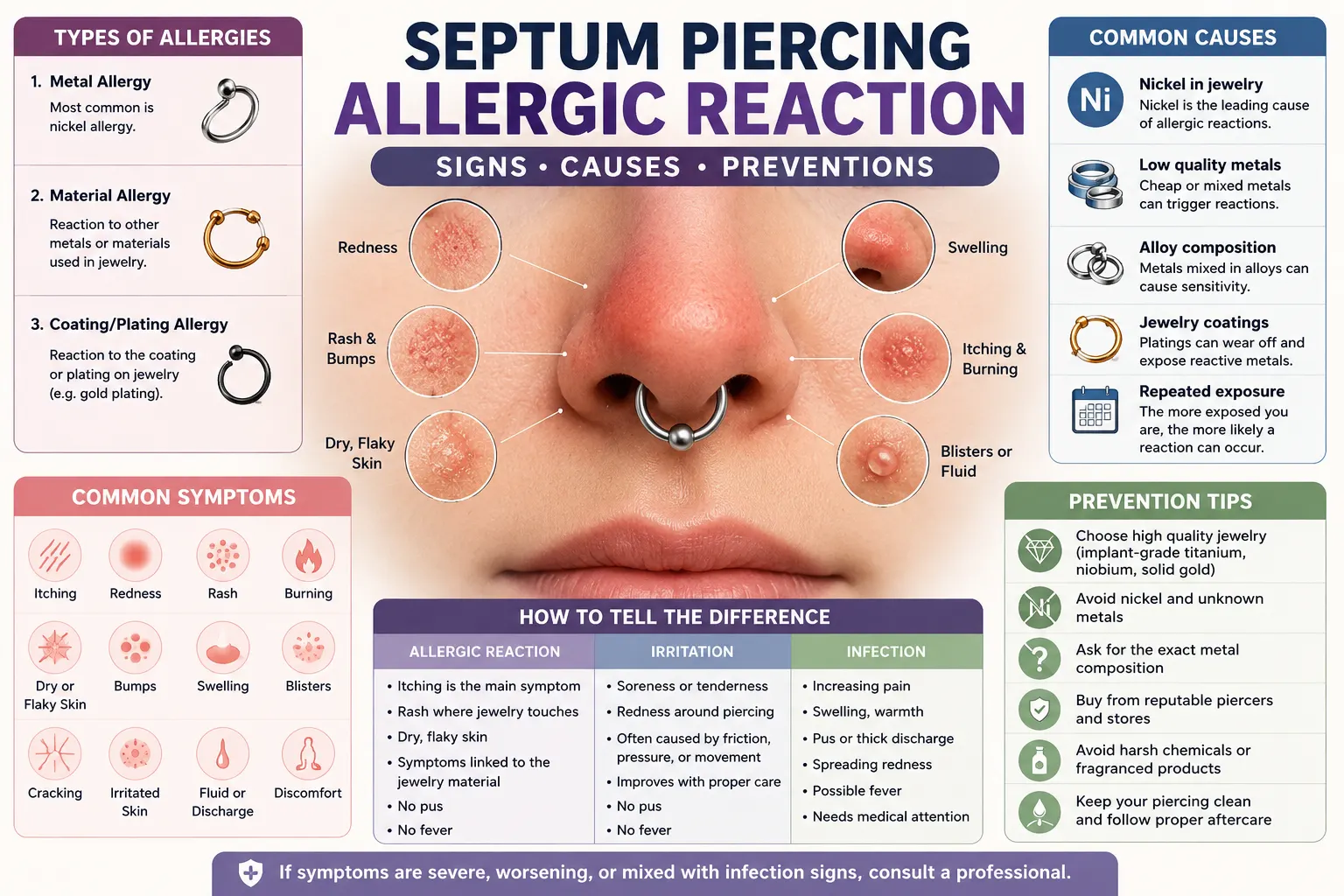
A septum piercing can look great, but I always pay attention to how my nose reacts to the jewelry. If I notice itching, redness, a rash, dryness, or burning around my septum piercing, I would not assume it is an infection right away.
Sometimes the problem is an allergic reaction to septum jewelry, especially if the jewelry contains nickel. Nickel is a common cause of allergic contact dermatitis, which can cause an itchy rash where the metal touches the skin.
The tricky part is that a septum piercing allergic reaction can look similar to irritation or infection. I would look at the full set of symptoms, when they started, and whether they seem connected to the jewelry.
In this guide, I will explain what a septum piercing allergy can look like, what can cause it, how I would tell it apart from irritation or infection, and what I would do if my septum jewelry caused a reaction.
Can You Be Allergic to a Septum Piercing?
Yes. You can have an allergic reaction to the jewelry used in a septum piercing.
The piercing itself is not usually the allergen. The reaction is more likely to come from a material in the jewelry. Nickel is one of the most common metals linked to allergic contact dermatitis and jewelry reactions.
If I had a fresh septum piercing and the area became very itchy, dry, red, or developed a rash where the jewelry touched, I would consider a metal allergy as one possible cause.
I would also remember that an allergic reaction does not always appear immediately. Contact dermatitis can develop hours or days after exposure.
What Does a Septum Piercing Allergic Reaction Look Like?

A septum piercing allergic reaction can cause several skin symptoms around the jewelry.
Common signs include:
- Itching
- Redness
- Rash
- Dry or flaky skin
- Burning
- Small bumps
- Swelling
- Irritated skin
- Cracking
- Blisters
- Fluid from irritated skin
Nickel allergy can cause an itchy rash, bumps, dry or cracked skin, and sometimes blisters or fluid.
Itching
Strong or ongoing itching is one of the signs that would make me think about an allergic reaction.
A healing septum piercing can feel sore or tender, but persistent itching around the area where the jewelry touches the skin can point to contact dermatitis.
Redness and Rash
A rash around the jewelry is another sign I would watch.
If the redness or rash follows the area that touches the jewelry, I would think about a possible metal allergy.
Burning
A burning or stinging feeling can happen with an allergic reaction, but it can also happen with simple irritation.
Because of that, I would not use burning alone to decide that I have a septum jewelry allergy.
Dry or Flaky Skin
Dry, flaky, thickened, or cracked skin can happen with a metal allergy.
If the skin around my septum became unusually dry after wearing a particular piece of jewelry, I would check what the jewelry is made from.
Bumps or Blisters
An allergic reaction can sometimes cause raised, swollen, or bumpy skin. More noticeable reactions can also produce blisters.
I would not assume that every septum piercing bump is an allergy, though. A bump can have several causes.
If the main issue is a persistent bump, I would look at Septum Piercing Bump: Causes and Treatment for a closer look.
Signs That Make Me Suspect a Septum Jewelry Allergy
If I were trying to work out whether my septum jewelry was causing an allergic reaction, I would look for a pattern rather than one symptom.
These signs would make me more suspicious of a jewelry allergy:
- The main symptom is itching.
- I have a rash where the jewelry touches.
- The skin is dry, flaky, or cracked.
- The reaction started after changing jewelry.
- The same reaction returns when I wear the same piece.
- I have a known nickel or metal allergy.
- The symptoms are mainly on the skin touching the jewelry.
- I do not have strong or increasing pain.
- I do not have fever or other signs of illness.
This does not prove that the problem is an allergy. It simply gives me a better reason to check the jewelry material.
If the same septum ring repeatedly causes a rash, I would stop treating it as a random irritation and look more closely at the metal.
What Causes an Allergic Reaction to Septum Jewelry?

The material used to make the jewelry is one of the first things I would check.
Nickel
Nickel is a common cause of allergic contact dermatitis. It is also a common concern with jewelry.
If I already knew that I had a nickel allergy, I would be especially careful about the material used for my septum ring.
I would look for nickel-free septum jewelry or another material that is suitable for my sensitivity rather than guessing.
Other Metal Allergies
Nickel is not the only possible trigger.
Some people can react to other metals or materials used in jewelry. This is why I would want to know the actual metal composition rather than relying only on a label such as metal or hypoallergenic.
Jewelry Coatings and Alloys
Some jewelry is made from an alloy, which means it contains more than one metal. Other pieces may have a coating over the base material.
If I had sensitive skin or a known metal allergy, I would ask exactly what the jewelry contains.
A clear material specification is much more useful than simply being told that a piece is hypoallergenic.
How I Would Check What My Septum Jewelry Is Made Of

If I suspected a septum ring allergy, checking the jewelry material would be one of my first steps.
I would:
- Ask the piercer what material was used.
- Check the jewelry packaging or product description.
- Look for the exact material specification.
- Ask whether the jewelry contains nickel.
- Avoid jewelry with an unknown metal composition.
- Ask about the grade and quality of the jewelry.
I would not rely only on words such as hypoallergenic or surgical steel.
If I had a known nickel allergy, I would want clear information about whether the jewelry contains or can release nickel.
If the jewelry material could not be confirmed, I would choose a reputable piercer or jewelry provider rather than guessing.
Can You Suddenly Become Allergic to Septum Jewelry?
Yes.
I would not assume that a piece of jewelry is safe just because I wore it before without a reaction.
A metal allergy can develop after repeated exposure. Once a person becomes sensitive to a metal, later contact can trigger an allergic reaction.
This means I could wear a certain septum ring for months and later start getting itching, redness, or a rash.
The reaction can also be delayed. It may take hours or days for symptoms to appear after exposure.
So if my septum piercing suddenly became itchy a few days after changing jewelry, I would still consider the new jewelry as a possible cause.
Septum Piercing Allergy vs Irritation vs Infection

This is the part I would pay the most attention to because these three problems can look similar.
| Sign | Allergic reaction | Irritation | Infection |
| Itching | Common | Possible | Possible |
| Rash | Common | Possible | Less typical |
| Dry or flaky skin | Common | Possible | Less typical |
| Burning | Possible | Common | Possible |
| Pain | Possible | Common | Often increases |
| Swelling | Possible | Possible | Common |
| Pus | Not typical | Not typical | More concerning |
| Heat | Less typical | Possible | More concerning |
| Blisters | Possible | Less common | Not typical |
| Fever | Not typical | No | Can occur |
| Linked to jewelry material | Often | No | No |
I would not use one symptom by itself to decide whether I have an allergy, irritation, or infection.
A metal allergy is more likely to cause an itchy rash where the jewelry touches. Irritation is more often linked to friction, pressure, movement, or harsh products.
An infection becomes more concerning when I notice increasing pain, warmth, swelling, spreading redness, pus, or fever.
For a detailed comparison of infection and irritation, I would use Septum Piercing Infection vs Irritation.
What Does an Allergic Reaction Inside or Around a Septum Piercing Feel Like?
Because the jewelry sits in the nasal septum, I would pay attention to the tissue immediately around it as well as the visible skin.
An allergic reaction can cause itching, burning, redness, swelling, dryness, or irritation in the area that comes into contact with the jewelry.
I would not assume that every feeling inside my nose is caused by a metal allergy, though.
A septum piercing can also become irritated from movement, pressure, cleaning products, or other factors. Infection can also cause symptoms that need medical attention.
The location of the symptoms matters, but I would still look at the full pattern rather than one feeling.
How Long Does a Septum Piercing Allergic Reaction Take to Appear?
A reaction does not always start right after I put the jewelry in.
Allergic contact dermatitis can take hours or days to appear after exposure. Nickel allergy commonly causes symptoms within a couple of days after contact.
So if my septum piercing looked fine at first but became very itchy and developed a rash later, I would still consider the jewelry as a possible trigger.
This delayed timing is one reason I would not dismiss an allergy simply because there was no reaction on the first day.
What Should I Do If My Septum Jewelry Causes an Allergic Reaction?

If I suspected a septum jewelry allergy, I would try to avoid continued exposure to the suspected material and get advice from a qualified professional.
I would not keep wearing jewelry that repeatedly causes an itchy rash just to see if the reaction becomes worse.
I would also avoid constantly touching, twisting, or changing the jewelry myself, especially if the piercing is still healing.
If the reaction was significant or kept returning, I would speak with a healthcare professional or dermatologist.
If I also had increasing pain, warmth, swelling, or pus, I would treat infection as a separate concern and seek medical advice.
Should I Remove My Septum Jewelry If I Have an Allergic Reaction?
I would not use a blanket rule that says I should always remove the jewelry immediately.
A fresh septum piercing is different from a fully healed one. If infection is also possible, removing jewelry without professional advice may not be the right step.
If I suspected the jewelry was causing a reaction, I would contact an experienced piercer and a healthcare professional about the safest way to change or remove it.
My main goal would be to stop exposure to the suspected allergen without causing another problem by repeatedly handling a healing piercing.
What Is the Best Jewelry for a Metal Allergy?

If I knew I had a metal allergy, I would look for jewelry made from a material that I tolerate well and has a clear material specification.
Implant-Grade Titanium
Implant-grade titanium is one material I would consider when metal sensitivity is a concern.
The important part is making sure the jewelry is actually made to a suitable standard rather than assuming every product labeled titanium is identical.
Nickel-Free Jewelry
If I had a known nickel allergy, I would look specifically for nickel-free septum jewelry and confirm the material before wearing it.
I would not rely on a vague label alone.
Stainless Steel
Some stainless-steel jewelry can contain nickel.
That does not mean every stainless-steel product will cause a reaction, but I would check the exact material if I already knew I had a nickel allergy.
Gold
Gold jewelry can contain other metals depending on the alloy.
If I wanted a gold septum ring, I would check the karat and the metals used in the alloy.
Platinum
Platinum can also be an option for people concerned about metal sensitivity, but I would still check the exact jewelry composition.
For a full comparison of materials, I would use Best Metal for Septum Piercing Jewelry.
Can Titanium Cause a Septum Piercing Allergic Reaction?
Titanium is often chosen for body jewelry when metal sensitivity is a concern.
However, I would still check the exact jewelry material and quality instead of assuming every product sold as titanium is identical.
If I continued to have a reaction after changing to a suitable titanium piece, I would not keep trying random jewelry. I would speak with a healthcare professional to work out what was causing the problem.
Can Stainless Steel Cause an Allergic Reaction?
It can depend on the exact material.
Some stainless-steel jewelry can contain nickel, so I would not assume that every stainless-steel septum ring is suitable for someone with a nickel allergy.
If I had known metal sensitivity, I would ask for the exact material specification instead of relying only on the words stainless steel or surgical steel.
Can Gold Septum Jewelry Cause an Allergic Reaction?
Yes.
Gold jewelry is not automatically allergy-free because different gold pieces can contain other metals in their alloy.
If I wanted gold septum jewelry, I would check the karat and the exact metals used.
For someone with a known metal allergy, I would ask the jewelry provider for the material details before wearing it.
Can a Septum Piercing Allergy Cause a Bump?
Yes, an allergic reaction can cause raised, swollen, or bumpy skin.
But I would not assume that every bump is caused by an allergy.
A septum piercing bump can have several possible causes, including irritation and other healing problems.
If the bump is my main concern, I would look at Septum Piercing Bump: Causes and Treatment rather than trying to treat every bump as an allergy.
Can a Septum Piercing Allergy Cause Discharge?
An allergic reaction can cause irritated or blistered skin to release fluid.
That does not mean every type of discharge is an allergic reaction.
If I noticed thick pus along with increasing pain, warmth, swelling, or spreading redness, I would be more concerned about infection.
For a closer look at discharge, I would use Septum Piercing Discharge: Normal or Infection?
Can an Allergic Reaction Turn Into an Infection?
An allergic reaction and an infection are different problems.
However, irritated skin can become damaged, and repeated scratching can create small openings that make it easier for bacteria to enter.
That is one reason I would avoid scratching an itchy septum piercing.
If the symptoms changed from mainly itching and rash to increasing pain, warmth, swelling, or pus, I would take infection more seriously.
For infection symptoms and what to do, see Septum Piercing Infection: Signs and What to Do.
What If My Septum Piercing Is Itchy but Not Infected?
If my main symptom was itching without increasing pain, heat, pus, or other concerning signs, I would consider an allergic reaction or irritation.
I would ask myself:
- Did I recently change the jewelry?
- What metal is the jewelry made from?
- Did I start using a new cleaning product?
- Is the jewelry rubbing or pulling?
- Is the skin dry or flaky?
- Does the reaction appear where the jewelry touches?
Itching alone cannot prove that I have a metal allergy.
But persistent itching and a rash around the jewelry would make me look more closely at the jewelry material.
Can a Metal Allergy Happen With an Old Septum Piercing?
Yes.
I would not assume that an old piercing cannot develop a jewelry reaction.
A person can become sensitive to a metal after repeated exposure. This means someone can wear the same type of jewelry for a long time and later develop symptoms.
If my old septum piercing suddenly became itchy after I started wearing a particular ring, I would check that ring’s material.
How I Would Prevent a Septum Jewelry Allergy

If I were choosing jewelry for a new septum piercing, I would try to reduce the chance of a metal reaction from the start.
I would:
- Ask what material the jewelry is made from.
- Check the exact metal composition.
- Avoid nickel if I knew I was sensitive to it.
- Look for suitable nickel-free jewelry.
- Consider implant-grade titanium.
- Buy jewelry from a reputable piercing professional.
- Avoid jewelry with an unknown metal composition.
- Avoid changing jewelry repeatedly while the piercing is healing.
- Keep unnecessary chemicals and products away from the piercing.
- Pay attention to itching, rash, dryness, or other unusual changes.
Choosing suitable jewelry and avoiding a known allergen are the main ways I would reduce the chance of another reaction.
Can Cleaning Products Cause a Septum Piercing Reaction?
Yes.
Not every reaction around a septum piercing is caused by the jewelry.
A harsh cleaning product, fragrance, cosmetic, or another substance can irritate the skin or cause contact dermatitis.
If I started using a new product around my nose at the same time that the reaction appeared, I would consider that as another possible cause.
I would keep aftercare simple and avoid putting unnecessary products on a healing septum piercing.
When Should I See a Doctor?
I would get medical advice if:
- The rash keeps getting worse.
- The reaction does not improve.
- The area becomes very swollen.
- I develop increasing pain.
- The area becomes hot or increasingly red.
- I notice pus.
- I develop a fever.
- The skin starts cracking badly or blistering.
- The symptoms keep returning.
- I cannot work out what is causing the reaction.
If I had trouble breathing, I would seek emergency medical care rather than treating it as a normal piercing problem.
If I suspected a metal allergy but could not identify the cause, a dermatologist can assess the symptoms and may use patch testing to help identify allergic contact dermatitis.
What Is Patch Testing for a Metal Allergy?
If I kept reacting to different pieces of jewelry and could not work out which metal was causing the problem, I would ask a dermatologist about patch testing.
Patch testing places small amounts of possible allergens against the skin. The skin is then checked later to see whether a reaction develops.
It can help identify the substance responsible for allergic contact dermatitis.
For someone who keeps getting a septum jewelry reaction without knowing the cause, this can be useful information when choosing future jewelry.
Final Thoughts
If I noticed itching, redness, dryness, burning, or a rash around my septum piercing, I would not immediately assume that the piercing was infected.
I would first look at the jewelry and ask whether the symptoms could be linked to a metal allergy. Nickel would be one of the first things I would check, especially if the reaction appeared where the jewelry touched the skin.
I would also keep irritation and infection in mind because their symptoms can overlap.
For me, the safest approach would be to avoid jewelry that I know causes a reaction, choose jewelry with a clear material specification, avoid unnecessary touching, and get professional advice if the symptoms continue or become severe.
A septum piercing allergic reaction is something I would take seriously, but I would not panic. The key is to work out whether the problem is the jewelry material, simple irritation, or another piercing issue and then deal with the actual cause.
Frequently Asked Questions
Can you be allergic to septum jewelry?
Yes. The reaction is usually to a material in the jewelry rather than to the piercing itself. Nickel is one of the most common metals linked to jewelry allergies.
Can a septum piercing cause a metal allergy?
The piercing does not usually create the allergy itself. The jewelry can expose the body to a metal that causes an allergic reaction.
Why is my septum piercing itchy?
Itching can come from healing, irritation, a metal allergy, or infection. If the itching is persistent and comes with a rash where the jewelry touches, I would consider an allergic reaction.
Can nickel cause a septum piercing reaction?
Yes. Nickel is a common cause of allergic contact dermatitis and can cause itching, redness, rash, dryness, bumps, and other skin symptoms.
Can you suddenly become allergic to septum jewelry?
Yes. Metal sensitivity can develop after repeated exposure. Wearing a particular metal without problems in the past does not guarantee that you will never react to it later.
How long does a septum piercing allergic reaction take to appear?
An allergic reaction can take hours or days to appear. A delayed reaction is possible, so I would not rule out the jewelry just because the symptoms did not start immediately.
How do I know if my septum piercing is infected or allergic?
I would look at the full pattern. An itchy rash where the jewelry touches is more suggestive of an allergic reaction. Increasing pain, warmth, swelling, pus, spreading redness, or fever would make me more concerned about infection.
What should I do if I am allergic to my septum ring?
I would avoid continued exposure to the suspected material and get advice from a qualified piercer or healthcare professional. I would avoid repeatedly changing or handling a healing piercing myself.
What is the best metal for a septum piercing if I have sensitive skin?
I would look for a well-made material with a clear composition. Implant-grade titanium is one option I would consider. If I had a known nickel allergy, I would also look for suitable nickel-free jewelry.
Can titanium cause a septum piercing allergy?
Titanium is commonly used for body jewelry and is often considered a good choice for people concerned about metal sensitivity. I would still check the exact material and quality.
Can stainless steel cause a septum jewelry allergy?
Some stainless-steel jewelry can contain nickel. If I had a nickel allergy, I would check the exact composition rather than assuming every stainless-steel septum ring was suitable.
Can gold septum jewelry cause an allergic reaction?
Yes. Gold jewelry can contain other metals depending on its alloy. I would check the karat and exact composition before choosing it.
Can an allergic reaction cause a septum piercing bump?
Yes. An allergic reaction can cause swelling and raised skin, but bumps can also have other causes. I would not assume that every bump is a metal allergy.
Can a septum piercing allergy cause discharge?
It can cause fluid from irritated or blistered skin. However, thick pus combined with increasing pain, warmth, swelling, or spreading redness would make me more concerned about infection.
Can an allergic reaction turn into an infection?
The allergy and infection are different problems, but damaged or scratched skin can become infected. That is why I would avoid scratching an itchy piercing.
Can a septum jewelry allergy happen with an old piercing?
Yes. A person can develop metal sensitivity after repeated exposure, so an old septum piercing can still develop a reaction to jewelry.
Will a septum jewelry allergy go away?
Symptoms can improve after avoiding the substance causing the reaction. However, an established metal allergy can remain a long-term sensitivity, so I would avoid the trigger once it has been identified.
How can I prevent a septum ring allergy?
I would choose jewelry with a clearly stated material, avoid known allergens, use suitable jewelry from a reputable source, and avoid jewelry with an unknown metal composition.
