


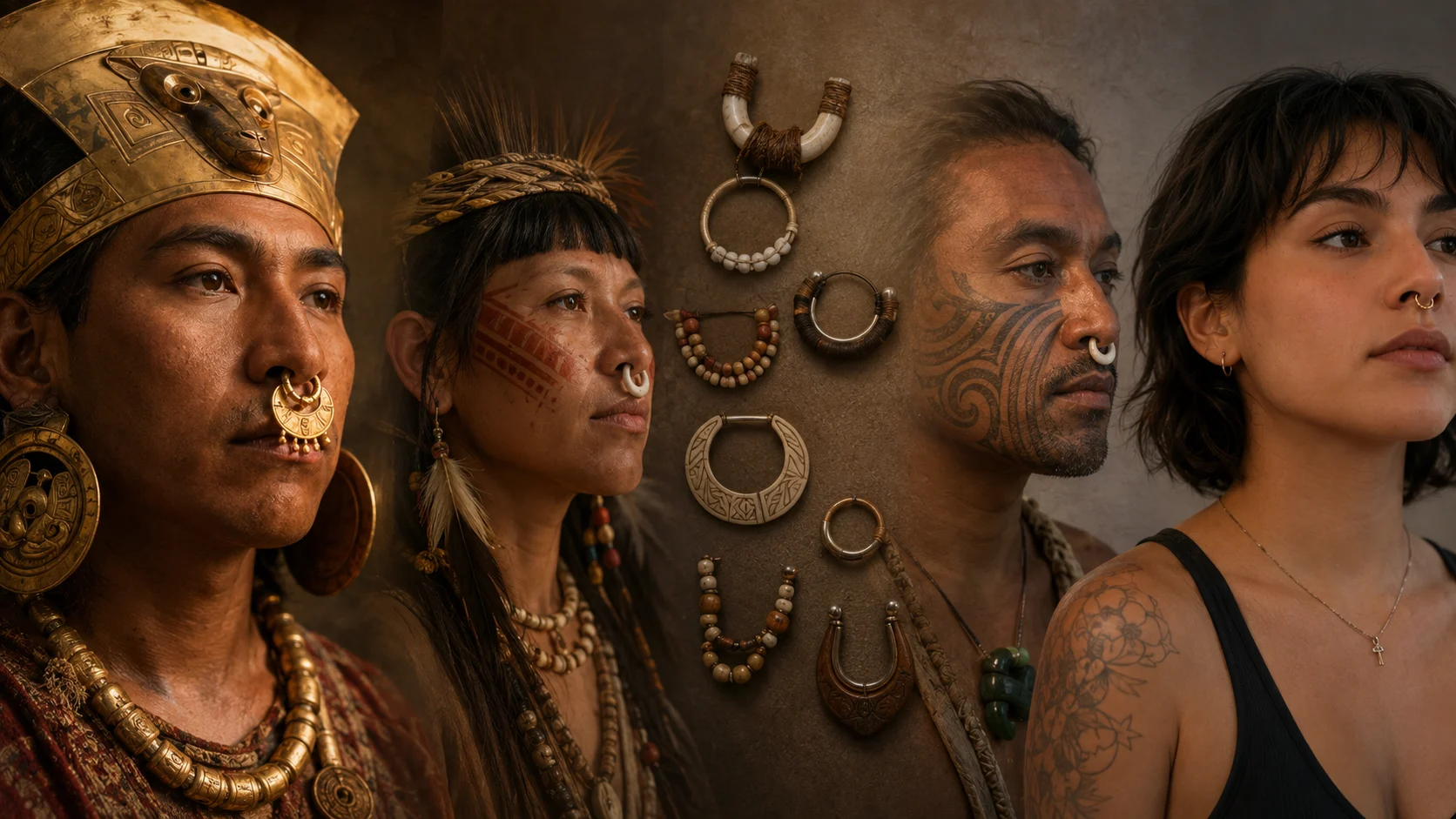
When I started looking into septum piercing history, I quickly found that the story is much older than the modern septum ring I see today.
Septum piercing was not created by modern Western fashion or punk culture. People in different parts of the world have pierced the nasal septum and worn nose ornaments for a very long time. The materials, reasons, and cultural roles were different from one community to another.
I also found an important point that is often missed online: nose piercing, nostril piercing, and septum piercing are not the same thing. A long history of nose jewelry does not automatically prove that every example was a septum piercing.
The clearest way to look at the history is to separate ancient and traditional practices from the much newer Western piercing movement.
When Did Septum Piercing Start?
There is no single confirmed date for the first septum piercing.
Nasal piercing has a very long history, and archaeological evidence shows that people in different parts of the world used nose and septum ornaments long before modern body-piercing studios existed.
I would be careful with claims that say a particular culture “invented” septum piercing. The historical record is too broad for that.
What we can say is that ancient septum piercing and septum ornaments have been documented in several societies, including communities in the Americas, Alaska, Papua New Guinea, and other regions.
For example, archaeological evidence from the Alutiiq region suggests that nose ornaments are at least 1,000 years old. The ornaments were placed through the nasal septum and came in forms such as polished coal rings and wooden nose pins.
So when I talk about the origins of septum piercing, I prefer to say that it has multiple historical roots rather than one known point of origin.
What Is the Difference Between Nose Piercing and Septum Piercing?
This distinction matters a lot in historical research.
A nostril piercing passes through the side of the nose.
A septum piercing passes through the tissue associated with the nasal septum, the structure that separates the two sides of the nose.
When I read about ancient nose jewelry, I check whether the source actually describes the jewelry as being suspended from or placed through the septum.
That helps prevent a common mistake in articles about nose piercing history: taking evidence of ancient nose jewelry and automatically calling it septum jewelry.
Some historical ornaments were clearly associated with the nasal septum, while others were worn elsewhere on the nose.
Septum Piercing in Ancient Peru

One of the strongest examples I found comes from ancient Peru.
The Moche culture of the North Coast of Peru used elaborate nose ornaments. Examples dated around 100–800 CE have been documented, and some were suspended from the nasal septum.
These were not simple modern-style rings.
Moche nose ornaments could be made from gold and other valuable materials and were associated with political and religious elites. Historical museum records describe these ornaments as markers of status and authority.
This tells me something important about ancient septum piercing history.
The jewelry could communicate information about the person wearing it.
It could be connected with:
- Social status
- Authority
- Identity
- Religious roles
- Political position
- Body adornment
Some Moche nose ornaments also used animal forms and religious imagery, showing that the decoration could carry meaning beyond appearance.
Septum Ornaments in the Salinar Culture
The Salinar culture is another important example from ancient Peru.
Museum collections contain nose ornaments associated with the Salinar period. Some were designed to hang from the nasal septum and were associated with people of high social status.
The materials and craftsmanship show that these were more than ordinary decorative objects.
For me, examples like this are much more useful than simply saying that “ancient people wore septum piercings.” They show exactly what the jewelry looked like, where it was worn, and what role it could play in society.
Septum Piercing Among the Alutiiq

The history of septum piercing among the Alutiiq is especially interesting because there is archaeological and cultural documentation for the practice.
In classical Alutiiq society, men, women, and children wore nose rings through a perforation in the nasal septum.
The Alutiiq word maitaq refers specifically to a septum piercing. The nasal septum itself is called kucurwik.
Historical descriptions mention jewelry made from materials such as:
- Slender bone
- Dentalium shells
- Abalone shell
- Animal teeth
- Wood
- Beads
Archaeological finds include polished coal rings and wooden nose pins. One wooden example from Karluk even has a puffin carved into one end.
The archaeological record suggests that these nose ornaments are at least 1,000 years old.
I think this is one of the clearest examples showing that traditional septum piercing cannot be reduced to a modern fashion trend.
Septum Piercing in Papua New Guinea

Papua New Guinea has a long and varied history of nose and septum adornment.
I would be careful here because Papua New Guinea contains many different cultural groups. There was no single “Papua New Guinean meaning” for septum piercing.
Different communities used different ornaments and materials.
Some historical examples include septum ornaments made from:
- Boar tusks
- Bone
- Shell
- Wood
- Plant materials
- Feathers
One documented Asmat nose ornament, known as a bipane, was worn through the nasal septum. It was associated with ceremonies and initiation practices.
Another documented Papua region nose ornament was worn through a pierced septum and had a shape connected with local symbolism.
This shows how septum jewelry could become part of ceremony, identity, and community traditions.
Septum Piercing and Initiation
One of the most interesting historical uses of septum piercing is its connection with initiation.
In some communities, body modification formed part of a transition from one stage of life to another.
Historical documentation from West Papua describes ceremonial septum piercing as part of an initiation process. The practice involved progressively larger pins and was surrounded by community rituals.
This is very different from the reason most people get a septum piercing today.
For some traditional communities, the piercing could mark a person’s place within society or a major stage of life.
For a modern wearer, it may simply be personal style.
That difference is worth keeping in mind.
Septum Piercing in Australia
Traditional body modification also has a history in Aboriginal Australian communities.
Historical accounts describe septum piercing as part of coming-of-age practices among the Arunta of Central Australia.
In this context, the piercing could be connected with a transition into adult social roles.
I would not describe this as a tradition shared by every Aboriginal Australian community. Australia contains many distinct Indigenous peoples, each with their own cultural practices.
This is another reason I prefer to discuss specific communities rather than making broad statements about an entire region.
Septum Piercing in Africa
Africa also has a long history of body adornment, but I would avoid saying that “African cultures” all used septum piercing in the same way.
There are many different cultures and traditions across the continent.
Some historical and ethnographic records describe septum adornment among particular communities, including traditions involving specific jewelry, materials, and social roles.
One documented example is the baTonga cisita tradition, associated with septum adornment among women.
The important point is that these practices belong to particular communities. They should not be combined into one general African septum piercing tradition.
Septum Piercing in South Asia
South Asia has a very long history of nose jewelry.
India, Nepal, Bangladesh, and other parts of the region developed their own traditions involving nose adornment.
But this is another place where I think historical accuracy matters.
Traditional nostril piercing is much more widely documented in South Asian customs than septum piercing.
Nose jewelry could be associated with beauty, marriage, family traditions, regional identity, and social customs.
That does not mean every traditional South Asian nose piercing was a septum piercing.
So I would not say:
Septum piercing originated in India.
That claim is much stronger than the historical evidence allows.
A better way to describe it is that South Asia has a long and varied history of nose jewelry, while specific septum traditions need to be linked to particular communities and regions.
Septum Piercing Among Indigenous Peoples of North America
Septum piercing also has a history among Indigenous peoples of North America.
The Alutiiq example is especially well documented, with archaeological evidence of septum ornaments dating back at least 1,000 years.
Historical references also describe septum piercing among some other Indigenous communities.
I would avoid saying that Indigenous people in North America had one shared septum piercing tradition.
The better approach is to look at individual communities, their jewelry, and the reasons behind the practice.
What Materials Were Used for Traditional Septum Jewelry?

Modern septum jewelry is often made from metals such as titanium, gold, or other body-jewelry materials.
Traditional septum jewelry could look very different.
Depending on the culture, people used materials such as:
- Bone
- Wood
- Shell
- Animal teeth
- Boar tusks
- Coal
- Abalone
- Beads
- Feathers
- Precious metals
The materials available in the local environment often shaped the design of the jewelry.
For example, Alutiiq nose ornaments included bone, shell, wood, coal, teeth, and beads.
In ancient Moche society, valuable metal nose ornaments were associated with elite individuals.
This tells me that the history of septum jewelry is also a history of local materials, craftsmanship, status, and cultural design.
What Did Septum Piercing Mean Historically?
The meaning depended heavily on the community.
Historical septum piercing could be connected with:
- Social status
- Identity
- Adulthood
- Initiation
- Ceremony
- Community membership
- Beauty
- Religious or spiritual life
- Political position
- Personal adornment
There was no single historical meaning.
For example, Moche nose ornaments could identify people connected with elite status and authority.
Among the Alutiiq, septum jewelry was part of everyday and traditional body adornment and was worn by men, women, and children.
In parts of Papua New Guinea, septum ornaments could be connected with initiation and ceremonial life.
This is why I would never use one historical explanation for every culture.
Did Ancient People Wear Septum Rings Like We Do Today?

Not usually.
The basic idea of placing jewelry through the nasal septum is old, but the modern septum ring is a much newer form of jewelry.
Historical ornaments could be:
- Large nose plates
- Pins
- Curved pieces of wood
- Shell ornaments
- Bone pieces
- Animal teeth
- Tusks
- Gold ornaments
- Decorative pieces made for ceremonies
Modern jewelry often uses small rings, horseshoes, clickers, and other standardized designs.
So there is a clear difference between the ancient practice of septum adornment and the modern commercial septum jewelry industry.
When Did Septum Piercing Become Popular in the West?
This part of septum piercing history is much more recent.
By the early 20th century, body piercing outside the ears was uncommon in much of Western society.
That began to change during the second half of the 20th century.
The 1970s were especially important for modern Western body piercing. Punk culture embraced visible body modification, while early professional piercing communities were also developing in the United States.
This period helped change piercing from something associated with specific communities into something that could eventually become mainstream fashion.
Did Punk Culture Invent Septum Piercing?
No.
This is one of the biggest points I would correct in many online articles.
Septum piercing existed in different cultures long before modern punk.
What punk did was give septum piercing a new Western cultural context.
During the late 1970s and 1980s, punk and other alternative communities used body piercing as a visible way to reject conventional appearance and social expectations.
Septum jewelry fit this style because it was highly visible and looked different from conventional jewelry.
So punk did not create septum piercing.
It helped shape the modern Western image of it.
The Rise of Professional Piercing
The development of professional piercing studios also played a major role.
One of the most important names in this history is Jim Ward.
Ward became a major figure in the modern Western piercing movement and opened The Gauntlet in West Hollywood in 1978. It became one of the earliest professional piercing studios in the United States.
This was important because professional studios helped move body piercing away from improvised practices and into a more organized industry.
Over time, professional piercers developed better methods, jewelry standards, and aftercare practices.
That helped make different types of body piercing easier for the wider public to access.
The Modern Primitive Movement
The 1980s and 1990s brought another important change.
Fakir Musafar became one of the best-known figures in the Modern Primitive movement.
The movement explored contemporary body modification while drawing inspiration from traditional body practices from different societies.
This period helped increase Western interest in traditional forms of body modification, including piercing, stretching, scarification, and other practices.
I think this part of the story needs some care.
The Modern Primitive movement did help bring attention to traditional body modification, but it should not be presented as if Western practitioners created the original practices.
The traditional practices existed first.
The modern movement created a new Western interpretation of them.
Septum Piercing in the 1990s
The 1990s were an important period for body piercing.
Professional piercing became more established, and body modification became more visible outside small underground communities.
Septum jewelry became associated with alternative fashion, punk, goth, and other subcultures.
At the same time, body piercing was beginning to move into mainstream fashion.
This period helped create the path from underground body modification to the modern piercing industry.
Septum Piercing in the 2000s
During the 2000s, septum piercing became more visible outside traditional alternative communities.
More people began choosing facial piercings as part of personal style rather than as a sign of membership in a particular subculture.
Jewelry choices also expanded.
Instead of only seeing heavy rings or basic horseshoe jewelry, people could choose smaller and more decorative pieces.
This made the piercing easier to fit into different styles.
Septum Piercing in the 2010s
The 2010s were a major turning point.
Septum piercing became increasingly common in mainstream fashion and popular culture.
Social media also changed how people discovered body modification.
Instead of seeing piercings only at concerts, alternative shops, or specialized communities, people could see septum jewelry on fashion pages, influencers, celebrities, and everyday users.
The piercing became much less tied to one subculture.
Septum Piercing Today
Today, septum piercing is a common option at professional piercing studios.
I see it worn with many different styles, from very small minimalist rings to large decorative clickers.
It can be part of:
- Alternative fashion
- Minimalist style
- Streetwear
- Everyday fashion
- Punk
- Goth
- Personal body modification
- Individual self-expression
The modern septum piercing has therefore moved a long way from its historical settings.
The physical placement may be similar, but the social meaning can be completely different.
How Septum Piercing Changed From Tradition to Fashion
When I put the history together, I see several broad stages.
Ancient and traditional practices
Different communities used septum ornaments as part of body adornment, ceremony, identity, status, or initiation.
Western underground culture
During the 1970s and 1980s, body piercing became increasingly visible in punk, alternative, and other subcultures.
Modern Primitive movement
During the 1980s and 1990s, Western body-modification communities became more interested in traditional body practices from other cultures.
Professional piercing industry
Specialized studios helped make body piercing more accessible and organized.
Mainstream fashion
During the 2000s and 2010s, septum piercing moved further outside underground communities.
Modern personal style
Today, many people choose septum jewelry simply because they like how it looks.
That is the biggest change I see in the history of septum piercing.
Is Modern Septum Piercing Connected to Ancient Traditions?
Yes, but the connection needs to be explained carefully.
The practice of piercing the nasal septum is historically much older than modern Western piercing culture.
However, a modern titanium clicker is not automatically a continuation of one particular ancient tradition.
There are several separate threads:
- Ancient and Indigenous septum practices
- Traditional nose ornaments
- Western body-piercing subcultures
- Modern Primitive body modification
- Professional piercing
- Contemporary fashion
These threads have influenced how people think about body piercing today, but they should not be treated as one continuous tradition.
Is Septum Piercing Cultural Appropriation?
This question comes up because modern Western piercing culture has adopted a practice that has existed in many Indigenous and traditional communities.
I think the most useful approach is to look at what is being copied and how it is being used.
A generic modern septum ring does not automatically reproduce the cultural meaning of a specific traditional ornament.
But copying a culturally specific ceremonial design, symbolic object, or traditional form without knowing its meaning is different.
Learning the history is a good starting point.
I also think it is better to name the specific culture involved rather than using vague terms such as “tribal piercing.”
Septum Piercing History Timeline

Here is the timeline I use to make the history easier to follow:
Ancient period:
Different societies develop their own forms of nasal and septum adornment.
At least 1,000 years ago:
Archaeological evidence shows septum-related nose ornaments among ancestral Alutiiq communities.
100–800 CE:
Moche communities in Peru use elaborate nose ornaments suspended from the nasal septum, including valuable metal examples.
Traditional and historical periods:
Septum ornaments appear in different Indigenous communities across regions including the Americas and Pacific.
20th century:
Traditional septum adornment continues in some communities, while Western body piercing remains relatively uncommon.
1970s:
Punk and emerging professional piercing communities help bring body modification into greater public view.
1980s–1990s:
Modern Primitive and alternative body-modification movements increase Western interest in traditional forms of body modification.
2000s:
Septum piercing becomes increasingly visible outside underground communities.
2010s:
Septum piercing has become a much more common mainstream fashion choice.
Today:
Septum piercing is widely used as personal body adornment and self-expression.

Final Thoughts
After looking through the history, I think the most important thing to know about septum piercing history is that there is no single origin story.
People in different societies developed their own forms of septum and nose adornment. The jewelry could be made from gold, bone, shell, wood, teeth, coal, tusks, beads, or other local materials.
In ancient Peru, Moche nose ornaments could show status and authority. Among the Alutiiq, septum jewelry was part of traditional body adornment and has archaeological roots going back at least 1,000 years. In parts of Papua New Guinea, septum ornaments could form part of ceremony and initiation.
The modern Western story came much later.
Punk and alternative communities helped give septum piercing a new meaning in the 1970s and 1980s. Professional piercing studios helped develop the modern industry, while the Modern Primitive movement brought more attention to traditional forms of body modification.
By the 2000s and 2010s, septum piercing had moved far beyond underground subcultures and into mainstream fashion.
Today, someone may wear a septum ring because of personal style, self-expression, cultural identity, or simply because they like the way it looks.
For me, that is what makes the history so interesting. The piercing itself is ancient, but its meaning keeps changing with the people and cultures that use it.
Frequently Asked Questions
When did septum piercing start?
There is no confirmed single starting date. Septum piercing and septum ornaments have been documented in different societies over long periods of history, including ancient Peru and ancestral Alutiiq communities.
Where did septum piercing originate?
It does not appear to have one single place of origin. Historical and archaeological evidence points to multiple independent traditions of septum adornment in different parts of the world.
How old are septum piercings?
The practice is very old, but there is no reliable single date for the first septum piercing. Archaeological evidence from ancestral Alutiiq settlements suggests nose ornaments associated with the septum are at least 1,000 years old.
Did ancient people have septum piercings?
Yes. Archaeological evidence from ancient Peru, for example, includes nose ornaments that were suspended from the nasal septum.
Did Indigenous people have septum piercings?
Yes. Several Indigenous communities have documented histories of septum piercing and nose adornment. The Alutiiq are one well-documented example.
Did the Moche have septum piercings?
The Moche used nose ornaments that hung from the nasal septum. Some were made from gold and other valuable materials and were associated with elite status and authority.
Did people in Papua New Guinea have septum piercings?
Yes. Various communities in Papua New Guinea used septum ornaments made from materials such as shell, bone, wood, and tusks. Some were connected with ceremony and initiation.
Did people in India have septum piercings?
South Asia has a long history of nose jewelry, but traditional nostril piercing is much more widely documented than septum piercing. Specific septum traditions should be linked to particular communities and regions rather than being treated as one Indian tradition.
Did Native Americans have septum piercings?
Some Indigenous peoples of North America had traditions of septum piercing and nose adornment. The Alutiiq provide a particularly well-documented example, with archaeological evidence dating back at least 1,000 years.
Did punk culture invent septum piercing?
No. Septum piercing existed in different cultures long before punk. Punk helped popularize a modern Western form of septum piercing and gave it a new association with alternative fashion and nonconformity.
When did septum piercing become popular in the West?
Modern Western body piercing expanded during the 1970s and became increasingly visible through punk, alternative communities, professional piercing studios, and later mainstream fashion.
Who popularized modern body piercing?
Jim Ward was one of the major figures in the development of professional Western body piercing. He opened The Gauntlet in West Hollywood in 1978, one of the earliest professional piercing studios in the United States.
Who was Fakir Musafar?
Fakir Musafar was a major figure in the Modern Primitive body-modification movement. He helped bring greater attention to traditional body-modification practices within modern Western culture.
What did septum piercing mean historically?
It depended on the culture. Historical septum jewelry could be connected with status, identity, ceremony, adulthood, initiation, beauty, or community traditions.
Is septum piercing originally a Western practice?
No. The historical practice of septum adornment predates modern Western piercing culture by a very long time.
Is septum piercing cultural appropriation?
Not every modern septum piercing is automatically cultural appropriation. However, I think it is worth learning about the cultural history of septum adornment and avoiding the careless copying of specific ceremonial or culturally significant designs.
