


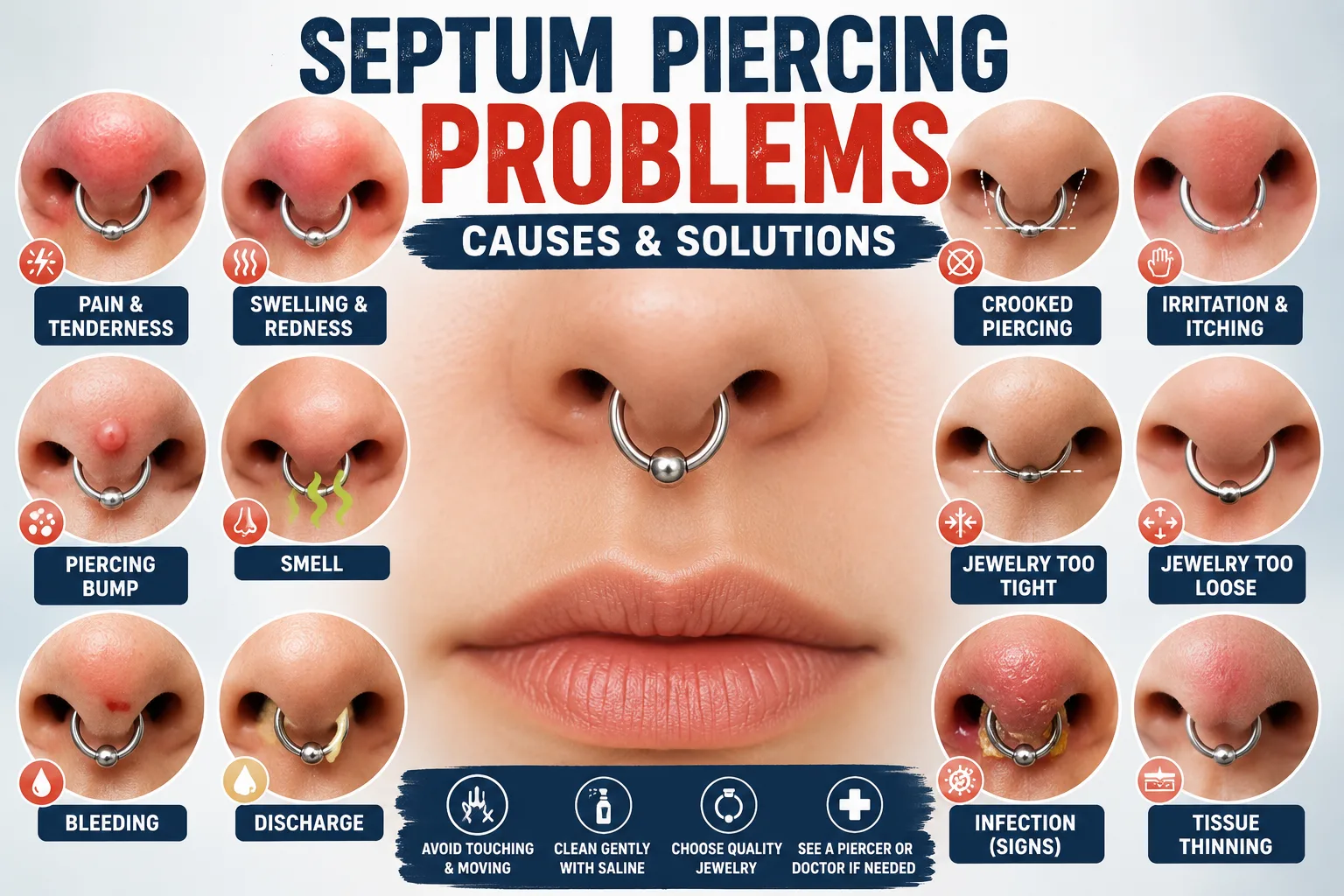
I’ve found that septum piercing problems are much easier to deal with once I look at the symptoms as a whole instead of assuming that every issue means infection. A little tenderness, itching, swelling, or crusting can happen during healing. Other changes, such as worsening pain, major swelling, heat, pus, or feeling unwell, need more attention.
A septum piercing can also have problems because of friction, trauma, jewelry fit, jewelry material, cleaning habits, or repeated movement. In this guide, I’ll cover the common problems, what may cause them, and what I would do next.
I’m keeping this article broad because each major problem has its own detailed guide. If your main concern is a bump, smell, pain, bleeding, discharge, crooked placement, or infection, you can use the related guide for that specific issue.
What Are the Most Common Septum Piercing Problems?

The problems I would watch for include:
- Pain or tenderness
- Swelling
- Redness
- Itching
- Irritation
- A piercing bump
- Unusual smell
- Bleeding
- Discharge
- Crooked-looking jewelry
- Jewelry that feels too tight
- Jewelry that moves too much
- Slow healing
- Skin reactions
- Possible infection
- Changes in jewelry position
- Tissue thinning around the piercing
These symptoms do not all mean the same thing. A new piercing can have mild tenderness, slight swelling, some redness, itching, and pale fluid that dries into crust as the tissue heals.
The thing I pay most attention to is how the symptoms change over time. Mild symptoms that gradually settle are very different from symptoms that keep getting worse.
Septum Piercing Problems at a Glance
| What I notice | Possible cause | What I would do |
| Mild tenderness | Normal healing | Give the piercing time and avoid unnecessary touching |
| Mild swelling | Normal healing or irritation | Avoid pressure and repeated movement |
| Persistent irritation | Friction, touching, jewelry, or cleaning products | Remove the source of irritation |
| Itchy red skin | Irritation or jewelry reaction | Check the jewelry and products used around it |
| Small bump | Irritation, friction, or tissue response | Avoid squeezing or picking it |
| Mild smell | Normal buildup around jewelry | Keep the area clean without over-cleaning |
| Strong smell with other symptoms | Possible infection | Get the symptoms assessed |
| Thick discharge | Possible infection | Seek medical advice if it occurs with worsening symptoms |
| Repeated bleeding | Trauma or another problem | Have it assessed if it continues |
| Jewelry changing position | Jewelry fit, swelling, or migration | Have a professional piercer check it |
| Severe swelling or pressure | Trauma or another medical issue | Seek prompt medical assessment |
| Fever or feeling unwell | Possible infection | Seek medical care |
This table is a starting point, not a way to diagnose a piercing problem at home.
How Do I Know If My Septum Piercing Has a Problem?

I don’t expect a fresh septum piercing to feel completely normal right away.
During early healing, I may notice mild tenderness, slight swelling, itching, some redness, or a small amount of pale fluid that dries around the jewelry. These symptoms can happen as the piercing heals.
What concerns me more is a clear change for the worse.
Symptoms That Can Be Normal During Healing
Some symptoms I may notice during healing include:
- Mild tenderness
- Slight swelling
- Minor redness
- Itching
- Light bleeding soon after getting pierced
- Pale or whitish fluid
- Small amounts of crust around the jewelry
I don’t pick at crust or keep moving the jewelry just to check whether the piercing is healing.
A piercing can also look fine on the outside while the tissue inside is still healing. That is why I don’t judge healing only by appearance.
Symptoms That Need More Attention
I take the situation more seriously if I notice:
- Increasing pain
- Significant swelling
- Increasing warmth
- Redness that spreads or keeps getting worse
- Thick or pus-like discharge
- Repeated or heavy bleeding
- Severe tenderness
- Fever or chills
- Feeling generally unwell
If several of these symptoms appear together, I would get medical advice rather than trying different home treatments.
Common Septum Piercing Problems and Their Causes
Septum Piercing Hurts
Some pain or tenderness can be normal during early healing.
I may also notice pain after accidentally bumping my nose, moving the jewelry too much, sleeping with pressure on it, or irritating the area while cleaning.
Jewelry that does not fit properly can also create pressure and ongoing irritation.
Pain becomes more concerning if it keeps increasing or appears with significant swelling, heat, spreading redness, pus, or other concerning symptoms.
If pain is your main problem, see Why Does My Septum Piercing Hurt?
Septum Piercing Is Swollen
Some localized swelling can happen after a fresh piercing.
I become more concerned when swelling keeps increasing instead of settling.
Repeated touching, friction, accidental trauma, jewelry pressure, and poor jewelry fit can keep a septum piercing irritated.
Severe swelling is different. If I notice major swelling, strong pressure, severe pain, or trouble breathing after trauma, I would get medical help rather than treating it as ordinary piercing irritation.
Septum Piercing Is Red or Irritated
Mild redness can happen during healing.
If the redness continues, I first look for something that may be irritating the piercing.
Possible causes include:
- Touching the jewelry
- Twisting or spinning it
- Excessive cleaning
- Harsh cleaning products
- Friction
- Accidental bumps
- Poorly fitting jewelry
- Sensitivity to a jewelry material
An itchy red area around the jewelry can sometimes point to a skin reaction rather than an infection.
Septum Piercing Has a Bump
A bump around a septum piercing can have several causes.
I would think about recent trauma, friction, pressure from jewelry, excessive movement, or other tissue reactions before assuming that every bump is an infection.
I avoid squeezing, popping, or picking at a piercing bump because that can create more irritation.
For the full topic, see Septum Piercing Bump: Causes and Treatment.
Septum Piercing Smells
A mild smell does not automatically mean that my septum piercing is infected.
Body oils, dead skin cells, and normal secretions can collect around jewelry and create an odor.
I become more concerned if the smell is strong or foul and appears with other symptoms such as increasing pain, swelling, heat, redness, or thick discharge.
For the full topic, see Septum Piercing Smell: Why Does It Smell?
Septum Piercing Is Bleeding
A little bleeding can happen soon after getting pierced.
I may also see some blood after accidentally bumping the nose or irritating the healing tissue.
What concerns me is bleeding that is heavy, persistent, keeps returning without an obvious cause, or appears with other concerning symptoms.
I would not keep touching or aggressively cleaning the area to check whether it has stopped.
For the full topic, see Septum Piercing Bleeding: Is It Normal?
Septum Piercing Has Discharge
Discharge can be confusing because not every fluid means infection.
During healing, a septum piercing can produce a small amount of pale or whitish fluid that dries into crust around the jewelry.
I become more concerned when the discharge is thick or pus-like, especially when it appears with worsening pain, swelling, heat, redness, or feeling unwell.
For the full topic, see Septum Piercing Discharge: Normal or Infection?
Septum Piercing Looks Crooked
Sometimes a septum piercing can look crooked because of swelling or because the jewelry is sitting unevenly.
I also have to consider natural nasal anatomy. The septum is not perfectly straight in everyone, so jewelry may look slightly different from one side to the other.
Jewelry size and shape can also affect how straight the piercing appears.
If the jewelry seems to become more crooked over time, or the tissue around the piercing looks thinner, I would have a professional piercer check it.
For the full topic, see Why Is My Septum Piercing Crooked?
Septum Piercing Is Not Healing
When a septum piercing seems to stay irritated for a long time, I look for something that is repeatedly disturbing the tissue.
Possible causes include:
- Repeated touching
- Twisting the jewelry
- Accidental trauma
- Friction
- Pressure
- Poor jewelry fit
- Unsuitable jewelry material
- Harsh cleaning products
- Over-cleaning
- Changing jewelry too early
- Possible infection
If the same source of irritation continues every day, the piercing may struggle to settle.
Septum Piercing Jewelry Is Causing Irritation

Jewelry itself can sometimes be the problem.
If the jewelry is too tight, it can place pressure on the healing tissue. If it is too loose, it may move more than necessary and create friction.
The material can also matter.
If I notice ongoing itching, redness, rash-like skin changes, or irritation that seems limited to the area around the jewelry, I would consider a jewelry reaction.
Nickel is one metal that can cause allergic reactions in some people. If I suspect a metal allergy, I would have a professional piercer assess the jewelry rather than repeatedly changing it myself.
Septum Piercing Jewelry Is Moving or the Tissue Looks Thinner
A change in jewelry position can have several explanations.
Swelling may change how the jewelry sits during early healing. Jewelry fit can also affect its position.
What gets more attention from me is a gradual change where the jewelry seems to be moving closer to the surface or the tissue around the piercing appears thinner.
This can be associated with migration, where the piercing gradually changes position.
I would not try to push the jewelry back into place. A qualified piercer can check the piercing and jewelry to see what is happening.
Why Do Septum Piercing Problems Happen?

I find that many problems can be traced back to one of four areas: mechanical irritation, cleaning habits, jewelry, or a biological problem such as infection.
Touching or Playing With the Jewelry
This is one of the first habits I would stop.
Touching the jewelry repeatedly can introduce dirt and create friction.
If I don’t need to touch the piercing, I leave it alone.
Moving or Twisting the Jewelry
I don’t twist or spin healing jewelry just because I think it needs to move.
Unnecessary movement can irritate healing tissue and make an existing problem worse.
Using Harsh Cleaning Products
I avoid strong products such as alcohol and hydrogen peroxide on a healing piercing.
They can irritate the tissue and make the area feel worse.
I prefer a simple cleaning routine instead of using several different products.
Over-Cleaning
More cleaning does not always mean faster healing.
If I clean the piercing too often or scrub the area, I can keep disturbing the tissue.
I focus on gentle care rather than constantly checking or cleaning it.
Jewelry Material
Jewelry material can play a major part in some septum piercing problems.
If I develop persistent itching, redness, or a rash around the jewelry, I consider whether the metal could be responsible.
This is different from an infection because a material reaction can mainly affect the skin around the jewelry.
Jewelry Size or Shape
Jewelry that is too tight can put pressure on healing tissue.
Jewelry that is too large can move excessively and catch on things.
Both situations can create irritation.
If I think the jewelry is causing the problem, I would have a professional piercer check the size, shape, and material.
Accidental Trauma
A septum piercing can become irritated after:
- Catching the ring
- Pulling the jewelry
- Bumping the nose
- Repeated rubbing
- Sleeping with pressure on the area
- Moving the jewelry accidentally
After an injury, I give the area time to settle instead of repeatedly touching it to see if it still hurts.
Severe Swelling or Pressure After Trauma

This is one problem I would not treat like ordinary piercing irritation.
If I experience sudden, significant swelling, strong pressure, severe pain, or difficulty breathing after an injury to the nose or septum, I would get medical assessment.
A collection of blood inside the nasal septum, called a septal hematoma, can require medical treatment. I would not try to drain or treat this myself.
Signs of Possible Septal Damage
A normal septum piercing should not be assumed to have caused damage to the nasal septum simply because it feels uncomfortable.
However, unusual symptoms deserve attention.
If I notice repeated nosebleeds, persistent crusting, nasal blockage, unusual whistling while breathing, ongoing pain, or a change in the shape of my nose, I would get checked by a healthcare professional.
I would not try to treat these symptoms as ordinary piercing irritation.
Septum Piercing Problems: Irritation or Infection?

This is where I try not to jump to conclusions.
A mild, localized problem that appears after friction, touching, or jewelry movement may be irritation.
An infection is more concerning when symptoms are getting worse and include significant swelling, increasing pain, warmth, marked redness, pus-like discharge, or feeling unwell.
| More consistent with irritation | More concerning for infection |
| Mild tenderness | Increasing pain |
| Mild localized redness | Increasing or spreading redness |
| Mild itching | Significant warmth |
| Symptoms after friction | Symptoms that keep getting worse |
| Minor swelling | Significant swelling |
| Improves after removing the irritant | Pus-like discharge |
| No general illness | Fever, chills, or feeling unwell |
This comparison is not a way for me to diagnose an infection at home.
If I suspect an infection, especially if symptoms are worsening, I would seek medical advice.
For the full comparison, see Septum Piercing Infection vs Irritation.
What Should I Do About a Septum Piercing Problem?

When I notice a problem, I keep my response simple.
Leave It Alone
I avoid unnecessary touching, twisting, and movement.
Wash My Hands Before Touching It
If I need to clean or check the piercing, I wash my hands first.
Use Appropriate Cleaning
For a healing piercing, I prefer sterile saline wound wash rather than experimenting with harsh products or strong homemade mixtures.
The Association of Professional Piercers provides detailed aftercare guidance if you want a reference for basic piercing care. Association of Professional Piercers aftercare guidance
Check the Jewelry
I consider whether the jewelry is:
- Too tight
- Too loose
- Moving too much
- Creating pressure
- Made from a material that may irritate my skin
If I think jewelry is the problem, I would have a professional piercer assess it.
Don’t Force Jewelry Through
If jewelry will not move easily, I do not force it.
Forcing jewelry through a narrowed or irritated piercing can damage the tissue and create more swelling.
If I cannot insert jewelry normally, I would ask a professional piercer to examine it.
When Should I See a Piercer?
I would contact a qualified piercer when the problem seems related to the piercing itself or the jewelry.
For example, I would get a professional assessment if:
- The jewelry seems too tight
- The jewelry moves excessively
- The jewelry keeps irritating the area
- I think the size is wrong
- I suspect a material reaction
- The piercing looks incorrectly positioned
- I think the jewelry is migrating
- I need to change jewelry during healing
- The piercing keeps getting irritated without an obvious reason
A professional can check the jewelry, placement, fit, and surrounding tissue.
When Should I See a Doctor?
Some septum piercing problems need medical attention rather than another change to my cleaning routine.
I would seek medical care if I notice:
- Severe or worsening pain
- Significant swelling
- Increasing warmth
- Spreading redness
- Thick pus-like discharge
- Persistent or concerning bleeding
- Fever
- Chills
- Feeling generally unwell
- Difficulty breathing
- Sudden severe swelling after trauma
- Symptoms that continue to get worse
I would not wait for a piercing problem to become severe if I am concerned that it could be an infection or another medical problem.
If infection is suspected, I also would not remove the jewelry on my own without medical or professional guidance.
Common Mistakes That Can Make Septum Piercing Problems Worse
Touching the Piercing With Dirty Hands
I avoid unnecessary contact because it can introduce bacteria and irritate the tissue.
Twisting the Jewelry
I don’t rotate the jewelry just because I think it needs to move during healing.
Over-Cleaning
I avoid repeatedly cleaning the piercing throughout the day.
Using Harsh Products
I don’t use alcohol, hydrogen peroxide, or other strong products on a healing piercing.
Picking Crusts
I let crust soften during cleaning instead of pulling it off when it is firmly attached.
Changing Jewelry Too Early
I don’t change healing jewelry simply because the outside looks fine.
Using Poor-Quality Jewelry
I choose suitable jewelry from a reputable professional rather than focusing only on appearance.
Forcing Jewelry Through
If jewelry doesn’t pass easily, I stop.
Ignoring Worsening Symptoms
I don’t assume that increasing pain, swelling, heat, or pus is simply part of healing.
Assuming Every Problem Is an Infection
I also avoid the opposite mistake.
Irritation, trauma, jewelry fit, and allergic reactions can cause symptoms that look concerning without necessarily being an infection.
How to Prevent Common Septum Piercing Problems

I keep prevention fairly simple.
I start with a qualified piercer and properly fitted jewelry. After that, I avoid unnecessary movement, keep my hands clean, follow a gentle cleaning routine, and try not to bump or pull the jewelry.
I also pay attention to jewelry material and fit. If something continues to irritate the piercing, I would rather have a professional check it than keep changing things myself.
During healing, I also avoid putting cosmetics, lotions, sprays, and other personal-care products directly around the piercing.
Most of all, I give the piercing enough time to heal and avoid treating every small change as an emergency.
Final Thoughts
The main thing I keep in mind with septum piercing problems is that one symptom does not tell the whole story.
A little tenderness, itching, swelling, or crusting can happen during normal healing. Problems become more concerning when symptoms become stronger, spread, or appear alongside other warning signs.
I also look at possible causes such as friction, trauma, jewelry fit, jewelry material, cleaning habits, and infection.
If the problem seems mild, I avoid touching the piercing, remove obvious sources of irritation, and keep my care routine gentle. If symptoms continue getting worse or I notice signs that suggest infection or another medical issue, I get professional help rather than trying to solve everything myself.
The right solution depends on the cause. That is why I find it more useful to identify the type of septum piercing problem first instead of treating every problem in the same way.
Frequently Asked Questions
Is it normal for a septum piercing to hurt?
Some tenderness can be normal during early healing. Increasing or severe pain is more concerning, especially if it appears with swelling, heat, redness, pus, or other concerning symptoms.
Why is my septum piercing swollen?
Early swelling can be part of normal healing. Continued or worsening swelling can also result from irritation, trauma, jewelry pressure, or infection.
Why does my septum piercing smell?
A mild smell can come from normal secretions, oils, and dead skin cells that collect around jewelry. A strong or foul smell combined with worsening pain, swelling, redness, or thick discharge deserves more attention.
Is discharge from a septum piercing normal?
A small amount of pale or whitish fluid that dries into crust can occur during healing. Thick pus-like discharge, especially with worsening pain and swelling, is more concerning.
Why is my septum piercing bleeding?
Minor bleeding can occur soon after piercing or after accidental trauma. Persistent, heavy, or unexplained bleeding should be assessed.
Is a septum piercing bump normal?
A bump can develop from irritation, friction, trauma, or other tissue reactions. I would not assume every bump is an infection.
Why is my septum piercing crooked?
Swelling, jewelry position, jewelry size, natural anatomy, or the original piercing placement can affect how straight it looks.
How do I know if my septum piercing is infected?
I would be more concerned about infection if pain, swelling, warmth, or redness is increasing, especially with pus-like discharge, fever, chills, or feeling unwell.
What should I do if my septum piercing is irritated?
I would stop unnecessary touching and movement, avoid harsh products, keep the area clean with an appropriate routine, and check whether jewelry fit or material could be causing the irritation.
Can bad jewelry cause septum piercing problems?
Yes. Poorly fitted jewelry can cause pressure, excessive movement, irritation, and healing problems. Certain metals can also cause skin reactions.
Can over-cleaning cause septum piercing irritation?
Yes. Excessive cleaning or harsh products can irritate healing tissue and make the area harder to settle.
What if my septum jewelry seems to be moving?
I would avoid trying to push it back into place. Jewelry movement can result from swelling, fit, or migration. A professional piercer can check the position and surrounding tissue.
Can a septum piercing cause septal damage?
A piercing problem should not automatically be assumed to mean septal damage. However, repeated nosebleeds, persistent crusting, unusual whistling while breathing, nasal blockage, ongoing pain, or changes in the nose should be checked by a healthcare professional.
When should I see a doctor about my septum piercing?
I would seek medical care for severe or worsening pain, major swelling, spreading redness, heat, pus-like discharge, fever, chills, feeling unwell, difficulty breathing, or sudden severe swelling after trauma.
