


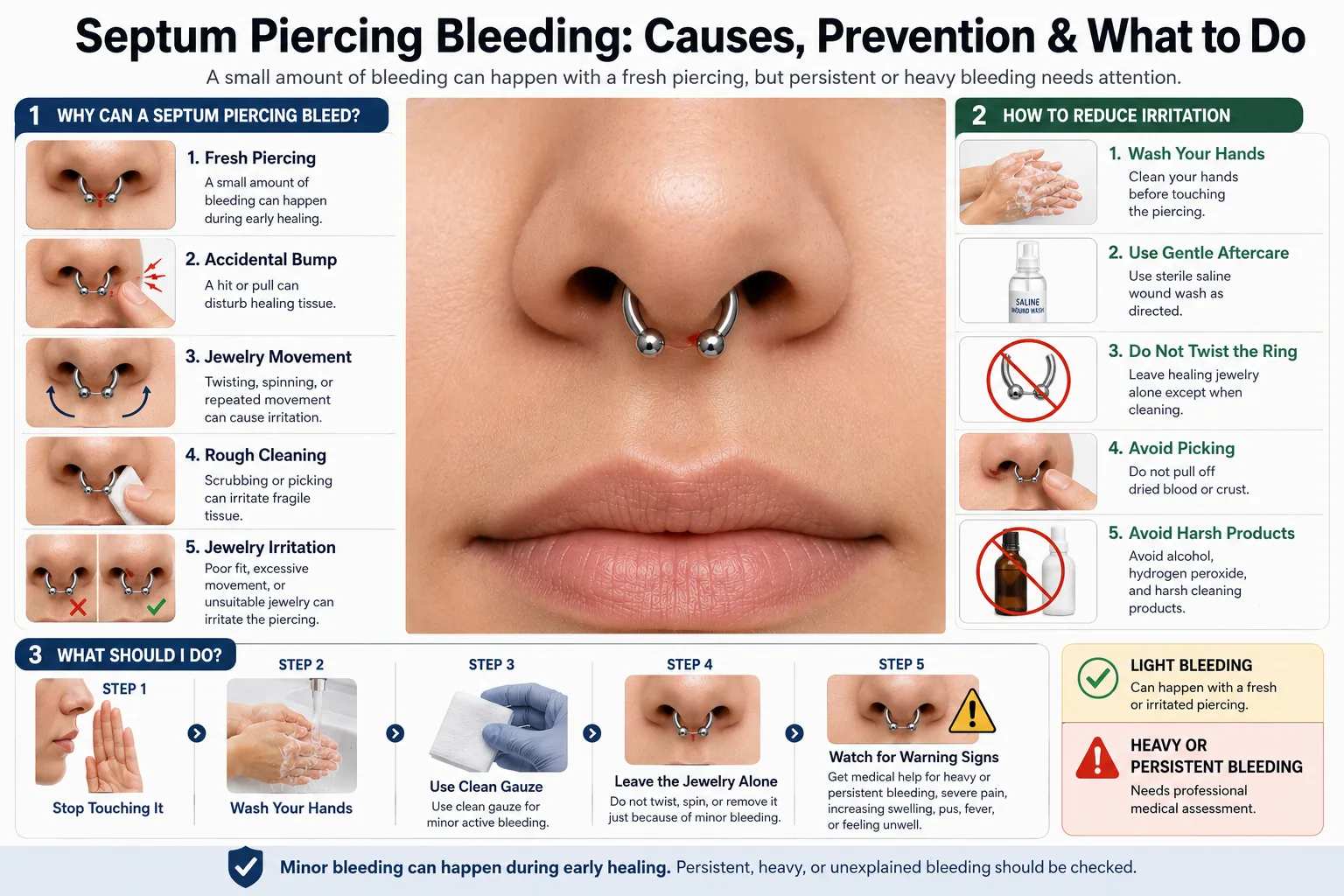
Seeing blood around a new septum piercing can be worrying. I remember that the first thing I would want to know is whether the bleeding is normal or a sign that something has gone wrong.
A small amount of bleeding can happen after a fresh septum piercing. The piercing creates a small wound, so light bleeding, tenderness, swelling, or bruising can occur during the early healing stage.
The part I pay attention to is how much I am bleeding, how long it continues, and whether I have other symptoms.
If I see a little blood after getting my piercing, I do not panic. If the bleeding keeps coming back, becomes heavy, or happens along with increasing pain, swelling, heat, pus, or feeling unwell, I take it more seriously.
In this guide, I will explain why a septum piercing can bleed, how I would deal with minor bleeding, and when I would get help.
Is Bleeding Normal After a Septum Piercing?
Yes, a small amount of bleeding can be normal after getting a fresh septum piercing.
The needle passes through tissue, so it is possible to see a little blood immediately after the piercing. Light bleeding can also happen during the first few days if the area gets irritated. Professional piercing aftercare guidance lists some initial bleeding, localized swelling, tenderness, and bruising as possible normal reactions.
I would not expect a large amount of blood.
For me, the main thing is to look at the overall situation. A small spot of blood on tissue is very different from bleeding that continues and is difficult to control.
How Long Does a Septum Piercing Bleed?
There is no exact amount of time that applies to everyone.
A fresh septum piercing may bleed a little immediately after the procedure. Some light bleeding can also happen during the first few days if the piercing is disturbed or irritated. The Association of Professional Piercers notes that light bleeding can occur during the first few days of a new piercing.
I would become more concerned if the bleeding continues for several days without improving or keeps restarting without an obvious reason.
I also would not keep touching the piercing to check whether it has stopped. That can irritate the area and cause more bleeding.
Why Is My Septum Piercing Bleeding?

There are several reasons a bleeding septum piercing can happen.
The Piercing Is Still Fresh
A new septum piercing is still an open healing wound.
Because the tissue has just been pierced, a small amount of blood can appear during the early healing period.
If my piercing is only a few days old and I see a small amount of blood, I first think about the normal healing process rather than assuming I have an infection.
I Accidentally Hit My Nose
A bump can disturb a fresh septum piercing.
I could hit my nose while sleeping, washing my face, changing clothes, drying my face, or doing everyday activities.
Even a small pull on the jewelry can irritate fragile healing tissue.
If the bleeding starts right after I accidentally hit the piercing, I leave the jewelry alone and give the area time to settle.
I Moved the Jewelry Too Much
Repeatedly touching, twisting, spinning, or moving a septum ring can irritate a healing piercing.
I try to resist the temptation to adjust the ring every time it looks slightly uneven.
Professional piercing aftercare guidance recommends leaving healing jewelry alone and avoiding unnecessary rotation because movement can irritate the piercing.
I Cleaned It Too Hard
Cleaning a septum piercing should be gentle.
If I rub the area, scrub away crust, or move the jewelry while cleaning, I can disturb the healing tissue.
More cleaning does not always mean better healing.
I prefer gentle cleaning and avoid trying to make the piercing look perfectly clean at all times.
The Jewelry Is Irritating the Piercing
Jewelry can sometimes cause mechanical irritation.
The size, shape, weight, and fit of the jewelry can affect how it sits in my nose.
If the jewelry repeatedly pulls or moves against the piercing, the tissue may become irritated.
If I think the jewelry is causing the problem, I would have a professional piercer check the fit instead of trying to fix it myself.
I Picked at Dried Blood or Crust
Dried blood can stick to the jewelry.
My first instinct might be to pull it off, but doing this forcefully can reopen irritated tissue.
I prefer to soften buildup during gentle cleaning and let it come away without pulling at it.
Why Is My Septum Piercing Bleeding Again?
Sometimes a septum piercing can stop bleeding and then start again.
This does not always mean there is a serious problem.
I would think about what happened shortly before the bleeding started.
Did I:
- Bump my nose?
- Pull the jewelry?
- Sleep with pressure on my nose?
- Twist the ring?
- Change the jewelry?
- Clean the piercing too hard?
- Pick at dried blood?
- Catch the jewelry on clothing or a towel?
If I can identify one of these triggers, irritation may explain the bleeding.
If the bleeding keeps returning without an obvious cause, I would have the piercing checked.
Septum Piercing Bleeding After Accidentally Hitting It

If I accidentally hit my nose and the septum piercing starts bleeding, I try not to panic.
My first step would be to stop touching the jewelry.
I would wash my hands before doing anything around the piercing. If there is minor active bleeding, I can use clean disposable gauze and apply gentle pressure.
I would then leave the piercing alone.
I would not keep moving the ring to see whether it is still bleeding. I would also avoid picking at any blood that dries around the jewelry.
If the bleeding is heavy, does not settle, or follows a significant injury, I would seek medical help.
How to Stop Septum Piercing Bleeding

If my septum piercing has minor bleeding, I keep things simple.
1. I Stop Touching the Piercing
The first thing I do is leave the jewelry alone.
Constant touching can introduce dirt and can also irritate the tissue.
2. I Wash My Hands
If I need to touch the area, I wash my hands first.
This is one of the simplest steps I can take to keep unnecessary bacteria away from a healing piercing.
3. I Use Clean Gauze if Needed
For light active bleeding, I can use clean disposable gauze.
I avoid rough materials that can catch on the jewelry.
4. I Do Not Twist the Jewelry
I leave the septum ring in its normal position.
I do not spin it back and forth or keep moving it through the piercing.
5. I Avoid Picking at Crust
If blood dries around the jewelry, I do not pull it off forcefully.
I let gentle cleaning soften the buildup instead.
6. I Give the Area Time
Once the bleeding stops, I leave the piercing alone.
I do not keep checking it every few minutes.
Is Septum Piercing Bleeding a Sign of Infection?

Bleeding by itself does not prove that my septum piercing is infected.
A fresh piercing can have light bleeding during the early healing stage.
I become more concerned if the bleeding happens with other symptoms.
These can include:
- Increasing swelling
- Worsening pain
- Skin that feels hot
- Increasing redness or darkening around the area
- Pus
- Feeling feverish, cold, shivery, or generally unwell
These symptoms can point to an infection and should be assessed by a healthcare professional.
So I do not look at blood alone. I look at the full picture.
For a full guide to infection symptoms and treatment, I would use my article on Septum Piercing Infection: Signs and What to Do.
Septum Piercing Bleeding vs. Irritation
I find it helpful to separate simple irritation from signs of a bigger problem.
| What I notice | What it may suggest |
| A small amount of blood after getting pierced | Normal early healing |
| A little blood after bumping the jewelry | Irritation or minor trauma |
| Bleeding after aggressive cleaning | Irritated tissue |
| Mild tenderness | Common during healing |
| Increasing swelling | More concerning |
| Increasing pain | More concerning |
| Heat around the piercing | Possible infection |
| Pus or unusual discharge | Possible infection |
| Fever or feeling unwell | Needs medical attention |
| Heavy or persistent bleeding | Needs assessment |
This does not give me a diagnosis, but it helps me decide whether I should simply protect the piercing or get professional help.
Can a Healed Septum Piercing Bleed?
A healed septum piercing can bleed if it gets injured or irritated.
If my healed septum suddenly starts bleeding, I think about what may have caused it.
For example, I may have:
- Changed the jewelry
- Pulled the ring
- Scratched the area
- Hit my nose
- Used too much force while cleaning
- Inserted jewelry roughly
- Used jewelry that does not fit well
A healed piercing should not be repeatedly bleeding for no clear reason.
If I cannot find an obvious cause, or the bleeding keeps returning, I would have it checked.
Why Is My Septum Piercing Bleeding After Changing Jewelry?
Changing jewelry can irritate the piercing, especially if it is still healing.
If I force jewelry through the piercing or insert it at the wrong angle, I can disturb the tissue and cause bleeding.
The same thing can happen if the new jewelry does not fit properly.
I would not treat bleeding as a reason to keep trying different jewelry.
If my piercing is still healing and I need a jewelry change, I would have an experienced piercer handle it.
For the actual changing process, I would keep that information in my dedicated article How to Change Septum Jewelry.
Can Cleaning Cause Septum Piercing Bleeding?
Yes, cleaning can cause bleeding if I am too rough.
I used to think that cleaning harder would help a piercing heal faster, but healing tissue needs gentle care.
I avoid:
- Scrubbing the piercing
- Pulling off crust
- Twisting the jewelry
- Using harsh products
- Cleaning far more often than needed
For routine aftercare, sterile saline wound wash is commonly recommended for healing body piercings. The Association of Professional Piercers also advises against rotating or moving jewelry during cleaning.
I also use clean disposable material to gently dry the area rather than rubbing it with a towel.
What Should I Do if My Septum Piercing Bleeds After Cleaning?
If I notice a little blood after cleaning, I stop.
I do not keep cleaning until the blood disappears.
I leave the jewelry alone and let the tissue settle.
If there is minor active bleeding, clean disposable gauze can be used gently.
Then I watch the area.
If the bleeding stops and there are no other concerning symptoms, I continue with gentle aftercare.
If it keeps bleeding every time I clean it, I would ask a professional piercer to check my cleaning method and the jewelry.
Can a Septum Piercing Bleed During Healing?
Yes, minor bleeding can happen during the early healing period.
A piercing can appear fine on the outside while the inside is still healing. The Association of Professional Piercers notes that piercing tissue heals from the outside inward, so a piercing can feel healed before the deeper tissue is fully healed.
That is why I do not treat a piercing as fully healed just because it looks good.
I continue gentle aftercare and avoid unnecessary movement.
If bleeding happens after I bump or disturb the piercing, I give it time to settle instead of repeatedly checking it.
Why Is My Septum Piercing Bleeding After a Week?
A small amount of bleeding after a week can happen if the piercing has been irritated.
At this stage, I would ask myself what changed.
Maybe I bumped my nose. Maybe I slept with pressure on it. Maybe I moved the jewelry too much or cleaned it aggressively.
If there is no obvious trigger and the bleeding keeps happening, I would not ignore it.
I would have a professional piercer assess the piercing. If I also have increasing pain, swelling, heat, pus, or feel unwell, I would seek medical advice.
Can a Septum Piercing Bleed From Sleeping on It?
Pressure during sleep can irritate a healing piercing.
I may not even realize that I am putting pressure on my nose while sleeping.
If I wake up and notice blood around the septum jewelry, I think about whether I slept with my face pressed into the pillow.
I avoid deliberately putting pressure on the piercing while it heals.
I also keep my bedding clean and avoid anything that can catch on the jewelry.
Can Flipping a Septum Piercing Cause Bleeding?
Repeatedly flipping a healing septum ring can irritate the piercing.
If I move the jewelry up and down often, I am repeatedly moving it through healing tissue.
If I need to keep my septum piercing hidden, I prefer to discuss the jewelry position with my piercer before getting pierced.
I would not repeatedly flip a fresh piercing just because I want to hide it.
For the full topic, I would use my dedicated guide Can You Flip Up a Septum Piercing?
Should I Remove My Septum Jewelry If It Is Bleeding?
I would not automatically remove my septum jewelry just because I see some blood.
Removing jewelry from a healing piercing can cause the opening to shrink, making reinsertion difficult. If an infection is suspected, I would get medical advice before deciding whether the jewelry should come out. The NHS specifically advises leaving jewelry in unless a doctor tells you to remove it when a piercing may be infected.
If I no longer want the piercing, that is a different situation.
If I am dealing with bleeding, infection, or another problem, I would first find out what is causing it.
When Is Septum Piercing Bleeding an Emergency?

Most minor bleeding from a fresh piercing is not an emergency.
Heavy bleeding is different.
I would seek urgent medical help if:
- The bleeding is heavy
- I cannot get the bleeding under control
- I feel dizzy or faint
- The bleeding follows a serious injury
- I have severe swelling
- I have severe pain
- I feel very unwell
- I have other serious symptoms
I would not try to treat heavy or persistent bleeding with random products at home.
If I am unsure how serious the bleeding is, getting medical advice is safer than guessing.
When Should I See a Doctor About Septum Piercing Bleeding?
I would speak with a healthcare professional if the bleeding is persistent, heavy, unexplained, or comes with other symptoms.
I would pay particular attention to:
- Increasing swelling
- Increasing pain
- Heat around the piercing
- Spreading redness or darkening
- Pus
- Fever
- Chills
- Feeling generally unwell
These symptoms can be signs of infection.
A professional piercer can help with jewelry fit, placement, and mechanical irritation.
A healthcare professional is the better choice for suspected infection, significant injury, or bleeding that is difficult to control.
Common Mistakes That Can Make Septum Bleeding Worse

When I see blood, it is easy to make the problem worse because I want to fix it immediately.
These are the mistakes I avoid.
Twisting the Jewelry
I do not keep spinning the septum ring.
Touching It Repeatedly
I keep my fingers away unless cleaning is necessary.
Picking Dried Blood
I do not pull crust or dried blood from the jewelry.
Using Harsh Products
I avoid alcohol, hydrogen peroxide, and other harsh products that can irritate healing tissue. Professional piercing aftercare guidance recommends sterile saline wound wash and avoiding products that can damage or dry the piercing.
Over-Cleaning
I do not keep cleaning the area again and again because I see blood.
Changing Jewelry Too Early
If the piercing is still healing, I do not change the jewelry just because I dislike how it looks.
Pulling the Jewelry With Clothing or Towels
I take care when drying my face and changing clothes so I do not catch the ring.
Trying to Fix the Piercing Myself
I do not bend the jewelry, push it around, or try to change the piercing channel.
Septum Piercing Bleeding: New vs. Healed
The age of the piercing makes a difference.
New Septum Piercing
With a new piercing, I consider:
- Initial bleeding
- Swelling
- Tenderness
- Accidental bumps
- Jewelry movement
- Cleaning irritation
Small bleeding can happen during the early healing period.
Healed Septum Piercing
With a healed piercing, I look for a clear reason for the bleeding.
It may have been:
- Trauma
- Scratching
- A jewelry change
- Poorly fitting jewelry
- Rough cleaning
- Repeated irritation
If a healed septum piercing bleeds repeatedly without a clear reason, I would have it checked.
What I Would Do If My Septum Piercing Started Bleeding
If I notice my septum piercing bleeding, I try not to react by touching it more.
I stop moving the jewelry and wash my hands.
If there is minor active bleeding, I use clean disposable gauze and handle the area gently.
Then I leave the piercing alone.
I think about what may have caused the bleeding. If I had just bumped my nose, changed the jewelry, or cleaned too hard, irritation may explain what happened.
I also watch for other symptoms.
If the bleeding settles and the piercing otherwise looks calm, I continue gentle aftercare.
If the bleeding keeps returning, becomes heavy, or comes with increasing swelling, pain, heat, pus, fever, or feeling unwell, I get professional help instead of trying more home remedies.
Final Thoughts
A little blood around a new septum piercing can look worse than it really is.
When I see minor bleeding, I first think about how new the piercing is and whether I recently bumped, pulled, moved, or irritated it.
I avoid twisting the jewelry, picking at dried blood, or cleaning the area over and over. I keep the aftercare gentle and give the tissue time to settle.
The situation changes if the bleeding is heavy, keeps returning, or comes with increasing pain, swelling, heat, pus, fever, or feeling unwell.
For me, the best approach is simple: look at the amount of bleeding, think about what caused it, leave the piercing alone, and pay attention to other symptoms.
Minor bleeding can be part of early healing, but persistent or unexplained bleeding deserves a proper check rather than more trial and error.
Frequently Asked Questions
Is it normal for a septum piercing to bleed?
A small amount of bleeding can be normal immediately after getting a septum piercing. Light bleeding can also happen during the early healing period if the area is irritated.
How long should a septum piercing bleed?
There is no exact time for everyone. Light bleeding should generally settle after the initial piercing. Bleeding that continues for several days, keeps returning, or becomes heavy should be assessed.
Why is my septum piercing bleeding after a week?
I would first think about irritation from bumping the nose, moving the jewelry, sleeping on it, cleaning too hard, or picking at the crust. If the bleeding keeps happening without a clear cause, I would have it checked.
Why is my septum piercing bleeding again?
A septum piercing can bleed again after being bumped, pulled, rotated, cleaned too aggressively, or otherwise irritated. Repeated bleeding without an obvious cause needs more attention.
Why is my septum piercing bleeding after cleaning?
Rough cleaning can irritate healing tissue and cause minor bleeding. I avoid scrubbing, picking, and moving the jewelry while cleaning.
Why is my septum piercing bleeding after I bumped it?
A bump can disturb fragile healing tissue and cause fresh bleeding. I would stop touching the jewelry, clean my hands, use clean gauze if needed for minor bleeding, and let the area settle.
Can a septum piercing bleed during healing?
Yes. Some initial bleeding can happen during the early healing period. A piercing may also remain fragile inside even after it looks better on the outside.
Can a healed septum piercing start bleeding?
Yes, but I would look for a cause such as trauma, scratching, a jewelry change, or irritation. Repeated bleeding from a healed piercing without an obvious reason should be checked.
Does bleeding mean my septum piercing is infected?
No. Bleeding alone does not prove an infection. I become more concerned when bleeding happens with increasing swelling, pain, heat, pus, redness or darkening, fever, chills, or feeling unwell.
Should I remove my septum jewelry if it is bleeding?
I would not automatically remove it. If infection is suspected, I would get medical advice before removing the jewelry. The NHS advises leaving jewelry in unless a doctor tells you to remove it when a piercing may be infected.
How do I stop my septum piercing from bleeding?
For minor bleeding, I would stop touching the piercing, wash my hands, use clean disposable gauze if needed, and leave the jewelry alone. I would avoid twisting, picking, and aggressive cleaning.
When should I see a doctor for septum piercing bleeding?
I would seek medical help for heavy or persistent bleeding, severe pain or swelling, significant injury, or bleeding accompanied by signs of infection or feeling unwell.
Can cleaning make a septum piercing bleed?
Yes. Scrubbing, picking at crust, or moving the jewelry during cleaning can irritate healing tissue and cause bleeding.
Can changing septum jewelry cause bleeding?
Yes. Inserting jewelry roughly or changing it before the piercing is ready can disturb the tissue. If I need a jewelry change during healing, I would have an experienced piercer do it.
Is a little blood around my septum ring normal?
A small amount of blood can happen with a fresh piercing or after minor irritation. I pay more attention if the bleeding is heavy, persistent, or comes with other concerning symptoms.
