


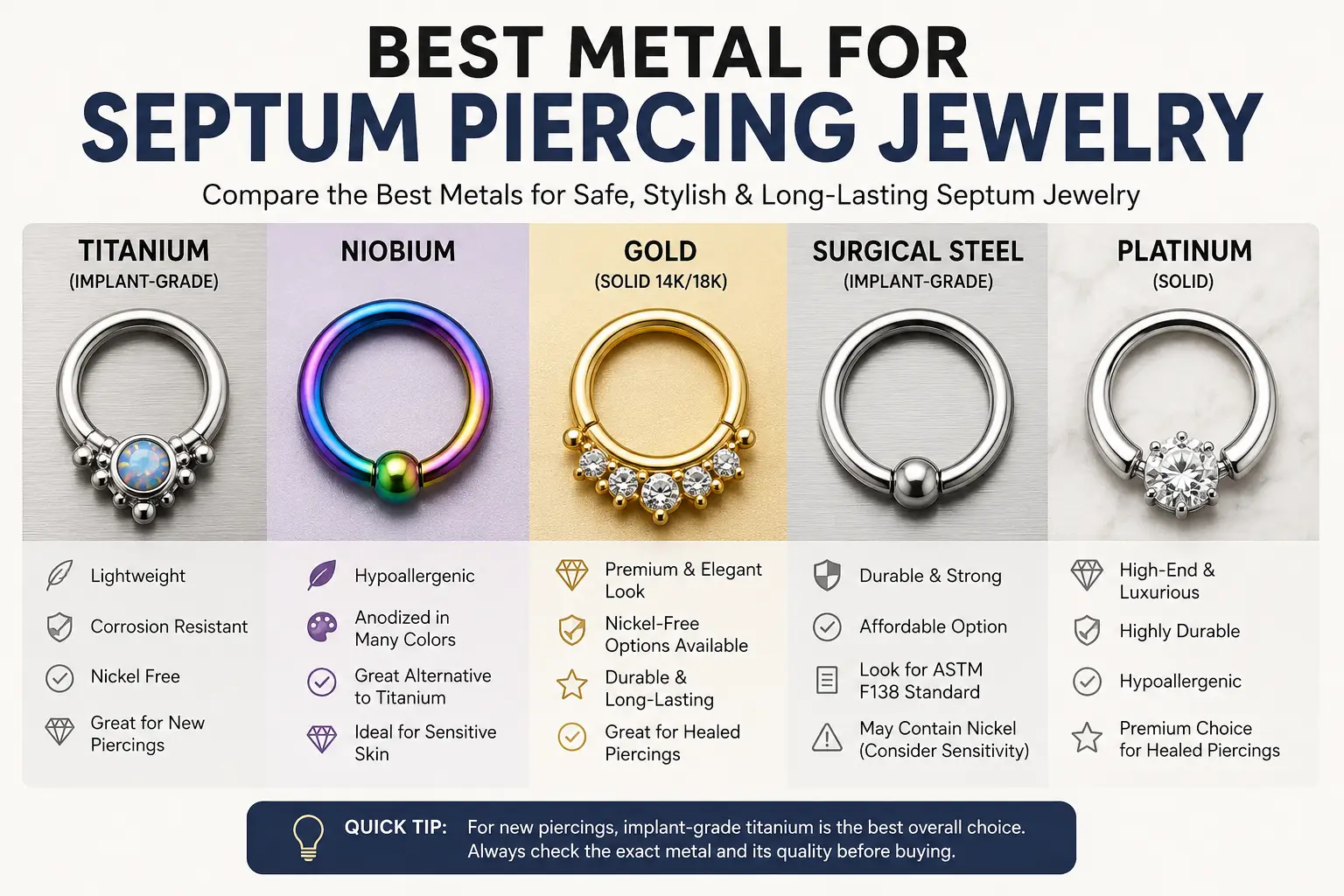
When I started looking at septum jewelry, I quickly learned that the metal matters just as much as the style. A beautiful septum ring is not a good choice if the material irritates my skin or is poorly made.
For me, implant-grade titanium is the best general choice for a new septum piercing. It is lightweight and a good option for people who are concerned about nickel sensitivity. Niobium and certain solid gold jewelry can also be good choices, while some specific grades of steel may work for people who tolerate them.
The key is to look beyond words such as surgical steel or hypoallergenic. I want to know exactly what the jewelry is made from and, where relevant, whether it meets a recognized material standard.
What Is the Best Metal for Septum Piercing Jewelry?
If I had to choose one metal for a new septum piercing, I would pick implant-grade titanium.
Titanium is lightweight and is commonly used for body jewelry. Specific implant-grade titanium, such as titanium meeting ASTM F136 or ISO 5832-3 standards, is a strong option for a healing piercing.
That does not mean titanium is the only suitable material.
Depending on the jewelry and the person, other options include:
- Niobium
- Solid 14K or 18K nickel-free gold
- Specific implant-grade steel
- Solid nickel-free platinum
For me, the important part is the exact material and its quality. I would rather buy a simple titanium septum ring with a known specification than an attractive ring made from an unknown metal.
Why Does Septum Jewelry Metal Matter?
A septum piercing creates a fresh wound, so the jewelry stays in direct contact with the healing tissue.
That means the metal can affect how comfortable the piercing feels during healing.
When I choose septum jewelry, I look at several things:
- What metal is it?
- Is the exact material identified?
- Is it made for body piercing?
- Does it have a recognized material standard?
- Is the surface smooth?
- Is the jewelry properly sized?
- Does it contain nickel or other metals that may cause a reaction?
I also pay attention to the finish. A good material can still be a poor choice if the jewelry has scratches, rough edges, or a damaged surface.
Best Metals for Septum Piercing Jewelry
There are several metals worth considering. I would rank them based on the type of piercing and what I need from the jewelry.
1. Implant-Grade Titanium
Implant-grade titanium is my first choice for a new septum piercing.
Titanium is lightweight and has a strong track record in body jewelry. It is also a good option for people who are concerned about nickel sensitivity.
When I shop for titanium septum jewelry, I look for a specific grade rather than simply trusting the word titanium.
One useful specification is ASTM F136 titanium. ISO 5832-3 is another material standard associated with titanium alloys used for surgical implants.
Why I Like Titanium Septum Jewelry
Titanium has several useful features:
- Lightweight
- Corrosion resistant
- Often a good choice for people concerned about nickel
- Available in many jewelry styles
- Can be anodized to create different colors
- Suitable for fresh and healed piercings when the jewelry is properly made and fitted
I also like that titanium does not have to look plain.
Anodized titanium can come in different colors, so I can get a colored septum ring without relying on a surface coating.
Is Titanium Good for a New Septum Piercing?
Yes, proper implant-grade titanium is one of the strongest choices for a new septum piercing.
I would still have the piercer choose the correct size, gauge, and jewelry style for my anatomy.
The metal alone does not make a piece of jewelry suitable. The fit and construction matter too.
How Can I Tell if Septum Jewelry Is Implant-Grade Titanium?

This is something I would check before buying.
I do not rely only on a product title that says titanium. I look for a specific material standard, such as ASTM F136 or another recognized specification that identifies the titanium alloy.
I would also check whether the seller can provide clear material information or documentation.
A listing that only says:
Titanium septum ring
does not give me as much information as one that identifies the actual titanium grade.
If the seller cannot tell me what type of titanium the jewelry uses, I would choose another piece.
2. Niobium
Niobium is another metal I would consider for septum jewelry.
It is similar to titanium in some ways and has been used for body jewelry for many years. It can also be anodized to create different colors.
When I look at niobium jewelry, I want the material to be clearly identified rather than simply labeled as a generic metal.
Why Choose Niobium Septum Jewelry?
I like niobium because it offers another option for people who want a well-tolerated metal.
It can be a good choice for:
- People concerned about metal sensitivity
- People who want colored jewelry
- People who want an alternative to titanium
- Healed septum piercings
- People who prefer the look of niobium jewelry
Niobium can also be anodized black, which gives it a different appearance from many anodized titanium pieces.
Is Niobium Good for a Septum Piercing?
Yes, niobium can be a suitable material for septum jewelry.
If I were choosing it for a new piercing, I would still buy it from a reputable piercer or jewelry maker and make sure the piece is made specifically for body piercing.
Titanium vs Niobium for Septum Jewelry

Both are useful options, but I would choose between them based on what I need.
Titanium has a major advantage because specific implant-grade titanium has clearly recognized standards, such as ASTM F136. It is also very lightweight.
Niobium is another good option and can be anodized in different colors. It can be especially appealing if I want a black or colored piece.
If both pieces were well made and appropriate for my piercing, I would be comfortable considering either.
For a new piercing, though, implant-grade titanium would still be my first choice.
3. Solid Gold
Gold is another option, especially if I want a more premium-looking septum ring.
But I would be very careful about the type of gold.
I would look for solid, nickel-free gold, rather than gold-plated jewelry.
Suitable body jewelry can include solid 14K or higher nickel-free gold. The exact alloy matters because different gold jewelry can contain different metals.
14K Gold vs 18K Gold
Both can be suitable in the right jewelry.
14K gold contains a larger proportion of other metals mixed with the gold.
18K gold contains a higher percentage of pure gold.
I would not automatically assume that 18K is always better for a piercing. What matters is the exact alloy, its quality, and whether the jewelry is made appropriately for body piercing.
Yellow Gold
Yellow gold gives me the traditional gold appearance.
For a septum ring, I like how it can make a simple clicker or hoop look more noticeable without needing a complicated design.
Rose Gold
Rose gold contains copper and other alloying metals that create its pink tone.
If I wanted rose gold septum jewelry, I would pay close attention to the exact alloy rather than buying based only on the color.
White Gold
White gold can contain different alloying metals depending on how it is made.
Because of that, I would be careful with white gold if I have a known metal sensitivity.
I would want to know exactly what the alloy contains before putting it into a healing septum piercing.
4. Implant-Grade Stainless Steel
Stainless steel is a little more complicated.
The term surgical steel can refer to different steel alloys. So I would not assume that every piece labeled surgical steel is suitable for a piercing.
Some specific steel grades are recognized for body jewelry, including steel that meets standards such as ASTM F138. Some implant-grade stainless steels are also covered by standards such as ISO 5832-1.
Is Surgical Steel Safe for a Septum Piercing?

I would not use the phrase surgical steel as a guarantee of suitability.
Instead, I would ask:
What exact grade is the jewelry?
That question tells me much more.
Some suitable implant-grade steel can be a good choice, but steel can contain nickel. If I have a known nickel sensitivity, I would lean toward implant-grade titanium instead.
Titanium vs Surgical Steel
For me, titanium has the easier starting point.
| Feature | Titanium | Implant-grade steel |
| Lightweight | Yes | Heavier |
| Nickel concern | Very low with appropriate titanium | Can contain nickel |
| New piercing | Strong option | Some specific grades may be suitable |
| Sensitive skin | Often preferred | May not suit people sensitive to nickel |
| Color options | Can be anodized | More limited |
| Cost | Usually moderate | Often less expensive |
The biggest mistake I would avoid is treating all stainless steel jewelry as the same.
5. Platinum
Platinum is another high-quality metal that can be used for body jewelry.
It is durable and can be a good option for someone who wants premium jewelry.
The problem for me is the price.
Platinum septum jewelry is usually much more expensive than titanium or steel, so I would not choose it unless I specifically wanted platinum.
For most people, I think titanium gives a better balance of quality, comfort, and price.
Titanium vs Gold vs Niobium vs Steel
When I compare the main septum jewelry metals, this is how I would look at them:
| Metal | Main benefit | Good for | What I check |
| Implant-grade titanium | Lightweight | New and healed piercings | ASTM/ISO specification |
| Niobium | Good alternative | Sensitive users and colored jewelry | Exact material |
| Solid gold | Premium appearance | Suitable piercings | Nickel-free alloy |
| Implant-grade steel | Durable and affordable | Suitable users | ASTM F138 |
| Platinum | Premium material | High-end jewelry | Exact alloy |
I would not choose based on appearance alone.
What Does Implant-Grade Mean?
When jewelry is described as implant-grade, I look for the specific material standard behind that claim.
For example, ASTM F136 identifies a specific titanium alloy standard, while ASTM F138 identifies a particular stainless-steel alloy specification.
That is much more useful than simply seeing words such as medical grade, surgical steel, or high quality.
For me, the important point is this:
The exact material specification matters more than a broad marketing label.
If a seller says a septum ring is implant-grade but does not provide any useful information about the material, I would ask for more details before buying.
What Is the Best Metal for a New Septum Piercing?

For a new septum piercing, I would choose implant-grade titanium.
It gives me a good combination of:
- Low weight
- Good corrosion resistance
- Good compatibility
- Wide availability
- Many style options
- Color choices through anodizing
I would also let my piercer confirm that the jewelry is properly sized for my anatomy.
The jewelry should not be so tight that it puts pressure on the piercing, and it should not be so large that it constantly catches or moves.
What Is the Best Metal for Sensitive Skin?
If I have sensitive skin or know that I react to certain metals, I would start by looking at implant-grade titanium.
Niobium is another option I would consider.
I would be more careful with steel because some steel alloys contain nickel.
I would also check the alloy used in gold jewelry rather than assuming every gold piece is suitable.
The word hypoallergenic alone would not be enough for me. I want to know the actual material.
What Is the Best Metal for a Nickel Allergy?
If I had a known nickel allergy, I would start by asking my piercer about implant-grade titanium or niobium and confirming the exact material before choosing the jewelry.
I would not treat any material as a guaranteed allergy-free solution.
If I already know that certain metals cause reactions for me, I would share that information with my piercer before the piercing or jewelry change.
Is Gold-Plated Septum Jewelry Safe?
Gold-plated jewelry is different from solid gold.
With plated jewelry, a thin layer of gold sits over another material.
The problem is that the gold layer can wear away over time, exposing the material underneath.
Because of that, I would not choose ordinary gold-plated jewelry for a fresh septum piercing.
If I want a gold look, I would rather choose suitable solid gold or consider anodized titanium that gives me a gold-colored appearance.
Solid Gold vs Gold-Plated Septum Jewelry

The difference is simple:
Solid gold: The jewelry is made from a gold alloy throughout.
Gold plated: A thin gold layer covers another material.
I would always check which one I am buying.
A product page showing a gold-colored ring does not automatically mean the ring is solid gold.
Is Sterling Silver Good for Septum Jewelry?
I would avoid using sterling silver as my first choice for septum jewelry, especially during healing.
Silver can tarnish and is generally not the material I would choose for a healing piercing.
If I want a silver-colored septum ring, I would choose implant-grade titanium or another suitable body-jewelry material instead.
What Metals Should I Avoid for a Septum Piercing?
I would avoid jewelry made from unknown or poorly identified metals.
I would also be careful with:
- Mystery metal
- Cheap plated jewelry
- Jewelry with an unknown alloy
- Jewelry with damaged plating
- Jewelry with rough surfaces
- Unspecified stainless steel
- Low-quality fashion jewelry
The main rule I follow is simple:
If I cannot find out what the jewelry is made from, I would not put it in a healing piercing.
Why Nickel Matters in Septum Jewelry
Nickel is one reason I pay attention to jewelry material.
Some people develop contact dermatitis or irritation from nickel exposure.
This is especially worth considering if I have already noticed itching, redness, rash, or irritation from certain jewelry.
Titanium is often a useful option for people concerned about nickel sensitivity, while some steel alloys contain nickel.
I would not try to diagnose a reaction myself. If my piercing stays irritated or develops unusual symptoms, I would have it checked by a qualified professional.
Does Jewelry Material Matter After a Septum Piercing Heals?
Yes, but I usually have more options once the piercing is fully healed.
With a healed septum, I can consider:
- Titanium
- Niobium
- Suitable solid gold
- Suitable implant-grade steel
- Platinum
I still want good-quality jewelry with a smooth surface and secure closure.
A healed piercing does not mean that poor-quality metal suddenly becomes a good choice.
Does the Metal Affect Septum Jewelry Style?
The metal and the style are two separate choices.
For example, I can find:
- Titanium clickers
- Gold clickers
- Niobium rings
- Titanium horseshoes
- Gold horseshoes
- Steel segment rings
So I would first decide what material I want and then choose the jewelry style.
This gives me much more flexibility.
If I want a gold appearance but prefer titanium, for example, anodized titanium can give me a different color without switching to solid gold.
How I Choose the Best Metal for Septum Jewelry

When I buy septum jewelry, I use a simple checklist.
1. I Check the Exact Metal
I look for a specific material rather than a vague description.
For titanium, I look for an appropriate ASTM or ISO specification.
2. I Check the Jewelry Grade
I do not treat the words surgical, medical, or hypoallergenic as enough information.
I want to know what standard or material specification the jewelry meets.
3. I Look for Material Documentation
If a seller claims that jewelry is implant-grade, I want clear information supporting that claim.
I would look for the material specification, manufacturer information, or documentation showing what the jewelry is actually made from.
If the seller cannot provide useful material information, I would choose another piece.
4. I Think About My Skin
If I know I am sensitive to nickel, I would avoid taking chances with an unknown alloy.
5. I Consider Whether the Piercing Is New or Healed
For a fresh piercing, I would be more selective about material, surface finish, fit, and jewelry construction.
6. I Check the Surface
The jewelry should feel smooth.
I would avoid pieces with:
- Scratches
- Rough edges
- Burrs
- Damaged plating
- Visible manufacturing defects
7. I Check the Fit
Even a good material can cause problems if the jewelry does not fit properly.
The gauge and diameter should match the piercing and my anatomy.
How I Would Choose Between Titanium, Gold, Niobium and Steel

If I wanted a quick decision, I would use this guide:
For a new septum piercing:
I would choose implant-grade titanium.
For sensitive skin or nickel concerns:
I would look at implant-grade titanium or niobium.
For a premium look:
I would consider suitable solid nickel-free gold.
For a lower-cost option:
I would look at a specific implant-grade steel rather than generic surgical steel.
For high-end jewelry:
I would consider platinum if the price is not an issue.
For a gold-colored look without solid gold:
I would consider anodized titanium.
Common Mistakes I Avoid When Buying Septum Jewelry
Choosing Jewelry Only Because It Looks Good
A ring can look great online and still be made from poor-quality material.
I check the metal before I think about the design.
Trusting the Words Hypoallergenic or Surgical
These words alone do not tell me enough about the material.
I want the exact metal and, where relevant, its specification.
Buying Gold-Plated Jewelry for a Fresh Piercing
I would rather use suitable solid gold or another appropriate body-jewelry material.
Ignoring Nickel Sensitivity
If I know I react to nickel, I would not gamble on an unknown alloy.
Buying From a Seller That Does Not Identify the Material
If a listing does not tell me what the jewelry is made from, I would move on to another option.
Forgetting About Surface Quality
The material is only one part of good jewelry.
I also want a smooth, well-finished surface without rough areas or defects.
Choosing the Wrong Size
The best metal cannot fix a poorly fitted septum ring.
I would make sure the gauge and diameter are appropriate before buying.
What Should I Look for When Buying Septum Jewelry?
Before buying, I would check these points:
- Exact metal identified
- Recognized material specification where applicable
- Material documentation when available
- Smooth surface
- No peeling coating
- No rough edges
- Correct gauge
- Correct diameter
- Secure closure
- Jewelry made specifically for body piercing
- Reliable seller or professional piercer
For a fresh piercing, I would have a professional piercer select or approve the jewelry rather than making the decision based only on an online product photo.
My Quick Ranking of Septum Jewelry Metals
If I had to rank the common options for different needs, this is how I would do it:
Best Overall: Implant-Grade Titanium
This would be my first choice for most new septum piercings.
Best Alternative: Niobium
I would consider niobium when I want another well-tolerated metal and more color choices.
Best Premium Choice: Solid Gold
I would choose suitable solid nickel-free gold when I want a more luxurious appearance.
Best Budget-Friendly Choice: Specific Implant-Grade Steel
I would consider it if I know I tolerate the material and the exact grade is identified.
Best High-End Choice: Platinum
I would choose platinum mainly if I specifically wanted the material and was comfortable with the higher price.
Final Thoughts
After comparing the main septum piercing jewelry materials, I would keep my choice simple.
For a new septum piercing, implant-grade titanium is my first choice. It is lightweight, widely available, and a good option for people who are concerned about nickel sensitivity.
If I wanted an alternative, I would look at niobium. If I wanted something more premium, I would consider solid nickel-free gold. Specific implant-grade steel can also work for people who tolerate it, while platinum is a high-end option.
The biggest lesson for me is that the name of the metal is not enough. I want to know the exact material, its grade when relevant, the quality of the surface, and whether the jewelry fits my piercing properly.
If I were choosing septum jewelry today, I would put material quality first, fit second, and appearance third. Once those three things are right, I have plenty of room to choose a septum ring style that matches my personal taste.
Frequently Asked Questions
What is the best metal for septum piercing jewelry?
For a new septum piercing, I would choose implant-grade titanium. Niobium, certain solid nickel-free gold, and specific implant-grade steel can also be suitable depending on the jewelry and the person.
What is the safest metal for a septum piercing?
There is no single metal that is guaranteed to work for every person. Implant-grade titanium is a strong general choice because it is lightweight and often suitable for people concerned about nickel sensitivity.
Is titanium good for septum piercings?
Yes. Implant-grade titanium is one of my preferred choices for septum jewelry, especially for a new piercing.
Is niobium good for septum jewelry?
Yes. Niobium is another material used for body jewelry and can be a good alternative to titanium.
Is titanium better than niobium for a septum piercing?
I would choose implant-grade titanium first for a new piercing because specific titanium grades have well-defined material standards and the metal is very lightweight. Niobium is still a good alternative, especially if I like its appearance or want a different material option.
Is gold safe for septum piercings?
Suitable solid nickel-free gold can be used for septum jewelry. I would avoid assuming that all gold jewelry is suitable because different gold alloys can contain different metals.
Is 14K or 18K gold better for a septum piercing?
Both can be suitable when the jewelry is made from an appropriate nickel-free alloy. I would focus on the exact alloy and jewelry quality rather than choosing based only on the karat number.
Is surgical steel safe for a septum piercing?
Some specific implant-grade steel is suitable, but surgical steel is a broad term. I would look for the exact grade instead of assuming that every piece labeled surgical steel is suitable.
Is stainless steel good for a septum piercing?
Some specific stainless-steel grades are suitable for body jewelry. I would check the exact material specification because stainless steel can contain nickel.
What is the best metal for sensitive skin?
I would start with implant-grade titanium or niobium. If I have a known metal allergy, I would discuss the material choice with my piercer.
What is the best metal for a nickel allergy?
If I had a known nickel allergy, I would ask my piercer about implant-grade titanium or niobium and confirm the exact material before choosing the jewelry.
Is gold-plated septum jewelry safe?
I would not choose ordinary gold-plated jewelry for a fresh septum piercing. The coating can wear away and expose the underlying material.
Is sterling silver safe for septum jewelry?
I would not use sterling silver as my first choice for a healing septum piercing. If I want a silver-colored appearance, I would choose a suitable titanium or other body-jewelry option instead.
What does ASTM F136 mean?
ASTM F136 is a material specification for a type of titanium alloy used for surgical implant applications. For body jewelry, it is one of the material standards I would look for when choosing implant-grade titanium.
What is ASTM F138?
ASTM F138 is a specification for a particular stainless-steel alloy used for surgical implant applications. For septum jewelry, I would look for the exact specification rather than relying only on the phrase surgical steel.
Can titanium septum jewelry be colored?
Yes. Titanium can be anodized to produce different colors. I like this option when I want colored septum jewelry without changing to a different metal.
Can I wear gold septum jewelry in a new piercing?
Suitable solid nickel-free gold can be used for body jewelry, but I would have a professional piercer confirm that the specific piece is appropriate for a new piercing.
Does the metal matter after my septum piercing heals?
Yes. A healed piercing gives me more flexibility, but I would still choose quality jewelry with a suitable material, smooth surface, and proper fit.
Is expensive septum jewelry always better?
No. Price does not tell me whether a piece is suitable for a piercing. I care more about the exact material, material grade, surface quality, construction, and fit.
How do I know if septum jewelry is high quality?
I look for a clearly identified material, recognized specifications where applicable, a smooth surface, secure closure, proper sizing, and a reputable seller or piercer.
