


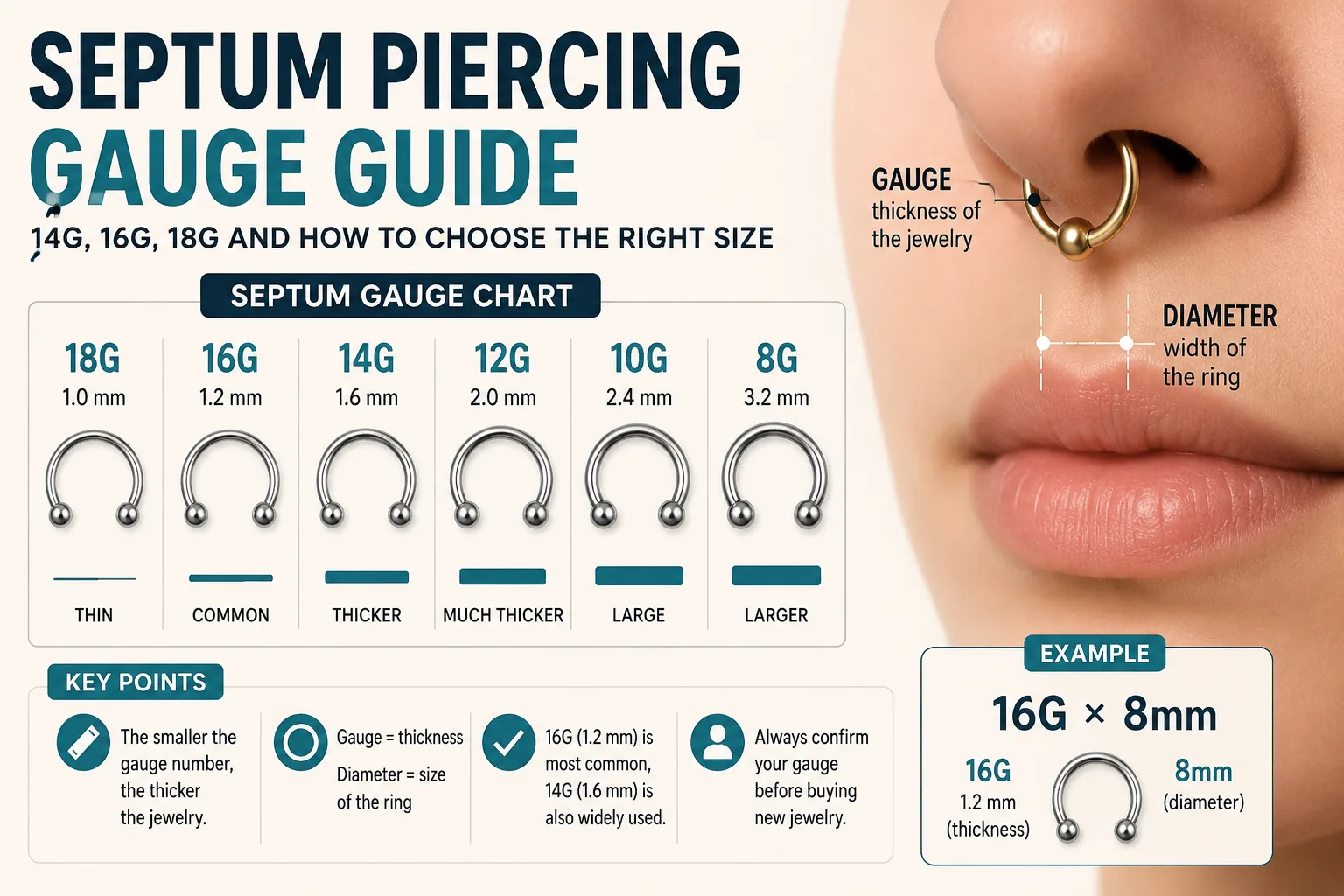
When I look at septum jewelry, the gauge can be one of the most confusing parts. The numbers seem backward at first. A 14G piece is actually thicker than a 16G piece, while an 18G piece is thinner.
I would always check the gauge before buying replacement septum jewelry. I also keep gauge separate from ring diameter because they describe two different parts of the jewelry.
In this guide, I’ll explain the common septum piercing gauge sizes, their millimeter measurements, the difference between 14G and 16G, how to find your gauge, and what to know before changing sizes.
What Is a Septum Piercing Gauge?

A septum piercing gauge tells me how thick the jewelry is.
It does not tell me how wide the ring is or how far the ring hangs below my nose.
Common septum gauges include:
| Gauge | Thickness |
| 18G | 1.0 mm |
| 16G | 1.2 mm |
| 14G | 1.6 mm |
| 12G | 2.0 mm |
| 10G | 2.4 mm |
| 8G | 3.2 mm |
The most common sizes I see for septum jewelry are 16G and 14G, while 18G is also available.
The rule that I always keep in mind is simple:
The smaller the gauge number, the thicker the jewelry.
So:
14G is thicker than 16G.
16G is thicker than 18G.
That is the opposite of what I might expect from the numbers.
What Is the Standard Septum Piercing Gauge?
There is no single gauge that every septum piercing must use.
That said, 16G (1.2 mm) is a very common septum piercing gauge. 14G (1.6 mm) is also commonly used, while some jewelry is available in 18G (1.0 mm).
I would not assume my piercing is 16G just because it is common.
The gauge can depend on:
- My anatomy
- Piercing placement
- The piercer’s technique
- Initial jewelry choice
- The jewelry style
- My future plans
If I do not know my gauge, I would ask the piercer who performed the piercing rather than guessing.
Septum Piercing Gauge Chart

Here is the simple chart I use to compare common septum gauge sizes:
| Septum gauge | Millimeters | Relative thickness |
| 18G | 1.0 mm | Thin |
| 16G | 1.2 mm | Common |
| 14G | 1.6 mm | Thicker |
| 12G | 2.0 mm | Much thicker |
| 10G | 2.4 mm | Large |
| 8G | 3.2 mm | Larger |
I would focus on the first three sizes if I am simply buying regular septum jewelry.
The larger gauges become more relevant if I am intentionally stretching my septum.
Is a Septum Piercing 14G or 16G?

It can be either.
16G is 1.2 mm, while 14G is 1.6 mm. Both are used for septum piercings.
If I am getting a new septum piercing, I would let my piercer decide which gauge is suitable for my anatomy and the jewelry I plan to wear.
I would not choose 14G simply because it is thicker, and I would not choose 16G simply because it is common.
The goal is to use a gauge that suits the piercing.
Is 14G Thicker Than 16G?
Yes.
This is one of the easiest mistakes to make with body jewelry.
- 14G = 1.6 mm
- 16G = 1.2 mm
- 18G = 1.0 mm
So a 14G septum ring has thicker metal than a 16G ring.
I find it easier to ignore the number for a moment and look at the millimeter measurement.
The larger millimeter measurement means thicker jewelry.
What Does 16G Mean for a Septum Piercing?
A 16G septum piercing uses jewelry that is approximately 1.2 mm thick.
This is a common size for septum jewelry, and I can find many horseshoes, circular barbells, rings, and other pieces made in 16G.
If my current jewelry is 16G, I would look for replacement jewelry listed as 16G or 1.2 mm.
I would also check the diameter separately because knowing the gauge alone does not tell me whether the ring will fit my nose correctly.
What Does 14G Mean for a Septum Piercing?
A 14G septum piercing uses jewelry that is approximately 1.6 mm thick.
It is thicker than 16G.
Some people have their septum pierced at 14G, while others reach this size later through stretching.
If I have a 14G piercing, I would buy jewelry that matches that gauge unless a professional piercer recommends a different size.
Is 18G Good for a Septum Piercing?
18G is 1.0 mm, making it thinner than both 16G and 14G.
18G septum jewelry is available, but I would not assume it is the right choice just because I want a thinner-looking ring.
If my piercing was made at 16G, moving to 18G changes the jewelry thickness. I would check with a piercer before making that change, especially if the piercing is still healing.
I would also keep in mind that jewelry availability can vary by gauge. 16G and 14G generally give me more septum jewelry options than some thinner sizes.
Is 16G or 14G Better for a Septum Piercing?
I would not call one universally better.
16G Septum
16G is 1.2 mm.
I would consider it a practical choice because it is common and there are many jewelry options available.
It works well for people who want a standard-looking septum ring without a very thick appearance.
14G Septum
14G is 1.6 mm.
It gives me a thicker jewelry appearance and can be useful for someone who prefers a more substantial ring.
It may also be relevant if I plan to stretch my septum later.
My choice
If I were choosing a new septum gauge, I would not make the decision from appearance alone.
I would have the piercer assess my anatomy and tell me which gauge is suitable for the piercing.
How Do I Know What Gauge My Septum Is?

If I don’t know my septum piercing gauge, I would check it before ordering new jewelry.
Here are the easiest options.
Ask Your Piercer
This is the easiest option if I remember where I got the piercing.
The piercer may have the original jewelry size recorded.
Check the Jewelry Packaging
If I still have the original packaging, the gauge may be listed as:
- 16G
- 14G
- 18G
- 1.2 mm
- 1.6 mm
- 1.0 mm
Check the Product Listing
If I bought my current jewelry online, I would check the original product page.
The listing may give both the gauge and diameter.
Measure the Jewelry
If I need to measure the thickness myself, a digital caliper can give me a better reading than trying to judge the jewelry by eye.
I would measure the jewelry, not poke or measure the piercing hole.
Can I Tell My Septum Gauge by Looking at It?
I would not rely on appearance alone.
The difference between common gauges can be quite small.
For example:
- 18G = 1.0 mm
- 16G = 1.2 mm
- 14G = 1.6 mm
A 16G piece and an 18G piece can look very similar in a photo.
If I am ordering replacement jewelry, I would confirm the measurement instead of guessing.
Is Septum Gauge the Same as Septum Ring Size?
No.
This is one of the most useful things I learned about septum jewelry sizing.
Gauge tells me the thickness of the jewelry.
Diameter tells me the size of the ring.
For example, a jewelry listing might say:
16G × 8 mm
In this example:
- 16G = 1.2 mm thick
- 8 mm = ring diameter
The 8 mm measurement does not mean the jewelry is 8 mm thick.
This is why I would check both measurements before ordering a new septum ring.
What Is the Difference Between Gauge and Diameter?

I think of these as two separate measurements.
Gauge
Gauge tells me how thick the metal is.
For example:
16G = 1.2 mm
Diameter
Diameter tells me the size of the circular jewelry.
For example:
8 mm diameter
So if I see:
16G, 8 mm
I know that the jewelry is 1.2 mm thick and has an 8 mm diameter.
A different ring could be:
16G, 10 mm
Both pieces are 16G, so both have the same thickness. The second ring is simply larger in diameter.
Does a Bigger Septum Ring Mean a Bigger Gauge?
No.
A bigger ring does not automatically have a bigger gauge.
For example:
16G × 8 mm
and
16G × 10 mm
have the same gauge.
The difference is the diameter.
This matters because I could order a ring that has the correct gauge but is too large or too small in diameter for the look and fit I want.
That is why I would never shop for septum jewelry by gauge alone.
Can I Wear a Different Gauge in My Septum?
Sometimes, but I would not treat it as a simple jewelry swap.
If my piercing is healed, a thinner piece may fit into a piercing that was originally made with thicker jewelry. But the fit can change.
Going from a thinner gauge to a thicker gauge is different because the thicker jewelry may not fit comfortably without stretching.
For example, moving from:
16G → 14G
means going from 1.2 mm → 1.6 mm.
I would not force the thicker jewelry into the piercing.
Can I Change From 16G to 14G?

It may be possible if the piercing is fully healed and suitable for stretching, but I would not force 14G jewelry into a 16G piercing.
The difference is:
16G = 1.2 mm
14G = 1.6 mm
That is a noticeable increase in thickness.
If I wanted to stretch my septum, I would do it gradually and use proper jewelry and technique. If I was unsure, I would have a professional piercer help me.
I would also avoid stretching a piercing that is still healing.
For more guidance on safe stretching practices, I would follow the advice from the Association of Professional Piercers stretching guide.
Can I Change From 14G to 16G?
Going from 14G to 16G means moving to thinner jewelry.
That is a different situation from stretching from 16G to 14G.
If my piercing is healed, 16G jewelry may fit into a 14G piercing, but I would still check how the jewelry sits and avoid repeatedly changing between sizes.
If I am unsure about the fit, I would ask a piercer to check it.
Does Septum Gauge Affect How the Piercing Looks?
Yes, but gauge is only one part of the appearance.
A thicker gauge can give the jewelry a more noticeable and substantial look.
A thinner gauge can create a lighter, more delicate appearance.
But the overall look also depends on:
- Ring diameter
- Jewelry shape
- Bead size
- Decorations
- Metal color
- Nose anatomy
- Piercing placement
For example, two people could wear 16G septum rings and still have very different looks because their ring diameters and jewelry designs are different.
Does Septum Gauge Affect Jewelry Choices?

Yes.
When I shop for septum jewelry, I check whether the piece is available in my gauge.
A 16G piercing needs jewelry made for that thickness. A 14G piercing needs jewelry made for 14G.
I would not assume that any septum ring will fit just because it looks similar to my current one.
I would check:
- Gauge
- Diameter
- Material
- Jewelry style
- Closure
This is especially important when buying clickers, horseshoes, circular barbells, and decorative septum rings.
What Gauge Should I Get for a New Septum Piercing?
I would not choose the gauge by myself based on a chart.
16G (1.2 mm) is a common choice, and 14G (1.6 mm) is also used for septum piercings. Some jewelry is also made in 18G (1.0 mm).
The right choice can depend on my anatomy, piercing placement, jewelry choice, and what I want to do with the piercing later.
If I plan to wear a certain type of jewelry or eventually stretch my septum, I would mention that before the piercing.
Does Septum Gauge Affect Stretching?
Yes.
If I want a larger gauge, I would need to treat it as stretching rather than simply changing jewelry.
For example:
16G → 14G → 12G
means the jewelry gets progressively thicker.
I would never jump several sizes at once.
I would also wait until the piercing is fully healed before considering stretching.
If stretching is my long-term goal, I would discuss it with a professional piercer before starting.
Common Septum Gauge Mistakes I Would Avoid
Thinking a Higher Number Means Thicker Jewelry
It does not.
14G is thicker than 16G.
Buying Jewelry by Diameter Only
An 8 mm ring can be made in different gauges.
Assuming Everyone Has 16G
16G is common, but it is not the only septum gauge.
Guessing My Gauge From a Photo
The differences are too small for a reliable visual guess.
Forcing a Larger Gauge Into the Piercing
I would never force thicker jewelry through a smaller piercing.
Confusing Gauge With Diameter
These are separate measurements.
Stretching Too Quickly
I would give my septum enough time to heal before considering a larger gauge.
Buying Jewelry Without Checking the Specifications
Before I order, I would check the gauge, diameter, material, and jewelry style.
Septum Gauge vs. Septum Ring Diameter
This is worth repeating because it causes so many sizing mistakes.
If I see:
14G × 10 mm
it means:
- 14G = 1.6 mm thick
- 10 mm = ring diameter
If I see:
16G × 8 mm
it means:
- 16G = 1.2 mm thick
- 8 mm = ring diameter
So I could have a smaller diameter ring with a thicker gauge or a larger diameter ring with a thinner gauge.
That is why I would check both numbers before buying jewelry.
My Final Take on Septum Piercing Gauge

For me, the easiest way to think about septum gauge is to forget that the numbers seem backward.
14G = 1.6 mm
16G = 1.2 mm
18G = 1.0 mm
The smaller the gauge number, the thicker the jewelry.
If I were getting a new septum piercing, I would let a professional piercer choose the gauge based on my anatomy and the jewelry I plan to wear. If I already have a healed piercing, I would confirm my current gauge before buying replacement jewelry.
I would also remember that gauge is only the thickness of the jewelry. Ring diameter is a separate measurement, and I need both pieces of information to choose jewelry that fits the way I want.
Most importantly, I would not force a different gauge into my piercing. If I want to move from 16G to 14G or go to a larger size, I would treat that as a stretching decision rather than a normal jewelry change.
FAQs About Septum Piercing Gauge
Can I use 16G jewelry in an 18G septum piercing?
I would not assume that it will fit comfortably. 16G jewelry is thicker than 18G jewelry, so inserting it may require stretching. If the piercing was made at 18G, I would ask a professional piercer before moving to 16G.
Can I use 18G jewelry in a 16G septum piercing?
18G is thinner than 16G, so it may fit a healed 16G piercing. However, the jewelry may sit differently, and the piercing can adjust to the smaller size. I would check with a piercer if I am unsure.
Is 12G too big for a septum piercing?
12G is 2.0 mm, so it is much thicker than common 16G and 14G jewelry. It can be used by people who intentionally stretch their septum, but I would not treat 12G as a normal replacement size for a smaller piercing.
Does septum gauge affect comfort?
Gauge can affect how jewelry fits and feels, but comfort also depends on the jewelry’s diameter, shape, material, placement, and individual anatomy. I would not choose a gauge based on comfort alone.
Can a septum piercing shrink if I wear a smaller gauge?
It can. Piercing tissue can adjust to jewelry size, and the amount of change varies from person to person. If I move to thinner jewelry, I would keep in mind that returning to a larger gauge later may require professional help.
Can I sleep with a different gauge septum ring?
If the piercing is healed and the jewelry fits correctly, sleeping with it may be fine, but I would make sure the jewelry is secure and not causing pressure or irritation. I would be more cautious with a new or healing piercing.
What gauge is best for a septum clicker?
A clicker does not have one universal gauge. I would first find the gauge of my piercing and then choose a clicker made in that gauge. I would also check its diameter because the gauge alone does not tell me how the clicker will sit.
Can septum jewelry have the same diameter but different gauges?
Yes. Two rings can have the same diameter but different gauges. For example, an 8 mm ring can be made in 14G or 16G. The diameter controls the ring’s overall size, while gauge controls its thickness.
Is a lower gauge better for stretching?
A lower gauge number means thicker jewelry, but that does not mean it is automatically better for stretching. I would increase size gradually and only stretch a fully healed piercing that is ready for the next size.
How often should I change my septum gauge?
There is no set schedule for changing gauge. If I am simply replacing jewelry with the same gauge, I do not need to change the gauge at all. If I want a thicker gauge, I would wait until the piercing is fully healed and get advice from a professional piercer.
