


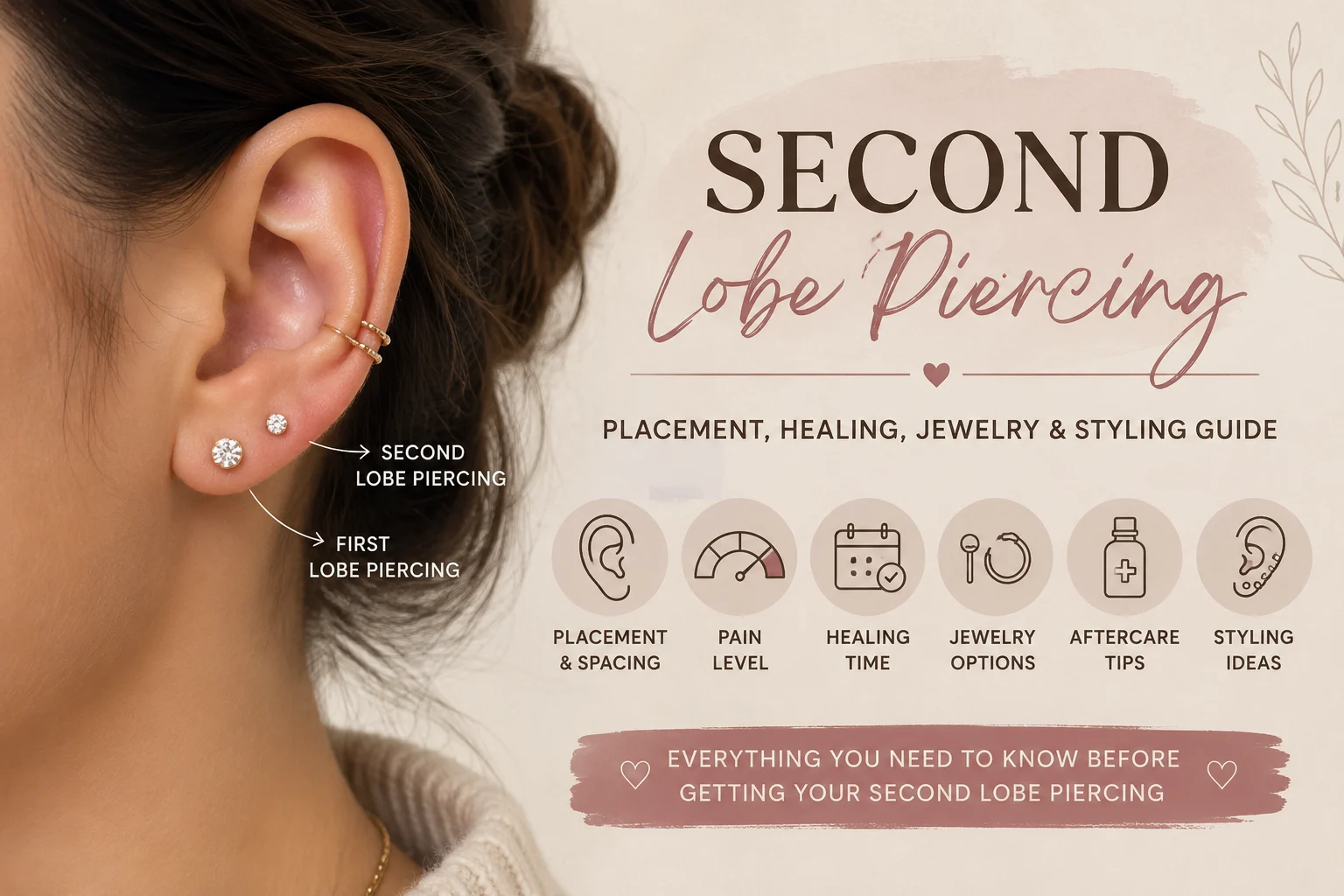
Getting a second lobe piercing can seem like a small change, but I quickly learned that the placement matters much more than I first thought. The second hole has to work with my first lobe piercing, the shape of my ear, and the jewelry I want to wear later.
A good second lobe piercing can give me a simple double-earring look, create the base for an ear stack, or become the starting point for a more detailed curated ear.
I also don’t want to treat it like a first lobe piercing all over again. The first hole can be placed on its own, while the second lobe has to be positioned in relation to an existing hole.
In this guide, I cover the things I would look at before getting one, including second lobe piercing placement, spacing, pain, healing, jewelry, aftercare, styling, and common problems.
What Is a Second Lobe Piercing?
A second lobe piercing is a new piercing placed above the original earlobe piercing. When it stays within the soft lobe tissue, it is still a lobe piercing rather than a cartilage piercing.
I think of it as an extension of my first lobe rather than a completely separate piercing. The two holes work together, so I need to think about their distance, alignment, and the earrings I want to wear in both.
A second hole can be placed fairly close to the first for a compact stacked look. I can also leave more space if I want to wear larger studs, hoops, or other jewelry.
This is why I would plan the jewelry before the piercing instead of choosing the position first and figuring out the earrings later.
Where Does a Second Lobe Piercing Go?

A second lobe piercing normally sits above the first lobe hole while following the natural shape of the earlobe.
The exact position depends on my ear anatomy. The size of my lobe, the position of the first piercing, the jewelry I plan to wear, and whether I want a third lobe later can all affect the final placement.
I would have the piercer mark the placement first and look at it from different angles before agreeing to the piercing.
Standard Second Lobe Placement
For a traditional double lobe look, the second hole sits above the first and follows the same general vertical line.
Some guides give measurements around 5–8 mm, while others use wider spacing such as 8–10 mm. This difference is a good reason not to treat one measurement as a rule for every ear.
What matters most to me is whether the two earrings will have enough room without looking crowded.
Close-Stacked Placement
A closer second lobe piercing creates a compact look.
I would choose this style if I mainly planned to wear:
- Tiny studs
- Small gemstones
- Matching flat-back earrings
- Small huggies
- Minimal jewelry
The smaller gap can make the two piercings look like one intentional set.
Wider Second Lobe Placement
A wider gap gives me more room to experiment with jewelry.
This can work well if I want a larger first-lobe stud with a smaller second-lobe hoop. It can also help if I plan to add another lobe piercing later.
Planning for a Third Lobe
If I already know that I want a third lobe piercing, I would tell the piercer before the second hole is marked.
The second and third holes need to work together. A placement that looks perfect with two earrings may leave poor spacing for a third.
Planning the complete lobe stack first can save me from having to work around awkward spacing later.
How Far Apart Should First and Second Lobe Piercings Be?

There is no single spacing that works for every ear.
Current piercing guides give different general measurements, including around 5–8 mm and 8–10 mm.
I would use these numbers as general reference points rather than a fixed target.
The final spacing should take into account:
- The size of my earlobe
- The position of my first piercing
- The size of my earrings
- Whether I want hoops
- Whether I want huggies
- Whether I plan a third lobe
- The natural curve of my ear
- The amount of soft tissue available
For example, a small stud can work well with a tighter second lobe placement. If I want two larger hoops, I may need more space.
The jewelry plan should be part of the placement discussion.
Is a Second Lobe Piercing Cartilage?
A properly placed second lobe piercing is generally through the soft earlobe tissue.
The confusion starts when the piercing is placed higher on the ear. As the lobe gets smaller toward the top, the tissue can become firmer and approach the cartilage area.
This is why I would not assume that every piercing called a second or third lobe is exactly the same.
If the planned placement is close to the upper edge of the lobe, I would ask the piercer what tissue the needle will pass through and whether the placement still counts as a lobe piercing.
How Much Does a Second Lobe Piercing Hurt?
A second lobe piercing is usually considered a relatively mild piercing because the needle passes through soft lobe tissue rather than the firmer cartilage found higher on the ear.
I would describe the sensation as a quick pinch followed by some tenderness.
The actual piercing is usually over very quickly. For me, the anticipation would probably be more noticeable than the few seconds of the piercing itself.
Pain is personal, though. Someone who has sensitive ears may have a different experience from someone who barely notices the piercing.
I also wouldn’t use an exact pain score as a promise. A 2 out of 10 for one person can feel very different to another.
How Long Does a Second Lobe Piercing Take to Heal?
A second lobe piercing can settle faster than many cartilage piercings, but I would still give it plenty of time.
Current guides commonly place the healing period somewhere around several weeks to a few months, with Vital giving an average of 2–3 months and another guide giving around 6–8 weeks.
I would not change the jewelry simply because the piercing looks fine from the outside.
A piercing can feel comfortable while the inside is still healing.
During this period, I would avoid unnecessary touching, twisting, pressure, and pulling. I would also keep the original jewelry in for the healing period recommended by my piercer.
Can You Get Second Lobe Piercings on Both Ears at Once?
Yes, it is possible to get a second lobe piercing on both ears in one appointment. The bigger issue for me would be how I am going to sleep while both sides are healing.
If I normally sleep on my side, having fresh piercings on both ears can make nights uncomfortable.
I would also think about:
- Headphones
- Earbuds
- Hair
- Glasses
- Helmets
- Pillow pressure
- Sports
- Work equipment
Some professional piercers may also recommend limiting the number of fresh piercings based on what else is already healing.
If I already had several healing piercings, I would ask before adding another.
Can You Get a Second Lobe and Helix Piercing Together?

It can be possible, but I would not decide based on the number alone.
A second lobe and a helix are different types of piercings with different healing demands. A helix involves cartilage, so it generally requires more patience than a soft-tissue lobe piercing.
I would consider:
- Which ear is being pierced
- Existing healing piercings
- Sleeping position
- Aftercare
- Headphone use
- Whether I can avoid pressure on the area
If my ear already has several healing piercings, I would rather space the appointments out than make the healing process unnecessarily difficult.
Should You Get a Second Lobe Piercing With a Needle or Gun?
I would choose a professional piercing studio that uses a sterile single-use needle.
Placement precision is especially useful for a second lobe piercing because the new hole has to line up with the existing one. A small placement error can become obvious once I put two earrings next to each other.
A professional piercer can also mark the position, assess my anatomy, select suitable jewelry, and make adjustments before the piercing is done.
I would not choose a piercing method based only on price.
The placement stays with me much longer than the appointment itself.
What Jewelry Is Best for a Second Lobe Piercing?

For a fresh second lobe piercing, I would keep the jewelry simple, lightweight, and suitable for healing.
Flat-Back Studs
Flat-back labret studs are one of the options I would consider first for a fresh second lobe.
The flat disc sits against the back of the ear and can be more comfortable than a bulky traditional earring back.
Threadless Jewelry
Threadless jewelry gives me the option of changing decorative tops later without replacing the entire post.
For a fresh piercing, I would still leave jewelry changes to the appropriate stage of healing.
Small Studs
Small studs are simple and easy to manage.
A tiny ball, gemstone, or other low-profile top can give me the double lobe look without adding much weight.
Hoops and Huggies
I like hoops and huggies for a healed second lobe because they create a very different look from a simple stud.
A small huggie can give the ear a clean stacked appearance.
I would wait until the piercing is properly healed before using jewelry that moves freely around the piercing. Movement and snagging can irritate a fresh piercing.
Best Jewelry Materials
For a fresh piercing, I would ask the piercer about suitable body-safe materials such as implant-grade titanium or appropriate solid gold.
Implant-grade titanium is widely used for body jewelry because of its biocompatibility and low weight. Solid 14K or 18K gold can also be an option when it is made appropriately for body piercing.
I would avoid assuming that every item labeled “hypoallergenic” is suitable for a fresh piercing.
What Gauge Is a Second Lobe Piercing?
Second lobe piercings are commonly fitted with 18G or 20G jewelry.
The exact gauge can depend on the piercer, jewelry style, and intended use.
I would not choose the gauge only because one size looks more delicate.
The jewelry needs to fit the piercing properly and suit the planned style. If I think I may want to change jewelry often later, I would tell my piercer before the piercing is done.
How to Care for a Second Lobe Piercing

I would keep the aftercare simple and consistent.
What I Would Do
- Wash my hands before touching the area.
- Use sterile saline as recommended by my piercer.
- Keep the jewelry in place during healing.
- Avoid twisting or rotating the jewelry.
- Keep hair from catching on the jewelry.
- Keep pressure off the piercing while sleeping.
- Dry the area gently after cleaning.
- Keep pillowcases and anything that touches the ear clean.
The general advice from current piercing guides is to avoid unnecessary touching, twisting, pressure, and harsh products during healing.
What I Would Avoid
I would avoid:
- Alcohol
- Hydrogen peroxide
- Picking crusts
- Constantly touching the jewelry
- Twisting the post
- Sleeping directly on the fresh piercing
- Heavy earrings
- Jewelry that repeatedly catches on hair
- Changing the jewelry too early
I also would not try random home remedies if the piercing becomes irritated.
Can You Sleep on a Second Lobe Piercing?
I would avoid direct pressure on a fresh second lobe piercing.
Sleeping on it can create friction and pressure, which may keep the area irritated.
If I had only one fresh second lobe piercing, I could sleep on the other side.
If I had both ears pierced at once, I would need another plan. A travel pillow can sometimes help because the ear can sit in the opening rather than directly against the pillow.
The key is to avoid putting repeated pressure on fresh jewelry.
When Can You Change Second Lobe Jewelry?

I would wait until the piercing has healed enough for a jewelry change.
The outside can look fine before the internal piercing channel has fully settled, so I would not use appearance alone to decide.
I would also consider having a professional piercer perform the first jewelry change if I am unsure whether the piercing is ready.
If the piercing is still swollen, painful, crusty, or easily irritated, I would wait rather than forcing a change.
Second Lobe Piercing Ideas

Once my second lobe is healed, this is where I can have more fun with jewelry.
Matching Studs
A simple matching pair gives me a clean and balanced look.
I can use the same stone or metal in both holes.
Graduated Studs
I can use a larger stud in the first lobe and a smaller one above it.
This creates a natural visual order without needing complicated jewelry.
Stud and Hoop
One of my favorite combinations is a stud in the first hole with a small hoop or huggie in the second.
The different shapes make the two piercings stand out from each other.
Double Hoops
Two small hoops can create a simple stacked look.
I would make sure the hoops have enough space so they do not constantly rub against each other.
Gemstone Pair
I can use two gemstones in different sizes.
For example, a larger stone in the first hole and a smaller matching stone in the second gives the ear a coordinated appearance.
Minimalist Stack
Two tiny studs are enough if I want something subtle.
This works especially well if I wear other small pieces higher on the ear.
Asymmetrical Styling
I don’t have to make both ears identical.
I could have a second lobe piercing on one ear while using a different combination of cartilage or lobe jewelry on the other.
This gives me more freedom to create a curated ear instead of copying the same arrangement on both sides.
Second Lobe vs Third Lobe Piercing

A second lobe piercing is usually the second hole within the soft lobe.
A third lobe sits higher and may approach the area where the soft lobe becomes firmer and transitions toward cartilage.
| Feature | Second Lobe | Third Lobe |
| Position | Above the first lobe | Above the second lobe |
| Tissue | Usually soft lobe tissue | Can approach firmer tissue |
| Jewelry | Studs, huggies, small hoops | Usually smaller jewelry |
| Placement | More room to work with | Anatomy becomes more limiting |
| Planning | Works with first lobe | Needs to work with first and second |
If I plan to have three lobe piercings, I would tell the piercer from the beginning.
That way, the second hole can be positioned with the third hole in mind.
Common Second Lobe Piercing Problems

Most second lobe piercings are straightforward, but irritation can still happen.
Second Lobe Piercing Bump
A small bump can develop from irritation, pressure, friction, jewelry problems, or repeated touching.
I would first look at what might be irritating the piercing.
Am I sleeping on it?
Is my hair catching it?
Is the jewelry too tight?
Am I touching it too much?
Am I changing the jewelry too often?
I would address those factors rather than immediately assuming the bump is an infection.
If the bump continues or becomes worse, I would have a professional assess it.
Swelling and Tenderness
Some swelling and tenderness can happen after a fresh piercing.
I would expect the area to be sensitive at first, but I would pay attention to whether the symptoms are improving or getting worse.
Increasing pain, heat, spreading redness, or other concerning symptoms should not be ignored.
Irritation
Repeated friction is one of the first things I would check if my second lobe becomes irritated.
Hair, headphones, phones, pillows, and jewelry can all make accidental contact with the area.
Sometimes the simplest solution is to stop disturbing the piercing and give it time.
Uneven Placement
This is something I would think about before the piercing rather than after it.
My ears may not be perfectly identical, and the position of the first lobe holes may differ from one ear to the other.
I would ask the piercer to mark both second lobe placements before piercing.
I would then look at the marks from the front and side and make sure I like the overall balance.
Jewelry Embedding
If jewelry starts pressing deeply into the skin or appears to be disappearing into the ear, I would not try to force it out myself.
I would have a professional piercer assess the jewelry as soon as possible.
Severe swelling, worsening pain, spreading redness, fever, pus, or an embedded earring are reasons to seek appropriate professional or medical care.
What If My Second Lobe Piercing Is Uneven?

If my second lobe piercing looks uneven, I would first give the swelling time to settle.
Fresh tissue can look different from healed tissue.
I would also consider whether my ears themselves are different. Most people’s ears are not perfectly symmetrical.
If the placement still looks clearly uneven after swelling has settled, I would ask a professional piercer to examine it.
I would not immediately remove the jewelry and try to pierce the area myself.
If the hole is genuinely placed incorrectly, a piercer can explain whether it is better to keep it, retire it, or plan a new placement after it has healed.
Can a Second Lobe Piercing Stretch?
A second lobe piercing can be affected by heavy jewelry or repeated pulling.
I would keep the initial jewelry lightweight while the piercing heals.
If I eventually want to wear heavier earrings, I would wait until the piercing is fully healed and choose jewelry that does not put unnecessary weight on the hole.
If I already have a stretched first lobe, I would tell my piercer before getting the second hole.
The size and position of the stretched first lobe jewelry can affect how much space is available for the second piercing.
Can You Stretch Your First Lobe With a Second Lobe Piercing?
If I plan to stretch my first lobe, I would think about that before getting the second lobe piercing.
A larger first-lobe plug or tunnel can take up more space than a small standard earring.
That can change how the second lobe jewelry sits.
I would tell the piercer about my stretching plans so the second piercing can be placed with the future jewelry in mind.
How Many Lobe Piercings Can You Get at Once?

There is no single number that works for everyone.
The number of fresh piercings I can reasonably manage depends on their locations, my existing healing piercings, my anatomy, and my ability to follow aftercare.
Getting second lobe piercings on both ears can be different from getting several lobe and cartilage piercings at the same time.
I would also think about sleep. Two fresh ear piercings on opposite sides can make side sleeping difficult, while several piercings on one ear can make that side uncomfortable.
If I am planning a larger ear stack, I would rather build it in stages than rush the whole setup.
Final Thoughts
A second lobe piercing looks simple, but I would put most of my planning into the placement.
The new hole needs to work with my first lobe, the shape of my ear, the jewelry I want, and any future piercings I may add.
I would decide on my overall style before the appointment, have the piercer mark the placement, and check the spacing from several angles.
For a fresh piercing, I would keep the jewelry lightweight and suitable for healing, avoid unnecessary touching and pressure, and give the piercing enough time to settle before changing the jewelry.
Once it has healed, the fun part starts. I can use matching studs, graduated gemstones, hoops, huggies, or a larger ear stack.
For me, the best second lobe piercing is one that looks good with today’s jewelry but also leaves enough room for whatever I want to add later.
Frequently Asked Questions
Is a second lobe piercing worth it?
For me, a second lobe piercing is one of the simplest ways to add more options to an ear without immediately moving into cartilage piercings. It gives me more room for studs, hoops, huggies, and stacked jewelry.
How painful is a second lobe piercing?
It is generally a mild piercing because it passes through soft lobe tissue. Most people describe the actual piercing as a quick pinch, although pain varies from person to person.
How long does a second lobe piercing take to heal?
Healing varies, but current guides commonly place it somewhere between several weeks and a few months. I would follow the healing advice from my professional piercer rather than changing jewelry based on a fixed date.
How far apart should second lobe piercings be?
There is no universal measurement. Current guides give different ranges, including 5–8 mm and 8–10 mm. The right distance depends on anatomy, jewelry size, and future piercing plans.
Is a second lobe piercing cartilage?
Usually no, as long as the piercing is placed within the soft lobe. A higher placement can approach firmer tissue near the cartilage transition, so anatomy needs to be checked before piercing.
Can I get both second lobe piercings at the same time?
Yes, many people choose to get both done in one appointment. I would mainly consider whether I can sleep comfortably and care for both sides while they heal.
Can I get a second lobe and helix together?
It may be possible, but I would discuss the complete plan with my piercer. A helix is a cartilage piercing and may have different healing needs from a second lobe.
What is the best jewelry for a fresh second lobe?
I would choose properly fitted, lightweight jewelry made from a suitable body-safe material. A flat-back stud is a practical option because it has a low-profile back and is less likely to catch on hair or bedding.
Can I wear a hoop in a second lobe piercing?
I would wait until the piercing is fully healed before switching to a hoop. Hoops move more than studs and can create friction in a fresh piercing.
What gauge is a second lobe piercing?
18G and 20G are common sizes for second lobe jewelry. The best size depends on the jewelry and piercing plan.
Can I sleep on a second lobe piercing?
I would avoid direct pressure on a fresh piercing. If I get both ears pierced at once, I would use a strategy that keeps pressure off both sides.
When can I change my second lobe jewelry?
I would wait until the piercing has healed sufficiently and ask my piercer if I am unsure. Looking healed from the outside does not always mean the inside is completely healed.
Why does my second lobe piercing have a bump?
A bump can come from irritation, friction, pressure, jewelry problems, or other causes. I would avoid touching it and have it assessed if it persists or gets worse.
What should I do if my second lobe piercing is uneven?
I would first let swelling settle and then ask a professional piercer to assess the placement. If it is genuinely misplaced, they can explain the safest next step.
Can I get a third lobe after my second lobe?
Yes, a third lobe can be added later if your anatomy allows it. I would plan the second and third placements together if I already know I want both.
What earrings look best in a second lobe?
I can use small studs, gemstones, huggies, hoops, or a combination. A stud in the first lobe and a small hoop in the second creates an easy everyday look.
