


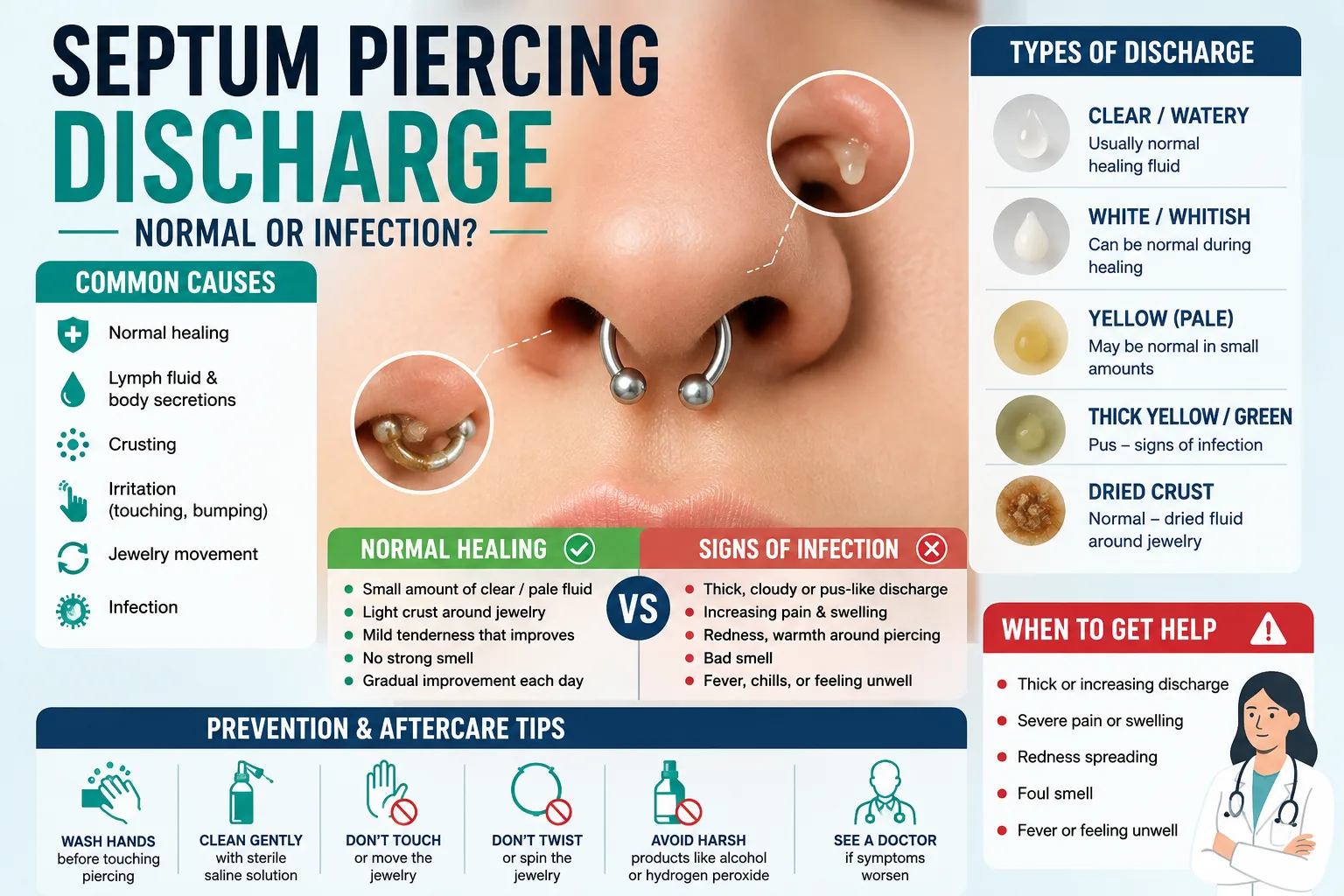
Seeing fluid around a septum piercing can make me wonder if something is wrong. I know how easy it is to see a little yellow or white fluid and immediately think it must be pus.
But that is not always the case.
A new septum piercing can produce a small amount of pale fluid during healing. This fluid can dry around the jewelry and form a light crust. That can be a normal part of healing.
What I pay attention to is the color, texture, amount, smell, and other symptoms around the piercing.
A small amount of clear, pale, or whitish-yellow fluid is usually less worrying. Thick pus-like discharge, a bad smell, increasing pain, swelling, heat, redness, or feeling unwell is more concerning.
In this guide, I will explain what septum piercing discharge can mean, how I tell normal healing fluid from pus, and what I would do if my piercing started producing discharge.
Is Discharge From a Septum Piercing Normal?
Yes, some discharge can be normal while a septum piercing is healing.
A new piercing is a healing wound. As the tissue repairs itself, it can produce a small amount of fluid. The Association of Professional Piercers describes whitish-yellow secretion during healing that can form crust around the jewelry. The NHS also says that a new piercing can produce pale fluid that forms a crust during the first few weeks.
So, when I see a small amount of fluid around a new septum ring, I do not automatically assume it is an infection.
I look at what the fluid is like and how the piercing feels.
If the piercing is becoming calmer each day, with less tenderness and no growing swelling, that is more reassuring.
If the discharge is getting heavier while the piercing is becoming more painful, swollen, hot, or red, I take that much more seriously.
What Does Normal Septum Piercing Discharge Look Like?

Normal healing discharge can look different from person to person.
I usually look for a few simple signs.
Clear or Watery Fluid
A small amount of clear or watery fluid can happen as a wound heals.
This type of fluid is called serous drainage. It can range from clear to yellow and is a normal part of wound healing when it appears in small amounts.
If I see only a little clear fluid around a new septum piercing, I do not treat that as proof of infection.
Whitish Discharge
A small amount of white or whitish-yellow secretion can also appear during septum piercing healing.
The important thing is that it is usually a small amount and may dry into a thin crust around the jewelry.
This is one reason I do not judge a piercing by color alone.
Pale Yellow Discharge
Pale yellow fluid can look alarming, but pale yellow does not automatically mean pus.
Small amounts of clear-to-yellow fluid can occur during normal wound healing. The APP also describes whitish-yellow secretion as a normal part of healing for piercings.
I pay more attention if the fluid becomes thick, heavy, foul-smelling, or appears along with other worsening symptoms.
Dried Crust Around the Jewelry
Fluid can dry around the septum ring and become crusty.
I may notice this more after sleeping or after the fluid has been sitting on the jewelry for a while.
A small amount of light crust does not automatically mean my septum piercing is infected.
I avoid picking it off because pulling at dried material can irritate the healing tissue.
What Does Infected Septum Piercing Discharge Look Like?
Infected septum piercing discharge is more concerning when it is thick, cloudy, or pus-like.
Pus can be white, yellow, green, or another color, so color alone cannot tell me whether I have an infection. Cleveland Clinic describes purulent drainage as thick, milky fluid that usually points to infection.
I also look at what is happening around the piercing.
Signs that make me more concerned include:
- Increasing swelling
- Increasing pain
- Skin that feels hot
- Strong or worsening redness or darkening
- Thick pus-like discharge
- A bad smell
- Symptoms that keep getting worse
- Fever or chills
- Feeling generally unwell
The NHS lists swelling, pain, heat, marked redness or darkening, pus, and feeling hot, cold, shivery, or generally unwell as signs that a piercing may be infected.
So I would never use the color of the discharge alone to decide that a septum piercing is infected.
Septum Piercing Discharge: Normal vs Infection
I find a simple comparison useful when I am trying to work out what the fluid means.
| Sign | More likely normal healing | More concerning |
| Small amount of clear fluid | Yes | |
| Small amount of pale fluid | Yes | |
| Whitish-yellow secretion | Can be normal | |
| Thin pale-yellow fluid | Can be normal | |
| Light crust around jewelry | Yes | |
| Thick pus-like fluid | Yes | |
| Large or increasing amount of fluid | Yes | |
| Strong or worsening smell | Yes | |
| Increasing swelling | Yes | |
| Increasing pain | Yes | |
| Heat around the piercing | Yes | |
| Spreading redness or darkening | Yes | |
| Fever or feeling unwell | Yes |
This table is only a guide. I would look at the full picture rather than trying to diagnose an infection from one symptom.
A small amount of pale fluid with mild healing symptoms is different from thick discharge combined with worsening pain and swelling.
Why Is My Septum Piercing Leaking Fluid?

There are several reasons a septum piercing can produce fluid.
Normal Healing
The simplest reason is healing.
The body sends fluid and other materials to an injured area as part of the repair process. Small amounts of clear or pale drainage can happen with healing wounds.
Irritation
Touching, bumping, moving, or putting pressure on a healing piercing can irritate it.
If I keep touching my septum ring or moving it around, I may notice more crust or fluid.
Crusting
Sometimes there is not much new discharge at all. What I am seeing may simply be dried fluid that has collected around the jewelry.
Jewelry Movement
Moving the jewelry repeatedly can disturb healing tissue.
During healing, I leave the jewelry alone except when cleaning it. The Association of Professional Piercers advises against twisting, spinning, or rotating healing jewelry.
Infection
An infection is another possible cause, especially when the discharge becomes thick or pus-like and the piercing is becoming more painful, swollen, hot, or red.
Why Is My Septum Piercing Producing Yellow Discharge?

Yellow discharge is one of the most common things that makes people worry.
But I would not automatically call every yellow fluid pus.
A small amount of pale yellow or whitish-yellow fluid can be part of normal septum piercing healing. It can dry around the jewelry and form a light crust.
The situation is different if the discharge is:
- Thick
- Cloudy
- Increasing in amount
- Pus-like
- Foul-smelling
- Combined with increasing pain
- Combined with swelling or heat
- Combined with spreading redness
- Combined with fever or feeling unwell
That combination is much more concerning.
So if I see pale yellow discharge but the piercing otherwise looks calm and is slowly improving, I do not panic.
If the yellow discharge is thick and the piercing is getting worse, I seek medical advice.
Is White Discharge From a Septum Piercing Normal?
A small amount of white or whitish-yellow discharge can be normal during healing.
The Association of Professional Piercers specifically describes whitish-yellow secretion that can form crust on the jewelry during the healing process.
What I watch for is the texture and the other symptoms.
Thin or small amounts of light secretion are different from thick, milky, pus-like drainage.
If I see thick white discharge along with swelling, heat, increasing pain, or other infection symptoms, I would get it checked.
Is Clear Discharge From a Septum Piercing Normal?
Yes, a small amount of clear discharge can be part of normal healing.
Clear-to-yellow serous drainage is a normal type of wound fluid when it appears in small amounts.
I would be more concerned if there is a large amount of fluid, the discharge becomes thick or cloudy, or the piercing is getting worse instead of better.
Clear fluid by itself does not mean that my septum piercing is infected.
Does Septum Piercing Discharge Mean Infection?
No.
Discharge alone does not prove that I have an infected septum piercing.
A healing piercing can produce fluid and crust. The APP describes whitish-yellow secretion as part of normal healing, while the NHS says pale fluid that forms a crust can be normal during the first few weeks.
I look at the trend.
If the discharge is small and the piercing is slowly becoming less tender, that is different from discharge that is increasing while pain and swelling are also getting worse.
For a full guide to infection symptoms, I would use my article Septum Piercing Infection: Signs and What to Do.
Septum Piercing Discharge vs Pus

This is one of the most useful differences to know.
Normal discharge
Normal healing fluid is more likely to be:
- Clear or pale
- Thin
- Small in amount
- Whitish-yellow
- Able to dry into a light crust
- Seen during the healing period
Pus
Pus is more likely to be:
- Thick
- Milky
- Cloudy
- White, yellow, green, or another abnormal color
- More noticeable or increasing
- Sometimes unpleasant-smelling
Pus is usually linked with infection. Cleveland Clinic describes purulent drainage as thick, milky fluid and says it generally indicates an infection.
I would still look at the other symptoms before making assumptions.
For example, a tiny amount of pale yellow crust is very different from thick yellow drainage coming from a swollen and painful piercing.
Why Does My Septum Piercing Have Discharge After Months?
This can be confusing if my septum piercing seemed completely healed.
A healed piercing can still collect normal bodily secretions if I do not clean the jewelry as part of my normal hygiene routine. The APP notes that these normal secretions can build up around healed piercings.
So a small amount of buildup does not automatically mean there is a problem.
But if a healed septum suddenly starts producing new or unusual discharge, I look for other changes.
For example:
- Did I recently change the jewelry?
- Did I bump my nose?
- Is the jewelry irritating the area?
- Is the piercing painful?
- Is there new swelling?
- Does the area feel hot?
- Is there a strong smell?
- Is the discharge thick?
If the discharge keeps returning or comes with other worrying symptoms, I would have it checked.
Septum Piercing Discharge With a Bad Smell
A little buildup around jewelry can sometimes have an odor.
Normal secretions can collect around a healed piercing if it is not cleaned as part of regular hygiene.
What I find more concerning is a new or strong smell that comes with thick discharge, increasing pain, swelling, heat, or redness.
I would not use smell alone to decide that my piercing is infected.
For a full look at this issue, I would link to Septum Piercing Smell: Why Does It Smell?
Septum Piercing Discharge With Pain or Swelling
Discharge becomes more concerning when it appears with worsening symptoms.
A little fluid from a new piercing may be normal. But if my septum becomes increasingly painful, swollen, hot, or red while the discharge is also getting worse, I would not ignore it.
The NHS lists pain, swelling, heat, redness or darkening, and pus among signs of an infected piercing.
This is why I look at more than the discharge itself.
If I only have a small amount of pale fluid and mild tenderness that is improving, the situation is different from a piercing that becomes more painful every day.
What Should I Do About Septum Piercing Discharge?

When I notice discharge, I keep my care simple.
Wash My Hands Before Touching It
I wash my hands before touching the piercing or jewelry.
This reduces the chance of bringing dirt and germs to the area.
The APP recommends washing hands before touching a healing piercing and leaving it alone except when cleaning.
Keep the Piercing Clean
I use appropriate piercing aftercare and avoid trying to scrub the discharge away.
Sterile saline is commonly used for healing piercings.
Do Not Pick at Crust
If discharge dries around the jewelry, I do not pull it off while it is hard and stuck.
Picking can irritate the tissue.
Do Not Squeeze the Piercing
I would never squeeze my septum piercing to force fluid out.
That can irritate the area and may make the problem worse.
Do Not Twist the Jewelry
I leave the jewelry in place.
During healing, I avoid twisting, spinning, or rotating it.
Avoid Harsh Products
I avoid using alcohol, hydrogen peroxide, or other harsh products on a healing piercing.
Repeated use of alcohol or hydrogen peroxide can slow wound healing.
Watch How the Piercing Changes
This is one of the most useful things I can do.
I look at whether the piercing is improving or getting worse.
Less tenderness and less swelling are reassuring.
Increasing pain, swelling, heat, redness, or thick discharge is more concerning.
Should I Remove My Septum Jewelry Because of Discharge?
I would not automatically remove my septum jewelry just because I see discharge.
If I have a healing piercing with a small amount of normal fluid, removing the jewelry is not necessary.
If I suspect an infection, I would get medical advice before removing it. The NHS advises leaving jewelry in unless a doctor tells you to take it out when a piercing may be infected.
I also would not keep taking the jewelry out and putting it back in to inspect the piercing.
That can cause more irritation.
When Should I See a Doctor for Septum Piercing Discharge?

I would get medical advice if the discharge is accompanied by symptoms that are getting worse.
These include:
- Increasing pain
- Increasing swelling
- Heat around the piercing
- Strong redness or darkening
- Thick pus-like discharge
- A worsening bad smell
- Fever
- Chills
- Feeling generally unwell
The NHS recommends urgent medical help if an infected piercing is suspected.
I would also get checked if the piercing does not seem to be healing or if a large amount of fluid keeps coming from it.
Common Mistakes That Can Make Septum Discharge Worse
When I see discharge, it is tempting to keep cleaning or touching the area.
I avoid that.
Picking at Crust
I do not pull dried discharge off the jewelry.
Squeezing the Piercing
I do not try to push fluid out.
Twisting the Jewelry
I avoid spinning the septum ring during healing.
Changing Jewelry Too Early
I do not change jewelry simply because I see discharge.
Touching It With Dirty Hands
I wash my hands before touching the piercing.
Over-Cleaning
I do not clean the piercing again and again because I notice a little fluid.
Using Harsh Products
I avoid alcohol, hydrogen peroxide, and other products that can irritate healing tissue.
Constantly Checking It
I also avoid moving the jewelry every few minutes to see whether the discharge is still there.
Sometimes leaving the piercing alone is the better choice.
What I Would Do If My Septum Piercing Had Discharge

If I noticed discharge from my septum piercing, I would first look at what it actually looks like.
Is it clear and watery?
Is it a small amount of pale or whitish-yellow fluid?
Has it dried into a light crust?
Or is it thick and pus-like?
Then I would look at the piercing itself.
Is the pain getting better or worse?
Is the swelling going down or increasing?
Does the skin feel hot?
Is the redness spreading?
Do I feel unwell?
If the discharge is small and the piercing otherwise looks calm, I would keep up gentle aftercare and leave the jewelry alone.
If the discharge becomes thick or increases while the piercing becomes more painful, swollen, hot, or red, I would seek medical advice.
I would not try to squeeze the discharge out or treat a possible infection with random products at home.
Final Thoughts
Septum piercing discharge can look alarming, especially when I see white or yellow fluid around a new piercing.
But I have learned that not all discharge is pus.
A small amount of clear, pale, or whitish-yellow fluid can be part of normal healing. It may dry into a light crust around the jewelry.
What gets my attention is a change in the overall condition of the piercing.
If the discharge becomes thick or heavy and the piercing is getting more painful, swollen, hot, or red, I do not treat it as normal healing.
I also avoid the common mistake of squeezing the piercing, picking at crust, twisting the jewelry, or using harsh products.
For me, the simplest rule is this: look at the discharge, check how the piercing feels, and watch whether things are improving or getting worse.
A little healing fluid can be normal. Discharge that keeps increasing along with other warning signs deserves proper medical attention.
Frequently Asked Questions
Is discharge from a septum piercing normal?
Yes, a small amount of clear, pale, or whitish-yellow fluid can be normal during healing. It may dry into a light crust around the jewelry.
What does normal septum piercing discharge look like?
Normal discharge is often clear, pale, or whitish-yellow and may be thin. A small amount can dry around the jewelry and form a crust during healing.
Is yellow discharge from a septum piercing normal?
A small amount of pale yellow or whitish-yellow fluid can be part of normal healing. Thick, increasing, pus-like yellow discharge is more concerning, especially if there is pain, swelling, heat, or redness.
Is white discharge from a septum piercing normal?
A small amount of whitish discharge can occur during healing. I would be more concerned if it becomes thick and pus-like or appears with worsening symptoms.
Is clear discharge from a septum piercing normal?
Yes. Small amounts of clear or watery fluid can occur during wound healing.
How do I know if my septum discharge is pus?
Pus is usually thicker and more milky or cloudy than normal healing fluid. It can be white, yellow, green, or another color and may have an unpleasant smell. Other infection signs make it more concerning.
Does septum piercing discharge mean infection?
No. A healing septum piercing can produce a small amount of normal discharge. I look at the texture, amount, smell, and other symptoms before deciding whether there may be a problem.
Why does my septum piercing have discharge after months?
A healed piercing can still collect normal bodily secretions. But new or repeated discharge from a previously calm piercing can also happen because of irritation, jewelry problems, trauma, or infection.
Should I remove my septum jewelry if it has discharged?
I would not remove it automatically. If I suspect an infection, I would get medical advice before removing the jewelry. The NHS advises leaving jewelry in unless a doctor tells you to remove it when infection is suspected.
How do I clean discharge from a septum piercing?
I wash my hands first, use gentle piercing aftercare, and avoid picking or squeezing the area. I also avoid twisting the jewelry while it heals.
When should I see a doctor for a septum piercing discharge?
I would seek medical advice if the discharge is thick or increasing, or if it comes with increasing pain, swelling, heat, redness or darkening, fever, chills, or feeling unwell.
Can septum piercing discharge smell?
Yes, normal secretions can sometimes collect around jewelry and develop an odor. A strong or worsening smell combined with thick discharge and other symptoms is more concerning.
Can cleaning make septum piercing discharge worse?
Yes. Rough cleaning, picking, or repeatedly moving the jewelry can irritate healing tissue. I keep cleaning gently and avoid overdoing it.
