


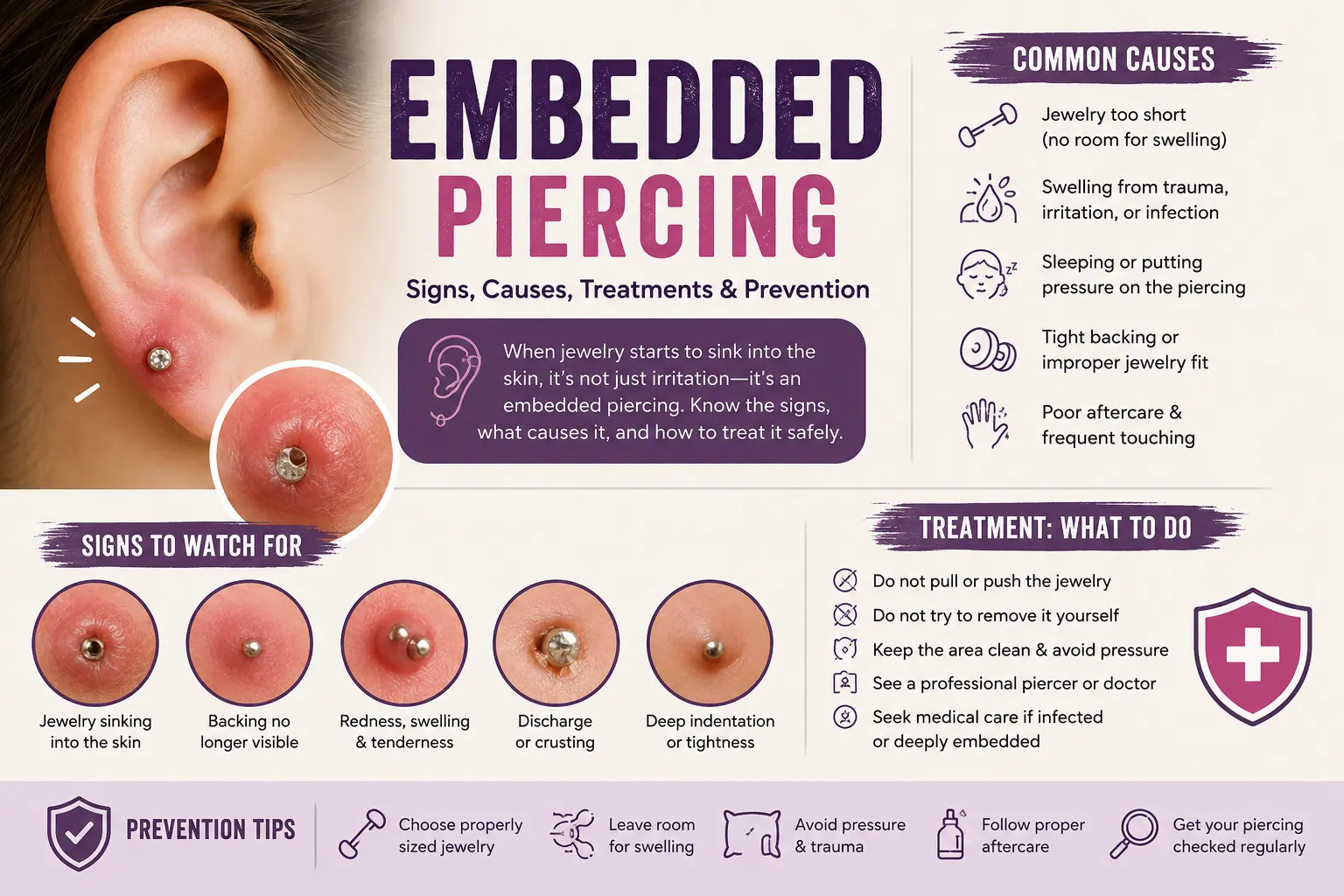
An embedded piercing can be scary, especially when the jewelry starts sinking into the skin or part of the jewelry disappears. I know how easy it is to look at a swollen piercing and wonder whether it is just irritating or whether something more serious is happening.
The first thing I look for is whether the jewelry is still fully visible and accessible. A little swelling can be part of normal healing, but jewelry that is becoming buried in the tissue needs attention.
An embedded piercing happens when jewelry becomes partly or fully trapped beneath the skin or surrounding tissue. This can happen because of swelling, jewelry that is too tight, pressure, trauma, irritation, or infection-related swelling. Embedded earrings are a recognized piercing complication, especially when the jewelry does not leave enough room for swelling.
If your jewelry is already disappearing into the skin, I would not try to force it out at home. The safest next step depends on how deeply it is embedded and whether there are signs of infection.
What Is an Embedded Piercing?
An embedded piercing is a piercing where the jewelry has started to sink into the surrounding tissue instead of sitting normally at the surface.
For example, an earring backing may disappear into an earlobe. A flat-back labret may become covered by swollen tissue. A barbell end may become difficult to see because the skin around the piercing has swollen over it.
The problem can start with something as simple as a piercing that feels unusually tight. As swelling increases, the jewelry presses against the tissue. If there is not enough room, the skin can begin covering part of the jewelry.
I think of the key difference this way: if the jewelry is simply snug, it is still visible and accessible. If the jewelry is becoming buried, the tissue is starting to cover or trap it.
What Does an Embedded Piercing Look Like?

The appearance can vary depending on the piercing location and jewelry.
Some common signs include:
- Part of the jewelry has disappeared
- The backing is no longer visible
- A flat-back disc looks like it is sinking into the skin
- A ball or decorative end is partly covered by tissue
- Skin appears to be growing over the jewelry
- The jewelry feels trapped beneath the skin
- Swelling is concentrated around one side of the jewelry
- The piercing feels increasingly tight
- The area becomes more painful or tender
- Redness or heat develops
- Discharge or crusting appears around the piercing
One thing I pay close attention to is whether the amount of visible jewelry is getting smaller. If I can see less of the post, backing, ball, or disc than I could earlier, I would not ignore that change.
An embedded earring can sometimes be present even when the symptoms are not dramatic. Medical reports have documented embedded earrings in people who did not have obvious pain, redness, or swelling, so the position of the jewelry itself matters.
Early Signs of an Embedded Piercing
Embedding does not always start with the jewelry completely disappearing.
It can begin with:
- Jewelry pressing tightly against the skin
- A deep indentation around the jewelry
- Less visible post than before
- Increasing swelling
- Tenderness around the jewelry
- Difficulty seeing the backing
- Jewelry becoming harder to move
- Skin starting to rise around the jewelry
This early stage is when I would take the problem seriously.
If the jewelry is still completely visible but feels too tight, there may still be time to correct the jewelry fit before the tissue grows over it.
Signs the Jewelry Is Fully Embedded
A more serious situation is when:
- The jewelry is completely covered by skin
- Only a small part of the jewelry can be seen
- You can feel the jewelry but cannot see it
- The backing has disappeared into the tissue
- The piercing hole looks closed around the jewelry
- The jewelry cannot be accessed normally
- Swelling and pain continue to increase
At this point, I would not try to dig into the skin or pull the jewelry through.
How Do I Know If My Piercing Is Embedded?
I would check three things: visibility, pressure, and tissue growth.
If the jewelry is fully visible, the area is only mildly swollen, and there is no skin covering the jewelry, it may simply be irritated or swollen.
If the jewelry is becoming less visible and the tissue is starting to cover the post, backing, ball, or disc, embedding becomes more likely.
If the jewelry is completely covered, stuck, or causing significant pain, I would get professional medical help rather than trying to fix it myself.
Embedded Piercing vs Irritated Piercing

An irritated piercing and an embedded piercing are not the same thing.
An irritated piercing may have:
- Mild redness
- Tenderness
- Swelling
- Crusting
- Dry skin
- Discomfort from pressure or friction
The jewelry is usually still visible and accessible.
With an embedded piercing, the jewelry itself becomes trapped beneath the tissue.
This difference matters because irritation may improve after removing the source of pressure and following proper aftercare, while embedded jewelry may need professional removal.
Embedded Piercing vs Infected Piercing
An embedded piercing is not automatically infected.
Embedding describes what is happening to the jewelry and surrounding tissue. Infection describes the presence of harmful microorganisms and an inflammatory response.
You may have embedding without an obvious infection, or you may have both problems at the same time.
Signs that make me more concerned about infection include:
- Increasing redness
- Significant swelling
- Increasing pain
- Skin that feels hot
- Thick or foul-smelling discharge
- Pus
- Fever
- Chills
- Redness spreading away from the piercing
An embedded earring or clasp that cannot move is also a reason to seek medical assessment, particularly when it occurs with pain, swelling, redness, or discharge.
Embedded Piercing vs Piercing Bump
A piercing bump does not automatically mean that the jewelry is embedded.
An irritation bump can form around a piercing while the jewelry remains completely visible.
Embedding is different because the jewelry itself is being pushed into or covered by the tissue.
So if you have a bump but can clearly see both ends of your jewelry, that does not necessarily mean you have an embedded piercing.
What Causes an Embedded Piercing?

There is usually a reason jewelry becomes trapped.
The most common causes I would look at are:
- Jewelry that is too short
- Excessive swelling
- Tight jewelry
- A backing pressed too tightly against the skin
- Constant pressure
- Sleeping directly on a fresh piercing
- Repeated trauma or snagging
- Irritation
- Infection-related swelling
- Poor jewelry fit
- Jewelry that is not suited to the piercing
- An incorrect piercing angle
- Changes in body tissue around the piercing
The exact cause can vary from one piercing to another.
Jewelry That Is Too Short

One of the biggest problems is jewelry that does not leave enough room for swelling.
A new piercing can swell during healing. If the post or bar is already very short, that swelling can press the jewelry against the tissue.
As the pressure increases, the jewelry can start sinking into the skin.
This is why I would not treat a fresh piercing as if it needs the same jewelry length as a fully healed piercing.
Excessive Swelling
Swelling can make a properly placed piece of jewelry feel too tight.
If the swelling is mild, the jewelry may remain visible.
If the swelling becomes significant and the jewelry has little room left, the tissue can begin covering the jewelry.
This is especially concerning when the swelling continues to increase instead of gradually settling.
Tight Jewelry Backings
The backing should not be clamped tightly against the skin.
A backing that is pushed firmly against a swollen earlobe can increase pressure on the piercing.
This is one reason I would avoid repeatedly tightening an earring because I am worried about losing it.
Sleeping on a Fresh Piercing
Pressure from a pillow can irritate a fresh piercing.
This is especially common with cartilage piercings because people often sleep directly on the side where the piercing was placed.
Hours of pressure can increase irritation and swelling.
If I had a fresh cartilage piercing, I would avoid putting my full body weight on it while sleeping.
Pressure and Friction
Pressure can come from many sources:
- Headphones
- Helmets
- Tight clothing
- Bra straps
- Hair
- Pillow contact
- Masks
- Sports equipment
- Frequent touching
If the same area keeps getting pressed or rubbed, swelling and irritation can continue.
Piercing Trauma
A piercing can become swollen after it gets caught on clothing, hair, towels, bedding, or jewelry.
Pulling or twisting the jewelry can also irritate the piercing channel.
Repeated trauma can keep the tissue swollen and make jewelry fit more tightly.
Infection-Related Swelling
An infection can cause swelling around a piercing.
That swelling can make jewelry tighter and may contribute to embedding.
This is one reason I would not assume that every embedded piercing is simply a jewelry-sizing problem.
Jewelry Material or Poor Jewelry Choice
Some people can react to certain jewelry materials or coatings.
Persistent irritation can lead to ongoing inflammation around the piercing.
For healing piercings, jewelry quality and material should be considered along with the size and shape of the jewelry.
Incorrect Jewelry Fit
Jewelry should suit the piercing location, anatomy, and stage of healing.
A post that is too short can create pressure. A post that is much too long can move around, catch on things, and cause repeated irritation.
The goal is not simply to choose the longest or shortest post. The goal is a suitable fit for the piercing at that stage of healing.
What Should I Do If My Piercing Is Embedded?

If I notice that jewelry is becoming embedded, I would first stop trying to manipulate it.
Here is the approach I recommend:
- Do not pull the jewelry through the skin.
- Do not push the jewelry back out from the other side.
- Do not dig into the tissue to find the backing.
- Do not cut the jewelry or skin yourself.
- Remove pressure from the area.
- Avoid sleeping directly on the piercing.
- Arrange a professional assessment promptly.
- Seek medical care if there are signs of infection or the jewelry is deeply buried.
The biggest mistake would be trying to force the jewelry out simply because part of it is still visible.
If tissue has already grown over the jewelry, pulling it can cause additional damage.
Should I Remove an Embedded Piercing Myself?
I would not recommend trying to remove genuinely embedded jewelry yourself.
There is a big difference between removing a loose piece of jewelry from a healed piercing and trying to pull jewelry out of tissue that has started growing around it.
Trying to force an embedded earring or piercing out can:
- Tear the tissue
- Cause bleeding
- Increase swelling
- Damage the piercing channel
- Push the jewelry deeper
- Increase the risk of infection
If the jewelry is buried, stuck, or covered by skin, professional assessment is the safer choice.
Should I See a Piercer or Doctor?

This depends on what is happening.
When a Professional Piercer May Help
A reputable piercer may be able to assess:
- Jewelry length
- Jewelry fit
- Swelling
- Pressure
- Piercing placement
- Whether the jewelry needs to be changed
- Whether the problem needs medical care
If the jewelry is still visible and the issue mainly appears to be poor jewelry fit, a professional piercer may be a useful first stop.
When I Would See a Doctor
I would seek medical care if:
- The jewelry is completely covered by skin
- The jewelry cannot be accessed
- Pain is severe or getting worse
- Swelling is significant
- Redness is spreading
- The area feels very hot
- Thick or foul-smelling discharge is present
- You have a fever or chills
- A cartilage piercing is very swollen, painful, or red
- You think an infection is developing
Cartilage infections can require medical treatment and should not be treated like a simple irritated earlobe piercing.
How Is an Embedded Piercing Removed?

The method depends on how deeply the jewelry is embedded.
If the jewelry is only beginning to sink and remains accessible, a professional may be able to remove or replace it without a major procedure.
If the jewelry is fully trapped under tissue, a healthcare professional may need to numb the area and make a small opening to remove it.
Medical reports describe cases where a small incision under local anesthesia was needed when embedded jewelry could not be easily removed.
I would not try to copy that procedure at home.
The right approach depends on the location, depth, swelling, infection risk, and type of jewelry involved.
What Happens After an Embedded Piercing Is Removed?
After removal, the tissue may still be swollen and irritated.
The area needs time to settle.
I would focus on:
- Keeping the area clean
- Avoiding unnecessary touching
- Avoiding pressure
- Following the care instructions given by the professional who removed the jewelry
- Watching for worsening redness, pain, swelling, or discharge
- Allowing the tissue to heal before considering another piercing
Whether the same piercing can be saved depends on how much tissue damage has occurred.
If the piercing channel has been badly irritated or damaged, allowing it to heal fully may be the better option.
Can an Embedded Piercing Heal Without Removal?
I would not rely on the jewelry simply working its way out.
If the jewelry is already embedded, the tissue is responding to pressure and the foreign object in the piercing.
Waiting can allow more tissue to grow around the jewelry and may make professional removal harder.
The sooner the problem is assessed, the more options there may be for dealing with it safely.
Can Downsizing Prevent an Embedded Piercing?
Downsizing can help when a piercing has healed enough that the original longer post is now too long.
But downsizing should not mean putting a very short post into a swollen fresh piercing.
During early healing, there needs to be enough space for normal swelling.
Once that swelling has settled, a professional piercer may recommend a shorter post if the original jewelry is moving too much or catching on things.
So I look at jewelry fit in two stages:
Early healing: enough room for swelling.
Later healing: a better-fitting length once swelling has reduced.
How to Prevent an Embedded Piercing

Preventing embedding mostly comes down to proper jewelry fit, good aftercare, and reducing pressure.
Choose Properly Sized Jewelry
The jewelry should match the piercing and your anatomy.
A professional piercer can select an appropriate post length or bar length.
Leave Room for Initial Swelling
Fresh piercings can swell.
Starting with jewelry that is too short leaves little room for that swelling.
Don’t Tighten the Jewelry Against Your Skin
Avoid pressing the backing tightly against the tissue.
The jewelry should not feel like it is squeezing the piercing.
Avoid Pressure
Try not to sleep directly on a fresh piercing.
Be careful with:
- Headphones
- Helmets
- Clothing
- Hair
- Towels
- Bedding
- Sports equipment
Don’t Play With the Jewelry
Twisting, pushing, pulling, and constantly checking the jewelry can irritate the piercing.
I prefer to leave a healing piercing alone as much as possible.
Get the Jewelry Checked During Healing
If the post starts looking too long after swelling goes down, have a professional check whether downsizing is appropriate.
If it starts looking too short, get it checked quickly.
Choose a Reputable Piercer
Good placement and suitable initial jewelry can reduce many problems before they start.
The use of spring-loaded ear-piercing devices has been associated with embedded earring backs, particularly in the earlobe and helix, according to published medical literature.
Can Different Types of Piercings Become Embedded?

Embedding is not limited to one piercing location.
The risk and symptoms can vary based on the tissue, jewelry, swelling, and pressure around the piercing.
Embedded Ear Piercing
An embedded earring is one of the most familiar examples.
The backing may become buried in the earlobe, or the front of the jewelry may sink into swollen tissue.
The earlobe can become tender, swollen, or red.
Embedded Cartilage Piercing
Cartilage piercings deserve extra care.
A helix, tragus, conch, or other cartilage piercing can become swollen after trauma or irritation.
If a cartilage piercing becomes very painful, hot, swollen, or significantly red, I would seek medical advice rather than treating it as a simple jewelry-fit issue.
Embedded Nose Piercing
A nostril stud can become too tight when swelling develops.
If the decorative end starts sinking into the nostril or surrounding skin, the jewelry should be assessed promptly.
I would not push the stud through swollen tissue to make it visible again.
Embedded Septum Piercing
An embedded septum piercing is less typical than an embedded earring, but jewelry can still cause problems if the fit is wrong or swelling develops.
If the jewelry becomes difficult to access or appears to be sinking into tissue, I would have it checked rather than forcing it into position.
Embedded Lip Piercing
Lip piercings have an extra concern because one end of the jewelry sits inside the mouth.
Swelling can cause the jewelry to press into the lip tissue.
If the jewelry starts disappearing into the lip, becomes painful, or causes significant swelling, I would seek professional or medical advice promptly.
Oral and perioral piercings can have complications involving soft tissue injury and jewelry embedding, so this is not an area where I would recommend experimenting with removal at home.
Embedded Navel Piercing
A navel piercing can experience pressure from clothing and body movement.
Tight waistbands can repeatedly press against the jewelry and irritate the area.
If the jewelry begins sinking into the skin, especially during swelling, I would have the jewelry fit checked.
Can an Embedded Piercing Cause an Infection?
Yes, an embedded piercing can be associated with infection, but embedding itself does not prove that an infection is present.
The risk becomes more concerning when the area has:
- Increasing redness
- Heat
- Significant swelling
- Worsening pain
- Pus
- Foul-smelling discharge
- Fever
- Chills
- Redness spreading away from the piercing
I would not wait for every symptom to appear before getting help.
If jewelry is buried and the area is becoming increasingly painful or inflamed, it is worth getting assessed.
What If the Skin Has Grown Over the Jewelry?
If skin has started growing over the jewelry, don’t try to cut the skin yourself.
The jewelry may be more deeply embedded than it appears from the outside.
A professional can assess how much of the jewelry is covered and whether the problem can be handled by a piercer or needs medical treatment.
If the jewelry is completely covered, painful, infected, or impossible to locate, medical care is the safer choice.
Can You Repierce After an Embedded Piercing?
Sometimes a piercing can be done again, but I would not rush into it.
The tissue needs time to recover from the original problem.
If there is significant swelling, scar tissue, infection, or tissue damage, repiercing too soon can create another problem.
I would wait until the area has fully recovered and then have a professional assess the tissue and placement.
The right timing depends on the location and how severe the embedding was.
Can a Healed Piercing Become Embedded?
It is less typical for a fully healed piercing to suddenly become embedded without a change in circumstances.
But problems can develop after:
- Changing jewelry
- Wearing jewelry that is too tight
- Significant swelling
- Trauma
- Allergic or irritant reactions
- Infection
- Changes in surrounding tissue
If a healed piercing suddenly becomes swollen and the jewelry begins sinking into the skin, I would treat that as a new problem rather than assuming it is normal.
Why Is My Piercing Sinking Into My Skin?
A piercing may sink into the skin because the tissue has swollen around jewelry that does not have enough room.
Pressure, irritation, trauma, infection, or an overly tight backing can also contribute.
If the jewelry is becoming less visible, I would have it assessed instead of waiting for the skin to cover it.
Why Is My Earring Disappearing Into My Ear?
The earring may be sinking into the earlobe because of swelling, pressure, a tight backing, poor jewelry fit, or infection.
This is particularly concerning if the backing is no longer visible or the earring cannot move.
An embedded earring should not be pulled through swollen tissue at home.
Can Tight Jewelry Cause an Embedded Piercing?
Yes.
Jewelry that presses tightly against swollen tissue can contribute to embedding.
This is why I would never intentionally clamp a piercing backing as tightly as possible against the skin.
The jewelry needs to fit securely without creating constant pressure.
Can Swelling Cause an Embedded Piercing?
Yes.
Swelling can reduce the amount of space around the jewelry.
If the jewelry is already too short, the tissue can press against the jewelry and eventually cover part of it.
This is one of the main reasons jewelry selection matters during the early healing period.
Can a Piercing Grow Over Jewelry?
Yes, tissue can cover jewelry when it becomes embedded.
This is more likely when swelling and pressure keep the jewelry pressed into the tissue.
If you can see the skin starting to cover the jewelry, I would deal with the issue promptly rather than waiting for it to disappear completely.
Can I Remove an Embedded Earring Myself?
I would not recommend it.
If the jewelry is actually embedded, pulling it can tear tissue and cause more bleeding and swelling.
If the jewelry cannot be removed easily, a healthcare professional may need to numb the area and use a minor procedure to remove it.
Should I See a Piercer or Doctor?
If the jewelry is visible but too tight, a reputable piercer may be able to assess the jewelry size and fit.
If the jewelry is deeply embedded, completely covered, or accompanied by severe swelling, increasing pain, spreading redness, pus, fever, or chills, I would seek medical care.
If you are unsure, it is better to have the area assessed than to force the jewelry out yourself.
Final Thoughts
An embedded piercing is something I would take seriously, but I would not panic.
The key is to spot the difference between normal healing, irritation, swelling, infection, and actual embedding.
If the jewelry is getting harder to see, the skin is starting to cover it, or the piece feels trapped beneath the tissue, I would stop touching it and get professional help.
The biggest mistake is trying to force embedded jewelry out at home.
For prevention, I focus on proper jewelry sizing, enough room for early swelling, avoiding pressure, leaving the piercing alone, and getting the jewelry checked as healing progresses.
If the jewelry is deeply buried or there are signs of infection, medical care is the right next step.
Frequently Asked Questions
Why is my piercing sinking into my skin?
A piercing can start sinking into the skin when swelling puts too much pressure on the jewelry. Jewelry that is too short, a tight backing, repeated pressure, irritation, trauma, or infection-related swelling can all contribute.
If the jewelry is becoming less visible, I would have it checked promptly rather than waiting for the skin to cover it.
How do I know if my piercing is embedded?
I look for a few clear signs: the jewelry is becoming less visible, the skin is starting to cover it, the jewelry feels trapped, or the backing or decorative end has disappeared into the tissue.
Mild swelling alone does not mean a piercing is embedded. The key concern is that the jewelry itself is being pushed into or covered by the tissue.
Why is my earring disappearing into my ear?
An earring may disappear into the earlobe because swelling has increased around jewelry that is too tight. A tight backing, pressure while sleeping, irritation, trauma, or infection can also contribute.
If you can no longer see the backing or the earring feels stuck beneath the skin, I would not try to pull it out myself.
Can swelling cause an embedded piercing?
Yes. Swelling reduces the space around the jewelry. If the jewelry does not leave enough room, swollen tissue can press against it and eventually begin covering it.
This is one reason I pay close attention to jewelry fit during the early healing period.
Can tight jewelry cause embedding?
Yes. Jewelry that presses constantly against swollen tissue can contribute to embedding.
The backing or end of the jewelry should hold the piercing securely without squeezing the skin. If the jewelry suddenly feels much tighter than before, I would have the fit checked.
Can a piercing grow over jewelry?
Yes. If jewelry remains under pressure while the surrounding tissue swells, skin can begin covering part or all of the jewelry.
I would not cut the skin or try to pull the jewelry through it. Once tissue has started covering the jewelry, professional assessment is the safer option.
Is an embedded piercing infected?
Not necessarily. An embedded piercing and an infected piercing are two different problems, although they can occur together.
Embedding means the jewelry has become trapped in the tissue. Infection is more likely when there is worsening redness, heat, significant swelling, increasing pain, pus, foul-smelling discharge, fever, or chills.
What does an infected embedded piercing look like?
It may have increasing redness and swelling around the embedded jewelry, worsening pain, warmth, pus or unusual discharge, and redness that spreads beyond the piercing.
Fever or chills are also warning signs. If these symptoms are present, I would seek medical care instead of trying to remove the jewelry at home.
Can I remove an embedded piercing myself?
I would not recommend trying to remove genuinely embedded jewelry yourself.
Pulling or pushing the jewelry through swollen tissue can cause bleeding, tearing, additional swelling, and tissue damage. If the jewelry is buried or cannot be removed easily, a healthcare professional can decide the safest way to remove it.
Should I see a piercer or a doctor for an embedded piercing?
If the jewelry is still visible but appears too tight, a reputable professional piercer can assess the jewelry size, fit, swelling, and placement.
If the jewelry is deeply embedded, completely covered by skin, or accompanied by severe pain, significant swelling, spreading redness, pus, fever, or chills, I would seek medical care.
What should I do if the skin is growing over my piercing?
I would stop touching and manipulating the jewelry. Do not push it through the tissue, cut the skin, or try to dig out the jewelry.
Arrange a professional assessment promptly. If the jewelry is completely covered or there are signs of infection, medical care may be needed.
Can an embedded piercing heal without removing the jewelry?
I would not rely on an embedded piece of jewelry to correct itself. If the jewelry is already trapped beneath the tissue, waiting may allow more tissue to grow around it.
Getting the problem assessed early gives you a better chance of dealing with the jewelry before the situation becomes more difficult.
Can I change the jewelry if my piercing is embedding?
I would not change deeply embedded jewelry myself.
If the problem is caused by poor jewelry fit and the jewelry is still accessible, a professional piercer can assess whether changing the size or style is appropriate. If the jewelry is buried or there are signs of infection, medical assessment may be more suitable.
Can downsizing prevent an embedded piercing?
Appropriate downsizing can help once the initial swelling has gone down and a professional determines that a shorter post is suitable.
I would not use very short jewelry on a fresh, swollen piercing. During early healing, the jewelry needs enough room to accommodate normal swelling.
Can a healed piercing become embedded?
It is less common, but a healed piercing can develop problems after a change in jewelry, significant swelling, trauma, irritation, or infection.
If a previously healed piercing suddenly becomes swollen and the jewelry starts sinking into the skin, I would treat it as a new problem and have it assessed.
Can an embedded piercing cause permanent damage?
The outcome depends on how long the jewelry remains embedded and how much tissue is affected.
Prolonged pressure, tearing, infection, or significant tissue damage can lead to scarring or other changes. Getting the problem assessed early can help reduce the chance of a more serious complication.
Can I repierce after an embedded piercing?
Sometimes a piercing can be done again after the area has completely healed, but I would not rush into repiercing.
The tissue may need time to recover from swelling, irritation, infection, or scarring. A professional can assess the area and decide whether the original location is suitable for a new piercing.
How can I prevent an embedded piercing?
I focus on proper jewelry sizing, leaving enough room for early swelling, avoiding pressure while sleeping, keeping hair and clothing from catching the jewelry, and avoiding unnecessary touching or twisting.
I would also have the jewelry checked during healing if it starts feeling too tight or too loose.
Can sleeping on a piercing cause it to become embedded?
Sleeping directly on a fresh piercing can create repeated pressure and irritation. That pressure may increase swelling and make jewelry fit more tightly.
For a healing cartilage or ear piercing, I would avoid putting direct pressure on it while sleeping.
When should I get urgent help for an embedded piercing?
I would seek medical care promptly if the jewelry is completely buried, the swelling is severe, pain is getting worse, redness is spreading, the area is very hot, there is pus or foul-smelling discharge, or you develop fever or chills.
I would also avoid trying to remove deeply embedded jewelry at home.
