


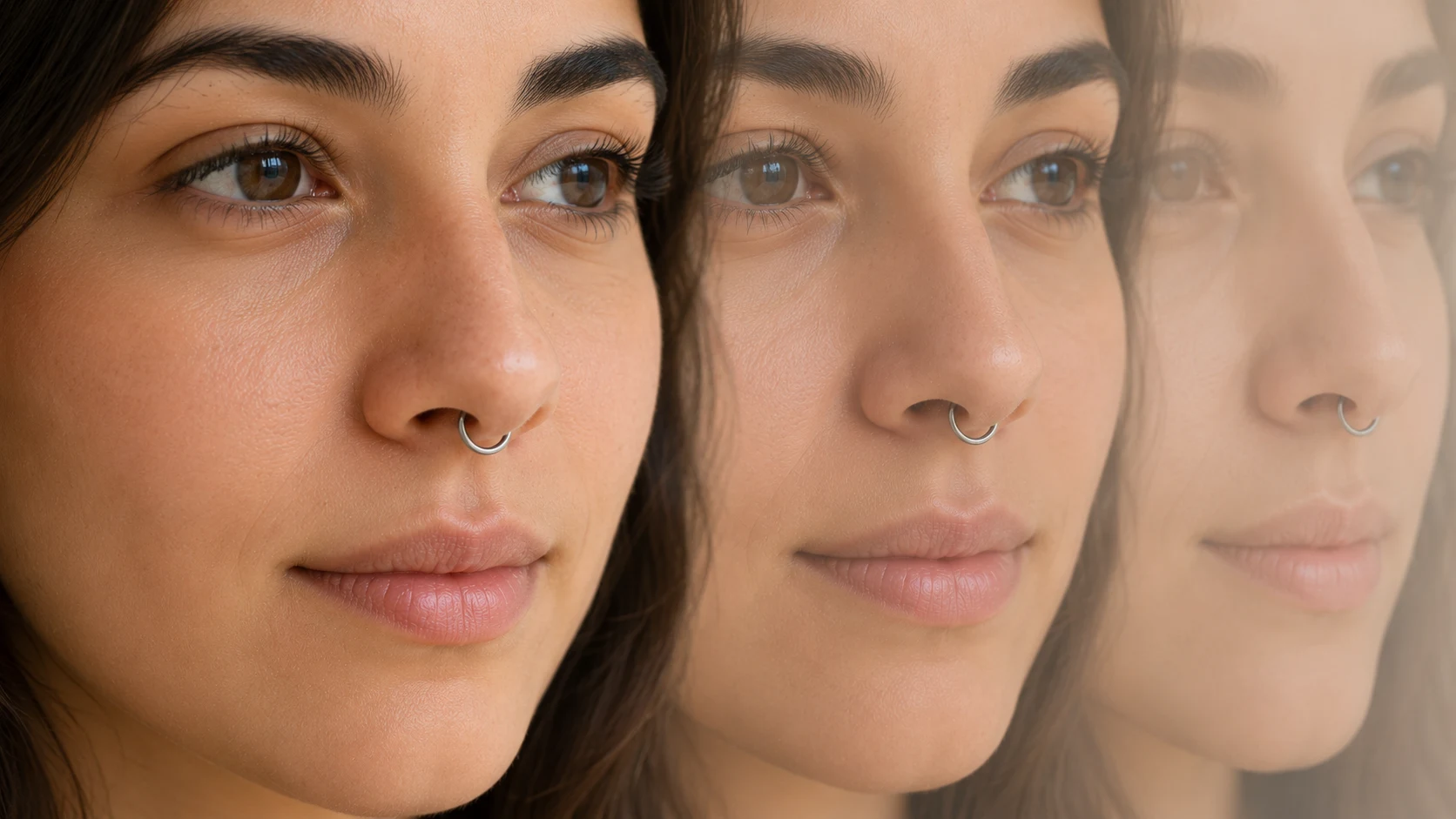
A new septum piercing can look better long before it is fully healed. That is the part I think causes the most confusion. One week it may feel sore and sensitive, and a few weeks later it can seem almost normal. But the tissue inside is still going through its own healing process.
I find it easier to think about septum piercing healing stages rather than focusing on one exact healing date. Everyone heals at a slightly different rate, so the timeline below is a guide rather than a strict schedule.
Here is what I would expect from the first few days through the later stages of healing.
What Are the Septum Piercing Healing Stages?

A septum piercing goes through several healing stages.
In the beginning, the body reacts to the fresh piercing with tenderness, swelling, and sometimes a little bleeding. After that, the area starts to settle, and you may notice crusting, itching, or occasional sensitivity.
Later, the outside can look almost completely normal even though the tissue inside is still getting stronger.
The main stages I would use are:
- Days 1–3: Fresh piercing and early inflammation
- Days 4–7: Initial swelling starts to settle
- Week 2: Early healing
- Weeks 3–4: Surface healing and less tenderness
- Weeks 5–8: More stable healing
- After 2–3 months: Later healing and tissue strengthening
- Fully healed: The piercing feels settled and comfortable
These stages can overlap. Your piercing does not have to follow this exact schedule.
Stage 1: Days 1–3

The first few days are when I would expect the septum to feel the most sensitive.
The piercing is a fresh wound, so some tenderness is normal. I might also notice mild swelling, a little bleeding, or sensitivity around the tip and inside of the nose.
Some people also experience:
- Watery eyes
- Sneezing
- A runny nose
- Mild redness
- Tenderness when the nose is touched
- Small amounts of clear or pale fluid
- Early crusting around the jewelry
I would not panic over every small change during these first days.
The area has just been pierced, so the body is starting its normal healing response.
What I would avoid is constantly checking the jewelry, touching it, or moving it to see how it feels.
The less I disturb a fresh piercing, the easier I make things for the healing tissue.
Stage 2: Days 4–7
By the end of the first week, I would expect some of the sharp tenderness to start settling.
The septum may still feel sensitive, especially if I accidentally bump my nose, sneeze, or move the jewelry.
Crusting may also become more noticeable.
This can happen because small amounts of fluid from the healing area dry around the jewelry. I would not pick the crust off with my fingers.
Instead, I would keep the area clean and let the crust soften naturally during gentle cleaning.
At this stage, the piercing may already look much better than it did on day one.
That does not mean I would consider it healed.
Stage 3: Week 2

During the second week, I would expect the septum to feel more comfortable.
The early swelling should be settling, and the piercing may no longer feel sore all the time.
I could still notice:
- Mild itching
- Occasional tenderness
- Small amounts of crust
- Sensitivity after touching the nose
- Discomfort after accidentally bumping the jewelry
This is also the stage where it can become easy to forget that the piercing is still healing.
I would be careful about that.
Feeling better is a good sign, but I would not start twisting, spinning, or flipping the jewelry simply because it no longer hurts.
Stage 4: Weeks 3–4

This is one of the stages I think people often misunderstand.
By weeks three or four, a septum piercing can look surprisingly normal.
The swelling may be gone. The redness may have settled. The piercing may feel comfortable most of the time.
I might even forget that I have a new piercing.
But the piercing channel is still healing.
This is why I would not use the outside appearance as proof that the piercing is fully healed.
The Association of Professional Piercers explains that a piercing can appear healed before the healing process is complete because healing takes place from the outside inward.
So, even if my septum looked perfect at four weeks, I would still treat it gently.
Stage 5: Weeks 5–8
Around weeks five to eight, I would expect the piercing to feel much more stable.
For many people, there may be:
- Little or no soreness
- Less crusting
- Less sensitivity
- No noticeable swelling
- More comfortable jewelry
- Fewer irritation episodes
However, I would not assume that every septum piercing is fully healed at eight weeks.
This is where the difference between healing stages and healing time matters.
The piercing may be doing very well, but the internal tissue can still be developing.
I would continue gentle care and avoid unnecessary jewelry movement.
If I wanted to change the jewelry, I would have an experienced piercer check it first rather than relying on the calendar alone.
Stage 6: After 2–3 Months
At this point, I would expect a well-healing septum piercing to feel much more settled.
For some people, the piercing may feel completely normal. For others, there can still be occasional sensitivity.
That difference does not automatically mean one person is healing correctly and another is not.
Healing depends on several things, including individual healing speed, placement, jewelry, aftercare, and how often the piercing has been irritated.
This is also why I would avoid comparing my septum piercing with someone else’s.
One person’s piercing may feel fine after two months, while another person’s may need more time.
Stage 7: What Does a Fully Healed Septum Piercing Feel Like?
When I think about a fully healed septum piercing, I would look for a pattern of stability rather than one single sign.
The area should generally:
- Feel comfortable
- Have no ongoing tenderness
- Have no persistent swelling
- Have no repeated irritation
- Have no unusual discharge
- Tolerate normal jewelry movement without pain
- Look calm and settled
Even when it feels healed, I would still avoid forcing the jewelry through the piercing.
Healed piercings can still become irritated if they are handled roughly.
What Should a Healing Septum Piercing Look Like?
There is no single appearance that every healing septum piercing will have.
Early on, I might see mild redness, swelling, or a little dried fluid.
Later, I may notice small amounts of crust around the jewelry.
The Association of Professional Piercers lists some bleeding, localized swelling, tenderness, itching, and whitish-yellow fluid that dries into crust as possible parts of normal piercing healing.
What matters to me is the overall trend.
If things are slowly becoming calmer, that is generally more reassuring than symptoms that keep getting worse.
Is Crusting Normal During Septum Piercing Healing?
Yes, some crusting can occur during normal healing.
The crust may form when fluid from the healing tissue dries around the jewelry.
I would not pick it off because doing so can irritate the fresh tissue.
Instead, I would follow gentle cleaning practices and allow softened debris to come away without pulling at the piercing.
Crusting should also become less frequent as healing progresses.
If I suddenly developed a large amount of unusual discharge along with increasing pain, swelling, warmth, or redness, I would not assume that was normal crusting.
Is It Normal for a Septum Piercing to Itch?
Mild itching can happen during healing.
I would try not to scratch the area or move the jewelry to relieve the itch.
Itching by itself does not tell me exactly how far along the piercing is. I would look at the rest of the symptoms too.
If itching comes with worsening swelling, strong pain, heat, or other concerning changes, I would have it checked.
Why Is My Septum Piercing Still Sore?
A little soreness can continue during healing.
If my septum were still sore, I would first think about possible irritation.
I would ask myself:
- Have I been touching the jewelry?
- Have I been moving or flipping it?
- Did I bump my nose?
- Have I been blowing my nose often?
- Did I change the jewelry too soon?
- Am I using harsh cleaning products?
- Is the jewelry putting pressure on the piercing?
Repeated irritation can make a piercing take longer to settle.
If the pain were becoming stronger instead of improving, I would have the piercing checked.
Can a Septum Piercing Look Healed Before It Is Fully Healed?
Yes.
This is probably the most important point I would take from the entire healing process.
A septum can look calm and feel fine while the tissue inside is still healing.
That is why I would not use appearance alone to decide that my piercing is ready for anything.
The piercing channel needs time to become stronger.
So if my septum looked perfect after a few weeks, I would still treat it like a healing piercing.
What Can Slow Down Septum Piercing Healing?
Several things can keep irritating the area.
Touching the Piercing
I would keep my hands away from the jewelry unless I need to care for the area.
Moving the Jewelry
I would not twist, spin, or repeatedly move the ring.
This can cause unnecessary irritation.
Flipping the Jewelry
If I needed to hide the piercing, I would talk to my piercer about the best way to handle that before moving it repeatedly.
Constantly flipping jewelry up and down can disturb healing tissue.
Bumping the Nose
Even a small bump can make a healing septum sore again.
I would be careful when changing clothes, washing my face, sleeping, and wiping my nose.
Changing Jewelry Too Soon
I would not change jewelry simply because a certain number of weeks has passed.
If I needed an early jewelry change, I would let a qualified piercer handle it.
Over-Cleaning
More cleaning does not always mean faster healing.
I would avoid harsh products and unnecessary rubbing.
Gentle care is what I would aim for.
How Do I Know My Septum Piercing Is Healing Normally?

I would look for gradual improvement.
For example, I would expect:
- Less soreness over time
- Less swelling
- Less redness
- Less crusting
- More comfortable jewelry
- Fewer irritation episodes
- No new or worsening symptoms
Healing is not always perfectly straight.
A piercing can feel great for several days and then become slightly sore after a bump or irritation.
What I would pay attention to is whether it settles again or keeps getting worse.
When Is Septum Piercing Healing Not Normal?
I would be more concerned if symptoms were getting worse rather than slowly improving.
Warning signs can include:
- Increasing or severe pain
- Significant swelling
- Increasing warmth
- Spreading redness
- Thick or unusual discharge
- Persistent bleeding
- Fever
- Feeling generally unwell
I would not try to diagnose an infection myself.
If I had symptoms that looked concerning, I would have the piercing checked by a qualified professional or seek medical care when needed.
Septum Piercing Healing Stages vs Healing Time
I would keep these two topics separate because they answer different questions.
Septum piercing healing time asks:
How long does the piercing take to heal?
Septum piercing healing stages asks:
What happens as the piercing heals?
For this article, I would focus on the second question.
The exact healing time can be mentioned briefly, but I would not turn this page into another full article about how many weeks or months healing takes.
That keeps the content focused and helps prevent overlap with a separate septum piercing healing time page.
My Experience With the Septum Piercing Healing Process

When I look at the healing process as a whole, I think the biggest mistake is expecting it to follow a perfect calendar.
I would expect the first few days to be the most noticeable. During the first couple of weeks, I would watch for swelling, tenderness, crusting, and irritation to settle.
By weeks three and four, I would expect the piercing to look much calmer. But I would still treat it as a healing piercing because looking normal does not prove that the inside is fully healed.
By weeks five to eight, I would expect much less discomfort if everything is going well.
After that, I would let my own piercing tell me how it is doing rather than comparing it with someone else’s timeline.
For me, patience would be the biggest part of good septum piercing care.
Final Thoughts
The septum piercing healing stages are easier to understand when I stop thinking of healing as one exact date.
The first few days are about the body’s early response to the piercing. The first few weeks are when swelling and tenderness usually start settling. Around weeks three to eight, the piercing may look and feel much better, but the internal tissue can still be healing.
After a few months, many piercings are much more settled, although individual healing times vary.
I would keep the jewelry clean, avoid unnecessary movement, and watch for gradual improvement.
Most of all, I would not rush the process just because my septum looks healed on the outside.
FAQs
What are the septum piercing healing stages?
The main stages include the first few days of inflammation, early healing during the first two weeks, surface healing around weeks three to four, continued healing through weeks five to eight, and later tissue strengthening after the first few months.
What should a septum piercing look like after 1 week?
It may still have some tenderness, mild swelling, sensitivity, and crusting. These can occur during early healing, but symptoms should not be getting steadily worse.
What happens to a septum piercing after 2 weeks?
By the second week, I would expect much of the early swelling and sharp soreness to have settled. Some tenderness, itching, or crusting can still occur.
What happens during weeks 3 and 4?
The piercing may look much calmer and feel comfortable most of the time. However, the internal piercing channel can still be healing.
What happens to a septum piercing after 6 weeks?
A well-healing piercing may have little tenderness and less crusting by this point. I would still avoid assuming it is completely healed.
Is crusting normal during septum piercing healing?
Some crusting can be normal. I would avoid picking it and would use gentle cleaning instead.
Is itching normal during septum healing?
Mild itching can happen as the tissue heals. I would avoid scratching or moving the jewelry to relieve it.
Can a septum piercing feel healed before it actually is?
Yes. The outside can look and feel normal while deeper tissue is still healing.
Why does my septum piercing keep getting sore?
Repeated touching, jewelry movement, bumps, pressure, or other irritation can cause soreness to return. If the pain keeps increasing, I would have it checked.
When should I change my septum jewelry?
I would wait until the piercing is sufficiently healed and have a qualified piercer assess it if I am unsure. I would not use a specific week as an automatic jewelry-change date.
Does flipping a septum piercing affect healing?
Repeatedly moving the jewelry can irritate the healing channel. If I needed to keep the jewelry hidden, I would discuss this with my piercer.
What does a fully healed septum piercing feel like?
It should generally feel comfortable, without ongoing soreness, swelling, or irritation. Normal jewelry movement should not cause pain.
Can healing go backward?
It can seem that way after a bump or other irritation. A piercing may become tender again even after feeling better. I would watch whether it settles or whether the symptoms continue to worsen.
