


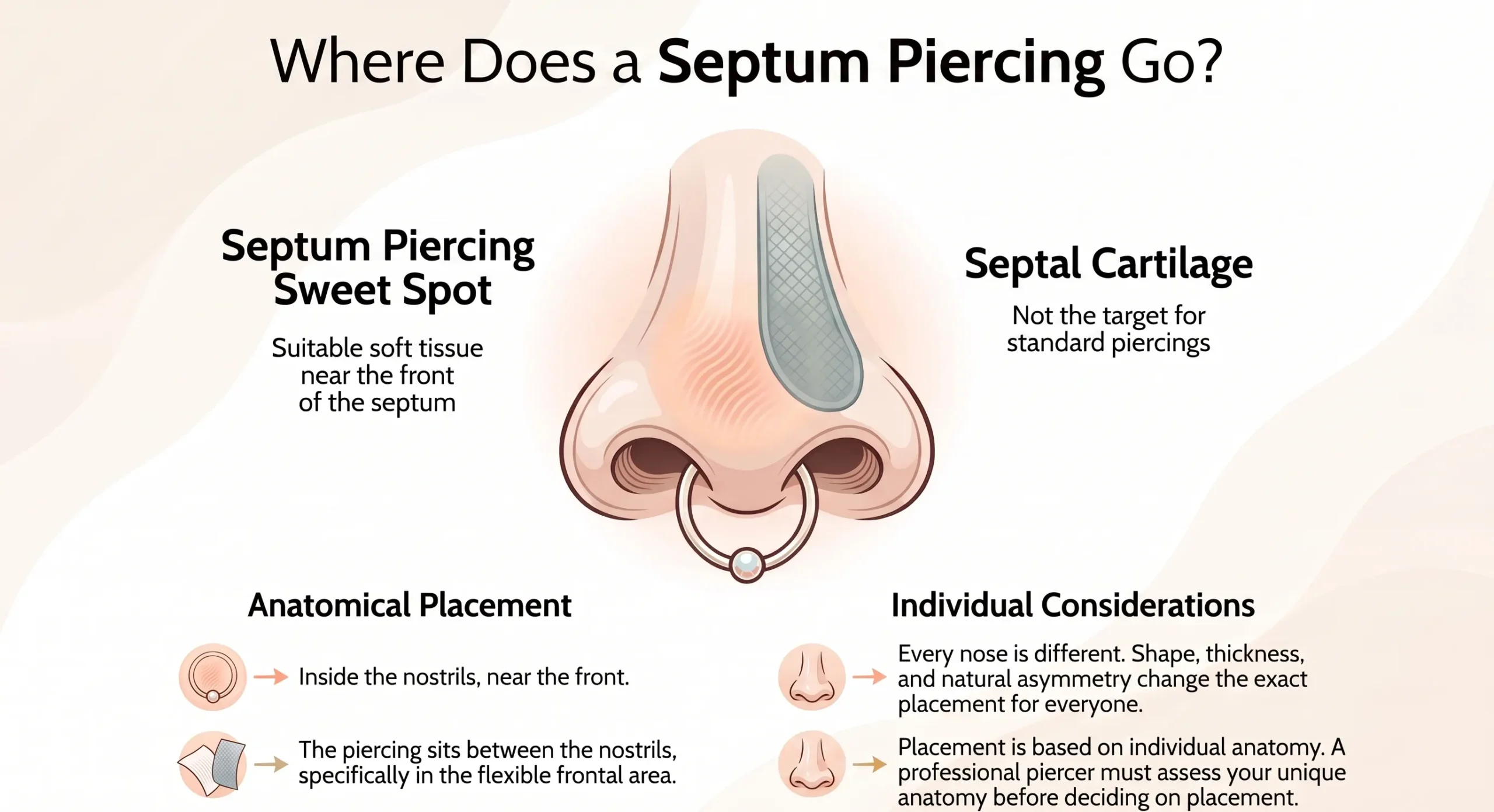
If you are thinking about getting a septum piercing, one of the first things I would want to know is exactly where the needle is supposed to go. The answer is a little more specific than simply saying it goes between the nostrils.
A properly placed septum piercing usually passes through the softer, flexible tissue at the front of the nasal septum area, often called the sweet spot by piercers. It should not simply be placed through the firm central cartilage of the nose. The exact spot varies from person to person because everyone’s nasal anatomy is a little different.
I think this is one of the most useful things to know before getting the piercing. Once you understand the basic placement, it becomes easier to talk with your piercer, choose suitable jewelry, and spot questions about placement before the needle goes in.
Where Exactly Does a Septum Piercing Go?

A septum piercing goes through the tissue inside the nose, between the two nostrils. The target is generally a softer area near the front of the nose, in front of the firmer septal cartilage.
You may hear this area called the septum sweet spot. It is the part a piercer looks for before deciding where to place the piercing.
The important thing is that there is no single measurement that works for every nose. Some people have a clear area of soft tissue, while others have a smaller or harder-to-find area. A deviated septum, previous nose injury, or past nasal surgery can also change the available anatomy.
So if you are looking at pictures online and trying to copy the exact position, I would not use the picture as your guide. Your nose may have a different shape.
What Is the Septum Piercing Sweet Spot?

The sweet spot is a common piercing term for the area where a septum piercing can be placed through suitable, more flexible tissue.
You may see this area described as the columella or as soft tissue in front of the septal cartilage. Piercing professionals can also use the term differently because nasal anatomy is not identical from one person to another.
The main idea is simple: the piercer is looking for the appropriate tissue rather than blindly placing the needle through the firm central cartilage.
This is why I would let a professional check the area in person. A photo or quick look in the mirror cannot show everything a piercer needs to assess.
Some people have a very obvious soft area. Others have a smaller one that is harder to find. Some people may have anatomy that makes standard placement more difficult.
Does a Septum Piercing Go Through Cartilage?

This is one of the biggest questions people have.
A standard, properly placed septum piercing is generally intended to pass through the suitable soft or flexible tissue at the front of the septum area rather than simply piercing through the firm septal cartilage.
The nasal septum itself contains cartilage and bone. That does not mean the piercing should be placed through the hard central part of it.
This distinction matters because piercing through firmer cartilage can be more painful and may take longer to settle. It can also create a different healing situation from a piercing placed in the intended tissue.
I would not use pain alone to decide whether a piercing is correctly placed, though. Everyone reacts differently, and only an in-person assessment can tell you what tissue was actually pierced.
What Does Correct Septum Piercing Placement Look Like?

A well-placed septum piercing usually sits fairly high and forward inside the nose.
From the front, the jewelry should generally hang between the nostrils. The piercing holes themselves are often difficult to see because they sit inside the nose.
The exact appearance can change with:
- Your nose shape
- Septum shape
- Facial symmetry
- Jewelry diameter
- Jewelry thickness
- Swelling
- Natural nasal deviation
This means there is no single visual position that will look identical on everyone.
I would focus less on copying someone else’s jewelry position and more on whether the placement works with your own anatomy.
From the front
The ring should generally look centered between the nostrils.
But a perfectly symmetrical appearance is not always possible. If your septum or nose is naturally uneven, the jewelry can look slightly off-center even when the piercing itself has been placed appropriately.
From the side
The jewelry should sit inside the lower part of the nose rather than appearing to hang from the very bottom of the nose.
The piercing channel itself should not be something you can easily see from the outside.
From underneath
The ring should sit naturally inside the nose without looking extremely low or awkwardly positioned.
Again, jewelry size affects what you see. A larger ring will hang lower than a smaller ring even when both are placed through the same piercing.
How Does a Piercer Find the Right Placement?

Before piercing, a good piercer should assess your anatomy rather than simply choosing a spot based on how the nose looks from the outside.
The assessment may involve looking at the inside of the nose and feeling the available tissue. The piercer may also consider your septum shape, symmetry, the position of the tissue, and the jewelry you plan to wear.
The exact technique varies between professionals.
Some piercers mark the area before piercing. Others may use a different approach. The important part for me is that the anatomy gets checked before the needle is used.
A proper consultation also gives you a chance to ask questions.
I would ask:
- Where is my septum sweet spot?
- Does my anatomy make placement difficult?
- Where will the jewelry sit?
- Will my septum look centered with my natural nose shape?
- What jewelry size is suitable for my anatomy?
- Do you have experience with difficult septum anatomy?
If the piercer cannot explain where they plan to place it, I would be cautious about proceeding.
Can Everyone Get a Septum Piercing?
Most people who want a septum piercing can have one, but there is no way to confirm suitable anatomy from a general article or photograph.
Your nasal anatomy may include:
- A small sweet spot
- A thicker septum
- A deviated septum
- Uneven tissue
- Previous scar tissue
- Changes from an old injury
- Changes from nasal surgery
A deviated septum does not automatically mean you cannot have a septum piercing. It may simply mean the piercer needs to assess the anatomy more carefully and account for the natural shape of your nose.
I would let the piercer make that call after checking your nose in person.
If you want more detail about anatomy and eligibility, see my guide to who can get a septum piercing.
What If a Septum Piercing Is Too Low?

A septum piercing that sits too low can look very different from the high, tucked-in position many people expect.
The jewelry may appear to hang from the lower part of the nose instead of sitting higher inside the nostrils.
But I would not judge placement from jewelry position alone.
A large ring naturally hangs lower than a small ring. Swelling can also change how the jewelry sits during the early healing period.
If you are worried that your piercing is too low, have an experienced piercer look at it in person rather than trying to diagnose the placement from a mirror.
What If a Septum Piercing Is Too Far Back?
The front-to-back position matters because the available tissue changes as you move deeper into the nose.
The suitable piercing area is generally toward the front of the nose. Moving farther back can bring the piercing closer to firmer septal structures.
A piercing that is too far back may also affect how the jewelry sits and feels.
I would not try to measure this yourself with a ruler or use another person’s nose as a reference. Nasal anatomy varies too much for that to give you a reliable answer.
What If the Piercing Is Too High?
A high septum piercing is not automatically a badly placed piercing.
The correct height depends on the person’s anatomy and the location of their suitable tissue.
Some people naturally have a higher sweet spot. Others have more tissue available lower down.
This is why I would avoid rules such as “every septum piercing must be exactly this high.
A good placement needs to work with the person’s actual anatomy.
Does Septum Placement Affect Pain?
It can.
The type and location of tissue involved can affect how the piercing feels. A correctly placed septum piercing is often described as a quick pinch, pressure, or sharp sensation, while piercing firmer cartilage can be more uncomfortable.
Still, I would not use someone’s pain score as a placement test.
One person may barely react, while another person may have watery eyes and a stronger response. The eyes can also water as a reflex during a nose piercing.
If you want the full answer about discomfort, I cover it separately in Does a Septum Piercing Hurt?
Does Placement Affect Healing?
Yes, the tissue involved can affect the healing process.
A septum piercing placed through the intended area can have a different healing experience from one that passes through thicker or firmer tissue.
Healing also depends on aftercare, jewelry, irritation, accidental bumps, individual healing, and your overall anatomy.
This is another reason I would not focus only on how the piercing looks on the day you get it. The way it settles over time matters too.
For the full healing timeline, see my guide to Septum Piercing Healing Time.
Can a Deviated Septum Change the Placement?

Yes, it can change how a septum piercing looks.
A deviated septum means the wall separating the nasal passages is not perfectly centered. This is common, and the degree of deviation varies from person to person.
If your septum is uneven, the jewelry may appear slightly off-center even when the piercing was placed correctly for your anatomy.
This is something I would discuss with the piercer before the procedure. They can look at the inside and outside of your nose and tell you what kind of result is realistic.
I would not expect every septum piercing to look perfectly symmetrical on every face.
Can You Tell if a Septum Piercing Is Correct From a Photo?
Not reliably.
A photo can give you clues, but it cannot show the full internal anatomy.
The camera angle can change how the nose looks. So can:
- Ring size
- Ring shape
- Swelling
- Facial angle
- Natural asymmetry
- Septum deviation
- Lighting
Even two people with similar-looking noses can have different internal anatomy.
I have found that this is one area where people can get confused by comparing their piercing with photos online. A ring that looks low on one person may be sitting perfectly well because that person’s jewelry or anatomy is different.
If you are unsure about your own placement, an in-person assessment is a much better option than asking strangers to judge a photo.
Should You Try to Find Your Own Septum Sweet Spot?
I would not use your own examination as a substitute for a professional assessment.
You may be able to feel that some areas are softer and others are firmer, but that does not mean you can safely mark and pierce the area yourself.
A septum piercing requires proper sterile equipment, suitable jewelry, and knowledge of nasal anatomy.
If you are planning to get one, I would use your own examination only to learn basic anatomy and prepare questions for your piercer.
I would leave the actual placement decision to an experienced professional.
Questions I Would Ask Before Getting a Septum Piercing
Before sitting down for the piercing, I would ask a few simple questions.
1. Can you check my anatomy first?
This should give the piercer a chance to examine the available tissue.
2. Where is my sweet spot?
Ask them to explain where they plan to place the piercing.
3. Will my natural septum shape affect how centered it looks?
This is especially useful if your nose or septum is naturally uneven.
4. What jewelry will you use initially?
Jewelry size and shape can affect how the finished piercing looks.
5. Do you have experience with septum piercings?
A septum piercing is a small area with anatomy that can vary a lot, so experience matters.
6. What should I do if I am unhappy with the placement?
It is better to ask this before the procedure than after.
Where Does a Septum Piercing Go? Quick Answer
A septum piercing is generally placed through suitable soft or flexible tissue near the front of the nasal septum area, between the nostrils. Piercers often call the target area the sweet spot. It is not simply a matter of putting the needle through the firm central septal cartilage.
The exact placement varies because nasal anatomy varies.
For me, the main takeaway is simple: don’t judge septum placement by a fixed height or by copying someone else’s nose. The right position depends on your anatomy.
If you are planning to get one, have an experienced piercer check your anatomy before the piercing and explain where they intend to place it.
Final Takeaway
The answer to where does a septum piercing go is more specific than simply “between the nostrils.”
The piercing is generally placed in a suitable area of softer, flexible tissue near the front of the nasal septum. Piercers often call this area the sweet spot. The exact location can vary because every nose has its own anatomy.
I would make anatomy the first thing to discuss with your piercer. Once the correct placement is found, the jewelry can be chosen around that anatomy rather than trying to force your nose to match a picture you saw online.
Frequently Asked Questions
Where is a septum piercing placed?
It is generally placed inside the nose through suitable soft or flexible tissue near the front of the nasal septum area, between the nostrils.
Does a septum piercing go through cartilage?
A properly planned piercing is generally placed in the appropriate softer tissue rather than simply passing through the firm central septal cartilage. The exact anatomy varies between people.
What is the septum piercing sweet spot?
The sweet spot is the term commonly used by piercers for the area of suitable tissue where the piercing is intended to sit.
How high should a septum piercing be?
There is no single height that works for every person. The correct position depends on your nasal anatomy and the available tissue.
Why does my septum piercing look crooked?
Natural nose or septum asymmetry, swelling, jewelry size, and actual piercing placement can all affect how the jewelry looks. If it remains noticeably uneven after swelling settles, have a professional assess it.
Can you get a septum piercing with a deviated septum?
A deviated septum does not automatically rule out a piercing. It can affect the available tissue and the way the jewelry looks, so an in-person anatomy check is useful.
Can I tell the correct septum placement from a picture?
No, not with certainty. A photo cannot show all of the internal anatomy, and jewelry size, camera angle, swelling, and natural asymmetry can change the appearance.
What should I do if I think my septum piercing is in the wrong place?
Have an experienced piercer examine it in person. Avoid trying to move, repierce, or adjust the piercing yourself.
