


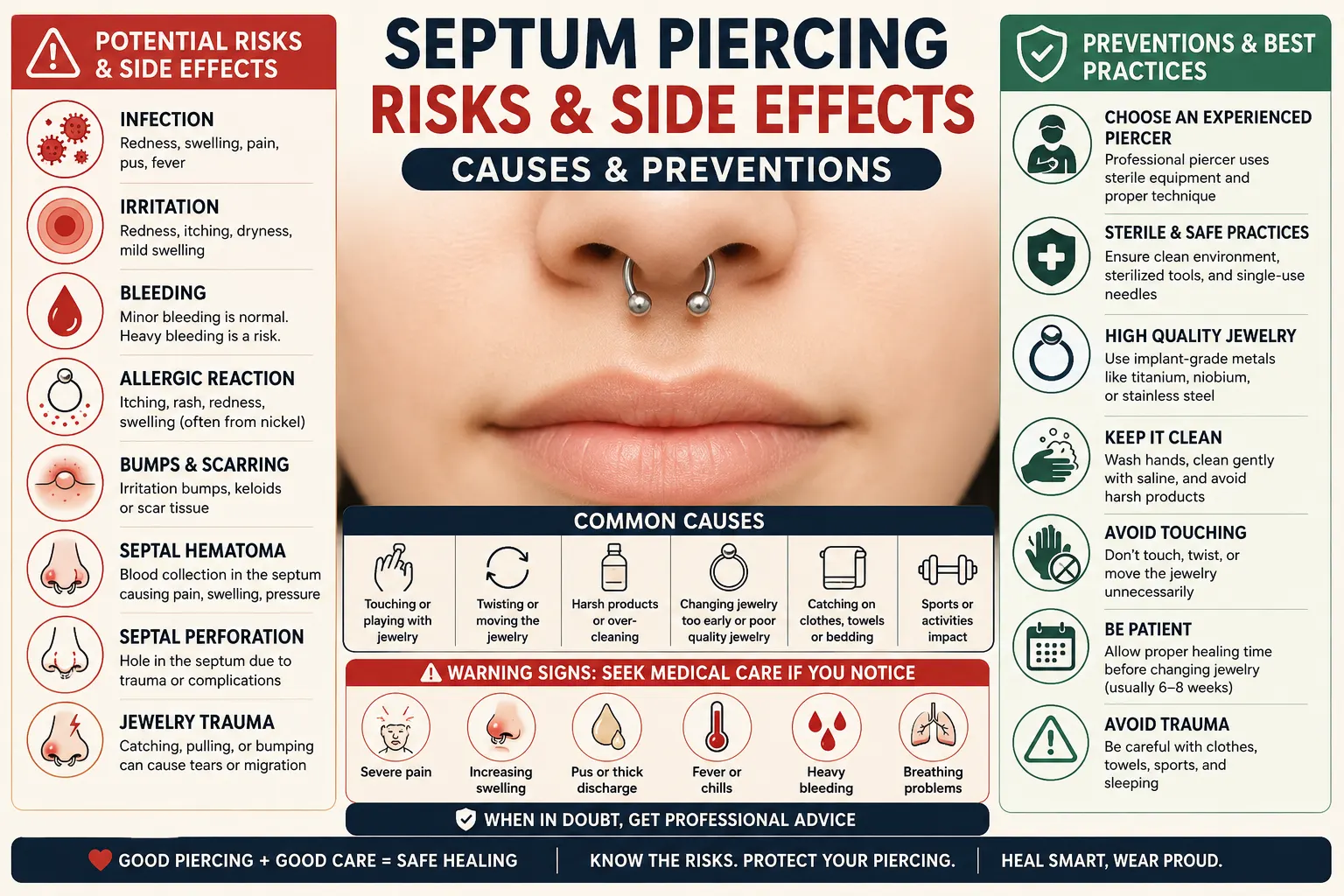
When I think about getting a septum piercing, I look at more than how the jewelry will look. I also think about the healing process, possible side effects, and the problems that can happen if something goes wrong.
A septum piercing is usually manageable when it is done correctly and cared for properly. But it still creates an opening in the nasal tissue, so there are some risks to consider. These include infection, irritation, allergic reactions, bleeding, scarring, tearing, and, in rare cases, more serious problems such as a septal hematoma.
I also find it useful to separate normal healing symptoms from actual complications. Mild soreness, tenderness, slight swelling, and some crusting can happen while the piercing heals. Symptoms such as worsening pain, major swelling, pus, fever, heavy bleeding, or breathing problems deserve more attention.
In this guide, I will cover the main septum piercing risks and side effects, what I would consider normal, what can cause complications, and what I would do if something does not seem right.
Quick Answer: What Are the Main Septum Piercing Risks?
The main septum piercing risks include infection, irritation, allergic reactions, bleeding, scarring, tearing, and mechanical trauma from the jewelry. Rare but more serious problems can include a septal hematoma, abscess, cartilage injury, or damage to the nasal septum.
Some mild pain, tenderness, swelling, redness, itching, and crusting can be part of normal healing. What matters most to me is how the symptoms change over time.
If pain, swelling, redness, discharge, or bleeding keeps getting worse instead of settling, I would get professional advice.
Are Septum Piercings Safe?
I would not describe any piercing as completely risk-free.
A septum piercing can be done safely, but the result depends on several things. The skill of the piercer, correct placement, sterile equipment, suitable jewelry, your anatomy, and your aftercare all play a part.
One thing I pay close attention to is placement. A proper septum piercing is generally placed through the softer tissue in the lower part of the septum rather than directly through the main septal cartilage. Piercing through cartilage can cause more bleeding and may increase the risk of tissue injury.
That is why I would choose a professional piercer who has experience with septum piercings instead of choosing someone based only on price.
Common Septum Piercing Side Effects
Not every symptom after a septum piercing means something has gone wrong.
A fresh piercing can react to the injury in several normal ways. I would expect some mild discomfort while the tissue starts to heal.
Mild Pain and Tenderness
A new septum piercing can feel sore or tender.
For me, the important part is how the pain changes.
Mild pain that slowly improves is much less worrying than pain that becomes stronger each day.
If the pain becomes severe or comes with increasing swelling, heat, pus, or fever, I would take it more seriously.
For a full guide on this topic, see Why Does My Septum Piercing Hurt?
Mild Swelling
Some swelling can happen after a fresh piercing.
I would watch the swelling instead of judging it from one moment.
If it gradually goes down, that is reassuring. If it keeps getting larger or becomes very painful, I would have it checked.
Minor Bleeding
A little bleeding can happen shortly after getting pierced.
I would expect this to settle rather than continue for a long time.
Heavy or persistent bleeding is different and deserves medical attention. Piercing-related trauma can also cause more serious bleeding if the wrong tissue is pierced.
For more detail, see Septum Piercing Bleeding: Is It Normal?
Crusting
Some crust can form around a healing piercing.
I would avoid picking at it or pulling it away with my fingers. Repeatedly disturbing the area can cause more irritation and mechanical trauma.
Mild Discharge
A small amount of watery or pale fluid can occur during healing.
I would look at the whole picture instead of judging the piercing by discharge alone. Thick or foul-smelling discharge combined with worsening pain, redness, or swelling is more concerning.
For the full topic, see Septum Piercing Discharge: Normal or Infection?
Mild Itching
Itching can happen as the tissue heals.
I would be more concerned if the itching comes with a rash, strong redness, swelling, or burning. That pattern can suggest irritation or a reaction to the jewelry.
The Most Common Septum Piercing Risks

There are several problems I would keep in mind before getting a septum piercing.
Septum Piercing Infection
Infection is one of the main risks with any piercing because the piercing creates an opening through the skin and tissue.
Possible signs include:
- Increasing pain
- Increasing swelling
- Strong redness
- Heat
- Pus
- Bad-smelling discharge
- Fever
- Feeling unwell
I would pay close attention to whether symptoms are getting worse rather than better.
If I suspected an infection, I would seek medical advice rather than trying several home treatments.
For the full topic, see Septum Piercing Infection: Signs and What to Do.
Septum Piercing Irritation
Irritation is another common problem.
It can happen from:
- Touching the jewelry
- Twisting the jewelry
- Bumping the nose
- Friction
- Pressure
- Poor jewelry fit
- Harsh cleaning products
- Cleaning too often
- Changing jewelry too early
If I notice that the problem started after I bumped or moved the jewelry, I would look at irritation as one possible cause.
I would stop unnecessary contact and keep aftercare simple.
For a detailed comparison, see Septum Piercing Infection vs Irritation.
Allergic Reaction to Jewelry
Some people react to certain metals used in body jewelry.
Nickel is one metal that can cause allergic reactions. Symptoms may include:
- Itching
- Redness
- Rash
- Burning
- Swelling
- Persistent irritation
A metal allergy can cause contact dermatitis, which is a skin reaction caused by contact with an irritating or allergenic substance.
A metal allergy can look similar to other piercing problems, so I would not assume that every red or itchy piercing is infected.
If I suspected a reaction to the jewelry, I would ask a professional piercer or healthcare provider for advice rather than repeatedly changing the jewelry myself.
For more information about jewelry materials, see Best Metal for Septum Piercing Jewelry.
Scarring and Keloids
Any piercing can leave scar tissue.
Some people can also develop a keloid, which is a raised area caused by excess scar tissue.
I would not assume that every small bump is a keloid. Septum piercing bumps can have several causes, including irritation.
For that topic, see Septum Piercing Bump: Causes and Treatment.
Tearing and Mechanical Trauma
This is one risk I would take seriously because septum jewelry can catch on things.
Mechanical trauma means the healing tissue is repeatedly injured by movement, pressure, pulling, or friction.
It can happen when:
- A towel catches the jewelry
- Clothing pulls on it
- A hand catches the ring
- Bedding catches the jewelry
- The jewelry is pulled during sports
- Someone accidentally hits the nose
A strong pull can cause pain, bleeding, or a tear in the tissue.
If the jewelry gets pulled hard, I would avoid trying to force it back into place.
Rare but Serious Septum Piercing Complications
Most people looking at septum piercing risks are thinking about infection or pain. There are also less common complications that are worth knowing about.
Septal Hematoma

A septal hematoma is a collection of blood inside the tissue of the nasal septum.
It can happen when blood vessels are damaged.
Possible signs include:
- Significant swelling
- Strong pain
- Pressure inside the nose
- Tenderness
- Nasal congestion or blockage
This is not something I would try to treat at home.
A septal hematoma can interfere with blood flow to the septal tissue and may lead to tissue damage or infection if it is left untreated.
If I had major swelling and pain inside my nose after a piercing, I would seek medical care.
Septal Abscess
An abscess is a pocket of infection.
I would be concerned about an abscess if I had severe or worsening pain, swelling, pus, fever, or felt generally unwell.
This is different from the small amount of fluid or crust that can occur during normal healing.
A suspected abscess needs medical assessment rather than home treatment.
Cartilage Damage
A correctly placed septum piercing is generally intended to pass through the softer tissue at the lower part of the septum.
If the needle passes through cartilage, there can be more bleeding and a greater chance of tissue injury.
This does not mean that every septum piercing damages cartilage.
Anatomy varies from person to person, so placement should be assessed by an experienced piercer before the piercing is performed.
Septal Perforation
A septal perforation means there is a hole in the tissue separating the two sides of the nose.
I would not treat this as a normal result of having a septum piercing.
A perforated nasal septum can have many causes, including injury and conditions that damage the blood supply to the septal tissue. Possible symptoms include crusting, nosebleeds, nasal blockage, dryness, and a whistling sound while breathing.
If I suspected a hole or structural problem in my septum, I would see a healthcare provider rather than trying to check it with my finger.
What Is the Most Serious Septum Piercing Risk?
There is no single complication that will happen to everyone, but some problems are much more serious than normal soreness or irritation.
Severe infection, a septal hematoma, major tissue injury, serious bleeding, or breathing problems are the issues I would take most seriously.
The good thing is that these are not the expected result of a properly performed and cared-for piercing.
If I noticed severe symptoms or a fast change in the condition of the piercing, I would get medical care instead of waiting for it to improve on its own.
Can a Septum Piercing Damage Your Nose?
A properly performed septum piercing should not normally damage the structure of the nose.
The greater concern is significant injury, poor placement, serious infection, or other complications that affect the nasal tissue.
I would be especially careful if a piercing causes major bleeding, severe swelling, strong pain, or a change in the shape of my nose.
I would not assume that every change in the nose came from the piercing. Other conditions and injuries can affect the nasal septum too.
Can a Septum Piercing Cause a Deviated Septum?
I would not treat a septum piercing as a common cause of a deviated septum.
A deviated septum means the wall between the nasal passages is shifted away from the center. It can be present because of natural anatomy or develop after an injury.
A piercing that appears crooked is also a separate issue from having a medically deviated septum.
If I noticed new breathing problems or a major change in the shape of my nose after an injury, I would have it checked instead of trying to diagnose the problem myself.
For piercing alignment, see Why Is My Septum Piercing Crooked?
Can a Septum Piercing Cause Breathing Problems?
A healed septum piercing should not normally block normal airflow.
Temporary congestion can happen because of swelling or irritation during early healing.
I would pay more attention to significant or persistent breathing problems, especially if they appear with major swelling, pain, or an injury.
A septal perforation can also cause nasal obstruction in some people.
If breathing becomes difficult after a piercing injury, I would seek medical care.
Can a Septum Piercing Cause an Allergic Reaction?
Yes.
The reaction is usually related to the jewelry material rather than the piercing hole itself.
I would look for symptoms such as:
- Itching
- Redness
- Rash
- Burning
- Swelling
- Ongoing irritation
Nickel is a common metal associated with allergic reactions from jewelry.
This is one reason I would ask about the jewelry material before getting the piercing.
If the area is itchy and has a rash but does not have the typical signs of infection, I would consider a metal reaction as one possibility.
Can You Get a Bloodborne Infection From a Septum Piercing?
There is a risk if piercing equipment is contaminated with infected blood or is not properly sterilized.
Potential bloodborne infections include hepatitis B, hepatitis C, and HIV. Unsafe equipment can also expose someone to other infections.
This is one reason I would never choose a piercing studio based only on price.
I would want to see safe hygiene practices, appropriate sterilization, and a fresh sterile needle for the piercing.
What Increases the Risk of Septum Piercing Complications?
I would pay attention to several factors before getting pierced.
Poor Piercing Placement
Placement matters.
A septum piercing is generally placed through the softer tissue at the lower part of the septum rather than directly through the cartilage.
Poor placement can lead to more pain, bleeding, irritation, or tissue injury.
Unsterile Equipment
Poor hygiene can increase the risk of infection and bloodborne diseases.
I would make sure the piercer uses appropriate sterile equipment.
Low-Quality Jewelry
Cheap or unsuitable jewelry can cause irritation or an allergic reaction.
I would ask about the metal before getting the piercing.
Touching the Piercing
I would avoid playing with the jewelry or touching it with dirty hands.
Twisting the Jewelry
I would not keep spinning the ring just to see if it moves.
Repeated movement can irritate healing tissue.
Changing Jewelry Too Soon
I would leave the initial jewelry in place while the piercing heals unless a qualified professional recommends a change.
Poor Aftercare
I would avoid harsh products and excessive cleaning.
More cleaning does not always mean better healing.
Accidental Trauma
I would be careful with towels, clothing, bedding, sports, and anything else that could catch the jewelry.
Septum Piercing Risks and Placement

One thing I would discuss with a piercer before getting the piercing is my anatomy.
Not everyone has the same amount of soft tissue in the front part of the septum.
Some people also have a naturally deviated septum, which can affect how a piercing looks or how centered the jewelry appears.
The goal is to place the jewelry through suitable tissue rather than simply putting the needle through the thickest part of the septum.
This is why I would let an experienced piercer examine the area before deciding exactly where the piercing should go.
Can Septum Jewelry Move or Migrate?

Jewelry can sometimes move from its original position.
I would watch for:
- A noticeable change in jewelry position
- A larger piercing hole
- Thinning tissue
- Redness around the piercing
- Flaking skin
- Increasing irritation
Migration means the jewelry slowly moves from its original position. Rejection is a more serious process where the body gradually pushes the jewelry closer to the surface.
I would watch for thinning tissue, a changing piercing angle, or jewelry becoming easier to see through the tissue.
If I noticed these changes, I would ask a professional piercer to examine the piercing.
I would not try to force the jewelry into a different position.
Can Septum Jewelry Get Pulled Out?
Yes.
A septum ring can catch on clothing, towels, bedding, hands, or other objects.
A strong pull can cause:
- Pain
- Bleeding
- Tearing
- Swelling
- New irritation
This is why I would be careful when drying my face, changing clothes, and blowing my nose during healing.
If the jewelry is pulled hard and the tissue looks torn, I would get professional help rather than trying to fix the injury myself.
Normal Septum Piercing Side Effects vs Warning Signs

I find it easier to judge a new piercing by separating normal healing from warning signs.
| Symptom | Usually less concerning | More concerning |
| Pain | Mild and improving | Severe or getting worse |
| Swelling | Mild and settling | Increasing or severe |
| Redness | Mild and localized | Strong or spreading |
| Bleeding | Small amount after piercing | Heavy or persistent |
| Discharge | Small amount of pale fluid | Thick pus |
| Crusting | Light crust | Heavy crust with worsening symptoms |
| Itching | Mild | Severe with rash or swelling |
| Smell | Mild buildup odor | Strong odor with other infection signs |
| Breathing | Normal | New or serious blockage |
| Jewelry position | Stable | Moving or pulling through tissue |
This table is only a guide. I would not use one symptom by itself to diagnose a medical problem.
The overall pattern matters more. If several warning signs appear together or symptoms continue getting worse, I would seek professional advice.
How I Would Reduce the Risk of Septum Piercing Side Effects

If I decided to get a septum piercing, I would focus on a few simple things.
I Would Choose an Experienced Piercer
I would look for someone with a strong record of septum piercings rather than choosing based only on price.
I would also look at healed work, not just fresh piercings.
I Would Ask About Sterilization
I would want to know how reusable equipment is sterilized and make sure a fresh sterile needle is used.
Proper sterilization lowers the risk of infection and bloodborne disease.
I Would Ask About Jewelry Material
I would ask what metal is being used for the initial jewelry.
If I knew I had a metal allergy, I would tell the piercer before the piercing.
I Would Follow Simple Aftercare
I would avoid touching the piercing unless necessary.
I would wash my hands before handling it and avoid harsh products.
I Would Avoid Playing With the Jewelry
I would not keep flipping, twisting, or pulling the jewelry during healing.
I Would Protect It From Trauma
I would be careful with towels, clothing, bedding, and anything else that could catch the ring.
I Would Watch the Healing Pattern
I would pay attention to whether the piercing is becoming calmer over time.
If symptoms continue getting worse, I would not keep assuming they are part of normal healing.
Can Septum Piercing Risks Be Completely Avoided?
No.
Even if I choose an experienced piercer, high-quality jewelry, and good aftercare, there is still some risk.
What I can do is reduce avoidable risks.
I would focus on:
- Correct placement
- Sterile equipment
- Suitable jewelry
- Clean hands
- Gentle aftercare
- Minimal jewelry movement
- Avoiding trauma
- Getting medical help when warning signs appear
That gives me a much better chance of having a smooth healing process.
When Should I See a Doctor?

I would seek medical care if I noticed:
- Severe or worsening pain
- Increasing swelling
- Significant heat
- Strong or spreading redness
- Thick pus
- Fever
- Chills
- Feeling generally unwell
- Heavy or persistent bleeding
- Major nasal blockage
- A possible septal hematoma
- A change in the shape of my nose
- Trouble breathing
- Signs of serious tissue damage
A suspected septal hematoma needs medical attention because untreated blood collection can damage the septal tissue.
I would also seek care if I suspected a septal perforation. A healthcare provider can check the nasal septum and work out what is causing the symptoms.
When Should I See a Piercer Instead?
A professional piercer is the better person to ask about some jewelry-related issues.
I would go to a qualified piercer for questions about:
- Jewelry size
- Jewelry fit
- Jewelry material
- Jewelry placement
- Jewelry changes
- Mechanical irritation
- Migration
- Whether the jewelry is sitting correctly
I would go to a healthcare professional for:
- Infection
- Severe swelling
- Severe pain
- Fever
- Heavy bleeding
- Septal hematoma
- Abscess
- Breathing problems
- Suspected tissue damage
I would not expect a piercer to diagnose or treat a medical complication.
Septum Piercing Risks During the Healing Period
The healing period is when I would be most careful.
I would avoid unnecessary contact with the jewelry and try not to bump the nose.
I would also be careful when:
- Blowing my nose
- Washing my face
- Drying my face
- Changing clothes
- Sleeping
- Exercising
- Wearing anything that could catch the jewelry
A healing piercing is still sensitive tissue, so repeated trauma can keep it irritated.
Final Thoughts
When I look at septum piercing risks and side effects, I try not to treat every small change as a serious problem.
A fresh septum piercing can be sore, tender, slightly swollen, and produce some crusting while it heals. Those changes can happen without a major complication.
What gets my attention is a clear change for the worse.
Increasing pain, major swelling, strong redness, heat, pus, fever, heavy bleeding, breathing problems, or significant nasal swelling are signs I would not ignore.
I would also take the piercing process itself seriously. Choosing an experienced piercer, making sure sterile equipment is used, selecting suitable jewelry, and protecting the piercing during healing can lower many avoidable risks.
For me, the best way to approach a septum piercing is to enjoy the jewelry while also respecting the healing process. Knowing the possible side effects ahead of time makes it much easier to tell the difference between a normal healing change and a problem that needs professional attention.
Frequently Asked Questions
What are the main septum piercing risks?
The main risks include infection, irritation, allergic reactions, bleeding, scarring, tearing, and jewelry-related trauma. Less common complications can include a septal hematoma and other tissue injuries.
What are the common side effects of a septum piercing?
Mild pain, tenderness, slight swelling, minor redness, light crusting, itching, and a small amount of discharge can occur during healing.
Is a septum piercing dangerous?
A septum piercing is not automatically dangerous, but it does carry risks like any piercing. Correct placement, sterile equipment, suitable jewelry, and good aftercare can reduce many avoidable problems.
Can a septum piercing damage cartilage?
It can cause cartilage injury if the needle passes through cartilage rather than suitable soft tissue. Piercing through nasal cartilage can cause more bleeding and increase the risk of complications.
Can a septum piercing cause a septal hematoma?
It is possible. A septal hematoma is a collection of blood in the septum and can cause pain, swelling, pressure, and nasal blockage. It needs medical assessment.
Can a septum piercing cause a hole in the septum?
A septal perforation is a hole in the nasal septum. It has many possible causes, including injury and conditions that damage the septal tissue. If I suspected one, I would have it checked by a healthcare provider.
Can a septum piercing cause a deviated septum?
I would not consider a normal septum piercing a common cause of a deviated septum. A deviated septum can be related to natural anatomy or injury.
Can septum jewelry cause an allergic reaction?
Yes. Some metals, especially nickel-containing jewelry, can cause an allergic reaction. It may cause itching, redness, rash, burning, or swelling.
Can a septum piercing get infected?
Yes. Like other piercings, a septum piercing can become infected. Increasing pain, swelling, heat, redness, pus, fever, or feeling unwell are warning signs.
Can a septum piercing cause scarring?
Yes. Piercings can sometimes cause scar tissue or keloids. Some people are more likely to develop raised scars than others.
Can septum jewelry tear the skin?
Yes. Jewelry can catch on clothing, towels, bedding, or other objects and cause a tear. A strong pull can also cause bleeding and additional tissue injury.
Can you get hepatitis from a septum piercing?
There is a risk of bloodborne infections such as hepatitis B and C if piercing equipment is contaminated or not properly sterilized.
Is bleeding after a septum piercing normal?
A small amount of bleeding can happen soon after a piercing. Heavy or persistent bleeding is different and should be checked.
Is swelling after a septum piercing normal?
Some mild swelling can occur after a fresh piercing. I would be more concerned if the swelling keeps increasing or comes with severe pain, heat, strong redness, or pus.
Is pain after a septum piercing normal?
Mild soreness and tenderness can happen during early healing. Pain that becomes severe or keeps getting worse is more concerning.
Can a septum piercing cause nerve damage?
Serious nerve damage is not what I would expect from a properly placed septum piercing. However, unusual numbness, severe pain, or other unexpected changes should be checked by a healthcare professional.
Can a septum piercing affect your sense of smell?
A septum piercing should not normally remove your sense of smell. Swelling or nasal congestion during healing can temporarily affect airflow, which may change how well I can smell.
Can a septum piercing cause permanent damage?
Permanent damage is not the expected result of a properly performed piercing. However, serious complications such as major tissue injury, an untreated septal hematoma, or severe infection can cause lasting problems.
What happens if a septum piercing is placed incorrectly?
Poor placement can lead to more pain, bleeding, irritation, slow healing, tissue injury, or an uneven-looking piercing. I would have questionable placement checked by an experienced piercer.
What is the difference between septum piercing migration and rejection?
Migration means the jewelry slowly moves from its original position. Rejection happens when the body gradually pushes the jewelry closer to the surface. Thinning tissue and a changing piercing angle can be warning signs.
How can I reduce the risks of a septum piercing?
I would choose an experienced piercer, make sure sterile equipment is used, choose suitable jewelry, keep my hands clean, avoid unnecessary jewelry movement, and protect the piercing from trauma.
When should I worry about a septum piercing?
I would take it seriously if pain, swelling, redness, heat, or discharge keeps getting worse. Fever, heavy bleeding, major nasal blockage, breathing problems, or severe swelling would be reasons for medical care.
