


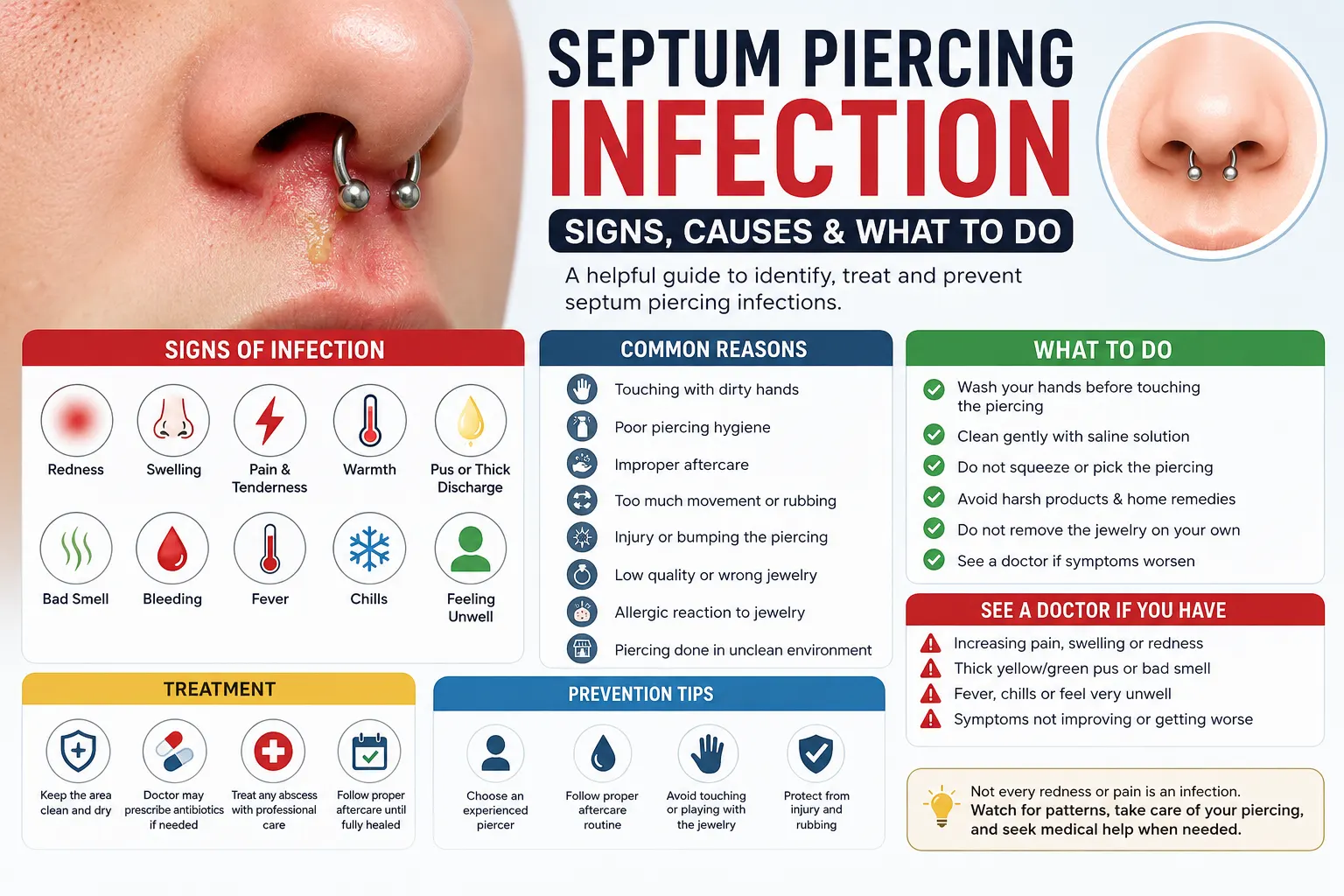
A septum piercing can be sore, itchy, or a little swollen while it heals. That does not always mean something is wrong. The part I pay closest attention to is how the symptoms change over time.
If the pain, swelling, warmth, redness, or discharge keeps getting worse instead of settling down, I take it more seriously. A strong smell, thick pus, spreading redness, fever, or feeling unwell can also point to an infected septum piercing.
In this guide, I’ll explain what an infected septum piercing can look like, what can cause it, how infection differs from normal healing and irritation, and what I would do if I noticed these signs.
Can a Septum Piercing Get Infected?
Yes. A septum piercing creates a small opening in the tissue, so bacteria can enter while it heals.
But I would not assume that every sore or red septum piercing is infected.
A new piercing can have mild soreness, slight redness, itching, minor swelling, and a small amount of pale fluid that dries into a crust. These can happen during normal healing.
What makes me more concerned is when the symptoms become stronger instead of slowly improving.
If the piercing becomes increasingly painful, swollen, hot, red, or starts producing thick discharge, I would have it checked.
An infection is also just one type of septum piercing problem. Other issues can include irritation, bumps, bleeding, smell, pain, crooked jewelry, and jewelry reactions.
What Does an Infected Septum Piercing Look Like?

An infected septum piercing may become:
- More painful
- More swollen
- Warm to the touch
- More red than before
- More tender
- Covered with thick discharge or pus
- Associated with a bad smell
- More painful instead of slowly improving
- Associated with fever or chills
- Associated with feeling sick or weak
I look at these signs together rather than using one symptom to decide whether a piercing is infected.
Increasing Pain
Some pain after getting a septum piercing is normal.
What concerns me is pain that keeps getting worse.
If the pain becomes deep, strong, or throbbing, especially when I am not touching the jewelry, I take that more seriously.
Pain that suddenly becomes worse after the piercing had started to feel better is also something I would watch closely.
Swelling and Warmth
Mild swelling can happen with a new piercing.
Strong or increasing swelling is different.
If the skin around the septum feels hot and the swelling continues to increase, I would pay close attention to any other signs of infection.
Spreading Redness
A little redness close to a new piercing can happen during healing.
I become more concerned if the redness gets stronger or starts spreading into the surrounding skin.
Redness that stays close to the piercing is less worrying than redness that continues to spread.
If spreading redness comes with increasing pain, swelling, warmth, or discharge, I would get medical advice.
Pus or Thick Discharge
A small amount of pale fluid can dry into a crust while a piercing heals.
Thick discharge or pus is more concerning, especially when it comes with pain, swelling, heat, or redness.
I would not squeeze the piercing to get the discharge out.
Foul Smell
A mild smell around piercing jewelry does not always mean infection.
But a strong or bad smell along with thick discharge, increasing pain, swelling, heat, or redness would make me more concerned about an infected septum piercing.
If smell is the main problem, I would treat it as a separate issue rather than assuming infection right away.
Fever, Chills, or Feeling Unwell
This is a sign I would take seriously.
If a piercing looks infected and I also have a fever, chills, feel unusually hot or cold, or feel sick, I would get medical help.
These symptoms can mean the infection needs medical treatment rather than basic piercing care.
Septum Piercing Infection vs Normal Healing

This is one of the most useful things to know because normal healing and infection can look similar at first.
What Normal Healing Can Look Like
During the early healing period, I may notice:
- Mild soreness
- Mild itching
- Slight redness
- Minor swelling
- A small amount of pale fluid
- Light crust around the jewelry
These signs should slowly become less noticeable as the piercing heals.
What Infection Can Look Like
An infected septum piercing is more likely to cause symptoms that get worse.
I would watch for:
- Increasing pain
- Throbbing pain
- Increasing swelling
- Strong warmth
- Spreading redness
- Thick pus
- Strong tenderness
- A bad smell with discharge
- Fever
- Chills
- Feeling unwell
The pattern matters as much as the symptom itself.
For example, mild redness that slowly fades does not worry me as much as redness that becomes stronger and spreads over several days.
Is Yellow Discharge Always a Sign of Infection?
No.
I would not judge a piercing by discharge color alone.
A new piercing can produce a small amount of pale fluid that dries into a crust. Thick yellow or green pus is more concerning, especially when it comes with pain, swelling, heat, or redness.
I look at the amount, texture, smell, other symptoms, and whether the problem is improving or getting worse.
Can a Septum Piercing Be Infected Without Pus?
Yes.
Pus does not have to be present for an infection to be possible.
If I notice increasing pain, swelling, heat, redness, or tenderness, I still take the problem seriously even if there is little or no discharge.
A healthcare professional can check whether the problem is an infection, irritation, an allergic reaction, or another issue.
I would not assume that no pus means there is no infection.
Septum Piercing Infection vs Irritation

Irritation is one reason I would not call every piercing problem an infection.
| More likely healing or irritation | More worrying for infection |
| Mild soreness | Increasing pain |
| Mild itching | Strong tenderness |
| Slight redness | Spreading redness |
| Minor swelling | Increasing swelling |
| Clear or pale fluid | Thick pus-like discharge |
| Symptoms after rubbing or friction | Symptoms that keep getting worse |
| No feeling of illness | Fever, chills, or feeling unwell |
Irritation can come from touching, rubbing, moving the jewelry, a poor fit, harsh cleaning products, or a reaction to the jewelry material.
If the problem improves after I stop the source of irritation, that is different from symptoms that keep getting worse.
For the full comparison, see Septum Piercing Infection vs Irritation.
What Causes a Septum Piercing Infection?

There is not always one clear cause.
When I think about how an infection may have started, I look at the piercing process, aftercare, touching, injury, jewelry, and anything else that may have brought bacteria to the area or damaged the healing tissue.
Touching the Piercing
I try not to touch a healing piercing unless I need to.
Hands can carry dirt and bacteria to the area. Touching can also irritate healing tissue.
If I need to touch the jewelry, I wash my hands first.
Poor Piercing Hygiene
The piercing process itself matters.
I would choose an experienced professional who uses clean and sterile equipment and follows good hygiene practices.
I would never try to pierce my own septum.
Poor Aftercare
Poor aftercare can also cause problems.
I keep the area clean, avoid unnecessary touching, and follow a simple care routine instead of constantly handling the jewelry.
Too Much Movement and Rubbing
Twisting, pulling, or playing with the jewelry can irritate the tissue.
Rubbing from towels, clothes, fingers, or other objects can also disturb a healing piercing.
If the irritation continues, the tissue may take longer to settle.
Injury
A bump or pull can hurt the tissue around the piercing.
This can happen from:
- Catching the jewelry
- Pulling the ring
- Bumping the nose
- Rubbing the area
- Sleeping with pressure on it
- Moving the jewelry by accident
After an injury, I try to leave the area alone instead of touching it repeatedly to check it.
Jewelry Problems
Jewelry can cause irritation if it does not fit well or if the material causes a skin reaction.
A jewelry reaction is not the same as an infection.
For example, an itchy rash around the jewelry may point more toward a reaction to the metal than a bacterial infection.
If I think the jewelry is causing the problem, I would have a professional piercer check the fit and material.
What Should I Do If My Septum Piercing Is Infected?

If I think my septum piercing may be infected, I do not try several treatments at once.
I keep the care simple and get medical advice if the signs point to an infection.
Keep My Hands Clean
I wash my hands before touching the piercing.
I also avoid touching it just to see if it still hurts.
Clean It Gently
I keep the area clean using proper piercing aftercare.
I avoid harsh products and hard scrubbing because they can irritate the tissue.
Don’t Squeeze the Piercing
If I see pus or a swollen area, I do not squeeze it like a pimple.
Trying to push fluid out can hurt the tissue and cause more irritation.
Don’t Use Random Home Remedies
I would not use strong chemicals, essential oils, or other harsh products on a healing piercing.
A product that feels strong is not automatically better.
Don’t Keep Changing the Jewelry
If I think the jewelry is causing the problem, I would ask a professional piercer to check it.
I would not keep taking the jewelry out and putting it back in because repeated handling can cause more irritation.
Don’t Remove the Jewelry Without Medical Advice
If I think the piercing is infected, I would ask a healthcare professional whether the jewelry should stay in or be removed.
I would not make that decision based only on how the piercing looks.
How Is an Infected Septum Piercing Treated?
Treatment depends on what is causing the problem and how serious it is.
A healthcare professional may decide that an infected piercing needs medicine, including antibiotics in some cases.
I would not use leftover antibiotics or take prescription medicine without medical advice.
If there is an abscess or a deeper infection, cleaning the outside of the piercing may not be enough.
A healthcare professional can also check whether the problem is actually an infection or something such as an allergic reaction to the jewelry.
What About Antibiotic Ointment?
I would not put antibiotic ointment on every irritated septum piercing.
If I think I have an infection, I would ask a healthcare professional whether medicine is needed and which treatment is right.
Treatment depends on the actual cause.
What If There Is an Abscess?
An abscess is a pocket of pus.
I would never try to squeeze or drain a suspected abscess myself.
If the swelling is painful, hard, red, warm, or seems to contain pus, I would have it checked by a healthcare professional.
How Long Does a Septum Piercing Infection Take to Heal?
There is no set number of days for every infected septum piercing.
Recovery can depend on:
- How serious the infection is
- How early it is treated
- Whether medicine is needed
- Whether an abscess is present
- Whether the source of irritation continues
- How the piercing responds to treatment
I would focus less on a fixed number of days and more on whether the symptoms are getting better.
If pain, swelling, redness, or discharge keeps getting worse, I would contact a healthcare professional instead of waiting for a certain number of days.
When Should I See a Doctor?

I would get medical advice if I notice signs that may point to an infection, especially if they are getting worse.
These include:
- Increasing pain
- Throbbing pain
- Strong swelling
- Increasing warmth
- Spreading redness
- Thick pus
- Bad-smelling discharge
- Ongoing bleeding
- Fever
- Chills
- Feeling unwell
- Symptoms that do not improve
- Symptoms that get worse after first getting better
I would not wait if the symptoms are spreading or becoming stronger.
A piercing infection can become more serious if it is left untreated, so I would rather have a worsening problem checked early than assume it will settle on its own.
When Is a Septum Piercing Infection an Emergency?
Most piercing infections do not become severe, but some signs need urgent medical care.
I would get urgent help if I had:
- Trouble breathing
- Fast-growing swelling
- Severe pain
- Redness that spreads quickly
- High fever
- Severe weakness
- Confusion
- Feeling very sick
I would also get urgent help after a serious injury if the septum suddenly became very swollen or painful.
I would rather get a serious-looking problem checked early than assume it is normal piercing irritation.
Can a Septum Infection Damage the Septum?
A septum piercing infection does not automatically mean that the nasal septum has been damaged.
Serious problems inside the nose can have different causes. A septal perforation, which is a hole in the septum, can happen for several reasons, including injury, surgery, certain medical conditions, and other forms of tissue damage.
I would not assume that an infected piercing will cause a septal perforation.
However, if I notice unusual signs such as:
- Ongoing nosebleeds
- Whistling when breathing
- Ongoing nasal blockage
- A lot of crust inside the nose
- Ongoing pain inside the nose
- A change in the shape of my nose
I would get medical advice instead of assuming the problem is normal piercing irritation.
Some symptoms inside the nose can also come from other conditions, such as nasal vestibulitis. A healthcare professional may need to examine the area to find the actual cause.
Can an Infected Septum Piercing Cause a Bump?
Yes. An infection can cause a swollen or pus-filled bump.
But I would not assume every septum piercing bump is infected.
A bump can also come from irritation, injury, jewelry problems, or a skin reaction.
If the bump is painful, warm, red, swollen, or has pus, infection becomes more concerning.
For the full topic, see Septum Piercing Bump: Causes and Treatment.
Can an Infected Septum Piercing Smell?
It can.
A strong or bad smell is more worrying when it comes with thick discharge, increasing pain, swelling, heat, or redness.
A mild smell by itself does not prove that I have an infected septum piercing.
For a full guide to piercing odor, see Septum Piercing Smell: Why Does It Smell?
Can an Infected Septum Piercing Cause Bleeding?
It can, but bleeding alone does not prove infection.
A healing piercing can bleed after an injury or irritation.
If bleeding keeps happening or comes with more swelling, pain, heat, pus, or other worrying signs, I would get it checked.
For the separate bleeding topic, see Septum Piercing Bleeding: Is It Normal?
How Can I Prevent a Septum Piercing Infection?

I focus on a few simple habits.
Choose an Experienced Piercer
I would choose a trusted professional piercer who follows good hygiene and uses sterile equipment.
I would never try to pierce my own septum.
Wash My Hands Before Touching It
This is one of the easiest habits to follow.
I do not touch the jewelry unless I need to. When I do need to touch it, I wash my hands first.
Follow a Simple Aftercare Routine
I keep the piercing clean without scrubbing it or touching it all the time.
I also avoid harsh products that can irritate the skin.
Don’t Pick at Crust
If crust forms, I let it soften during cleaning instead of pulling it off while it is stuck to the skin.
Avoid Unnecessary Jewelry Movement
I do not play with the jewelry or move it repeatedly just to check the piercing.
Protect It From Injury
I try not to catch the jewelry on towels, clothes, fingers, or other objects.
Be Careful With Products Around the Nose
I avoid putting unnecessary makeup, perfume, or other irritating products directly around a healing piercing.
Don’t Change Jewelry Too Early
I do not change the jewelry just because the outside looks fine.
If I need to change jewelry during healing, I would ask a professional piercer to check it first.
What Is the Difference Between Infection and a Jewelry Allergy?
This is worth knowing because both problems can look similar.
An infection is more likely to cause increasing pain, swelling, heat, redness, and pus or unusual discharge.
A jewelry allergy may cause an itchy, rash-like reaction around the jewelry.
If my main problem is strong itching and a rash around the jewelry rather than increasing pain and pus, I would consider a possible reaction to the metal.
I would have a professional check the jewelry instead of assuming I need antibiotics.
Final Thoughts
The biggest thing I keep in mind with a possible septum piercing infection is that one symptom does not tell the whole story.
A little soreness, itching, redness, swelling, or pale crust can happen during normal healing. What worries me more is when these symptoms get worse, especially when pain, swelling, heat, spreading redness, pus, or feeling unwell appear together.
I also do not assume that every irritated piercing needs antibiotics. Jewelry reactions, rubbing, injury, poor fit, and harsh aftercare can cause problems that may look similar to an infection.
If the signs are mild, I keep my care gentle and avoid unnecessary touching. If I notice clear signs of infection or the problem keeps getting worse, I would get medical advice instead of trying random home remedies.
For me, the key is to look at the whole pattern and how the symptoms change over time. That makes it easier to separate normal healing and irritation from a septum piercing problem that may need professional care.
Frequently Asked Questions
What are the first signs of a septum piercing infection?
I would watch for increasing pain, swelling, heat, redness, and tenderness. Fever, chills, or feeling unwell make the problem more worrying.
How can I tell if my septum piercing is infected?
I look at the full pattern. Mild soreness, itching, slight redness, and pale crust can happen during normal healing. More pain, swelling, heat, spreading redness, pus, or feeling unwell are more worrying signs.
Can a septum piercing be infected without pus?
Yes. Pus does not have to be present. More pain, swelling, heat, redness, or feeling unwell can still point to a possible infection.
What does infected septum piercing discharge look like?
It may be thick and pus-like. It can be white, yellow, or green. A small amount of pale fluid that dries into a crust can happen during normal healing.
Can an infected septum piercing smell?
Yes. A strong or bad smell can happen with an infection, especially when it comes with thick discharge, pain, swelling, heat, or redness.
Should I remove my septum jewelry if it is infected?
I would not remove it on my own. I would ask a healthcare professional whether it should stay in or be removed.
How do you treat an infected septum piercing?
Treatment depends on the cause and how serious the infection is. A healthcare professional may recommend medicine, including antibiotics in some cases. I would not use leftover antibiotics or choose prescription medicine myself.
How long does a septum piercing infection take to heal?
There is no fixed healing time. It depends on the infection, treatment, and how the piercing responds. I would watch for signs of improvement instead of relying on a set number of days.
Can an infected septum piercing cause a bump?
Yes. An infection can cause a swollen or pus-filled bump. But not every piercing bump is caused by an infection.
Can a septum piercing infection damage the septum?
A serious problem inside the nose can affect the septum, but a routine piercing infection does not automatically mean the septum has been damaged. If I notice ongoing nosebleeds, whistling when breathing, ongoing blockage, or unusual swelling inside the nose, I would get medical help.
Is yellow crust on a septum piercing always an infection?
No. A small amount of pale fluid can dry into crust during normal healing. Thick pus, along with more pain, swelling, heat, or redness, is more worrying.
Can irritation turn into a septum piercing infection?
Ongoing irritation can damage healing tissue and make the area more prone to problems. I would deal with the source of irritation instead of touching or cleaning the piercing repeatedly.
Can an infected septum piercing spread?
It can become more serious if an infection is left untreated. If redness, swelling, warmth, or pain starts spreading or getting worse, I would seek medical advice rather than waiting.
Can I use saline if my septum piercing is infected?
Saline may be part of normal piercing care, but I would not rely on saline alone to treat a suspected infection. If I have increasing pain, swelling, warmth, spreading redness, pus, fever, or other signs of infection, I would seek medical advice.
